This was a pile of gorse that my wife and I had PULLED OUT (that’s a different story). We had had lots of rain so it was soaking wet. I had fanned the little flame with a piece of cardboard but it kept dying back. Then I remembered my battery-powered leaf blower. Hahaha. It worked VERY well. I was almost done burning when I thought I should shoot some video.
Where did the gorse (Ulex europaeus) come from, you ask? The gorse, as well as the name of our town of Bandon, Oregon actually came from Bandon, IRELAND in the 1890’s.
June 6, 2018…..I can’t say if these echiums are “Towers of Jewels” or “echium Pininana,” but I’m quite sure they came from the seeds of my original single plant purchased from my favorite nursery in October of 2013. They called it a “Tower of Jewels.” “Your bees will love it.” They were right.
A couple of years ago, Johann, one of our young neighbors, wanted to start a garden. My wife and I grow many bee-loving flowers and donated a couple of little echium starts to him for as you may know, once an echium decides to bloom, it will attract the pollinators and start many little seedlings.
On one of our daily walks last month, Johann flags us down, “You know those plants you gave me? They grew real tall.” He pointed them out and I could see the tops of them from the backyard. I haven’t made any videos for a long while and asked if I could shoot one. Then I remembered that he was a musician…maybe he could provide some music. This is the collaboration along with some scenes from around the neighborhood.
I wasn’t surprised by the deer. We had been bribing the deer with little gifts of spent pea vines and leafed out fruit tree suckers. It was the ‘blur in the background’ that caught my attention. It wasn’t the first time we had seen the fox.
The first time we spotted Mr. Fox was back in April, when he was visiting the bird feeding area. The crows had been spilling the food onto the ground where they could get it easier. Mr. Fox could get it too…how often I wonder?
The fox was probably cleaning up the dropped plums. My wife wonders if foxes can eat cats. It looks big enough.
Speaking of deer…
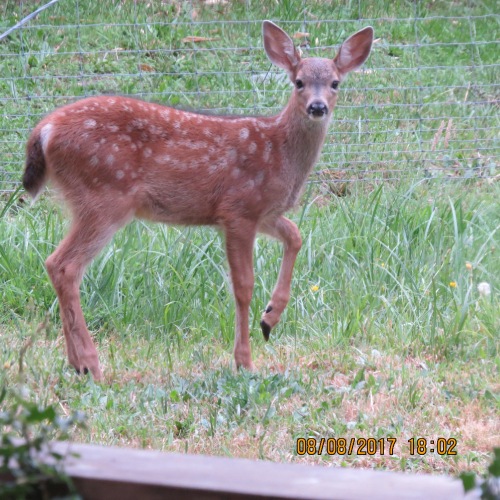
August 8…A baby deer appeared for the first time this evening. My very observant wife says the mama deer trusted us enough to bring out her fawn. My wife had been observing the doe for a few days. When the doe came out yesterday, she kept looking back at something, staring at what, another deer? Possibly her fawn, making sure it stayed put.
The proud mama… I’m quite sure the deer can see us looking at them through the window. How do I know? There are times in the spring when there’s nothing out on the board. The deer will just STAND AND STARE.
May 22, 2017…Lupines, planted from seed last year are bringing in the bees.
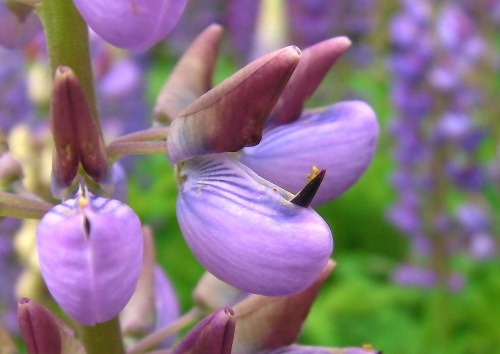
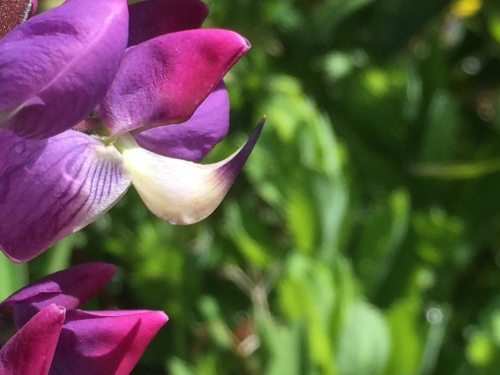
When I saw all the bees on the Lupines I got out the camera. I noticed the bees would land on the bottom petals (referred to as ‘wings or sails,’). They would separate and what looked like a spike (referred to as a ‘keel’) would rise up. When the bee lifted off, the petals (wings) snapped shut over the keel. I had to find out more, so I consulted with Darcy Grahek of “Go Native Nursery,” at Bandon High School. Darcy said that the stigma (female parts) AND the anthers (male parts) are contained within the keel.
May 30…Bee lifts off lupine blossom after rubbing it’s body on the ‘keel.’ Petals (or ‘wings’) will close over keel. Watching the video, you’ll see the stigma poking up through the tip of the keel after the bee lifts off.
By rubbing it’s body on the keel, the bee pollinates the flower when the anthers touch the stigma and the bee picks up pollen. For a more detailed explanation scroll to lupin in Sexual Reproduction in Plants,by Johny Thomas.
The ‘keel’
I pulled off the outside petals (referred to as sails or wings) of the keel, revealing the pollination parts of the flower. The female part is the stigma (longer). The male parts are the anthers which can be seen atop the (shorter) filaments. When the bee rubs it’s abdomen against the keel, the pollen on the anthers comes in contact with the stigma and pollination occurs while the bee is rewarded with grains of pollen. Win-win.
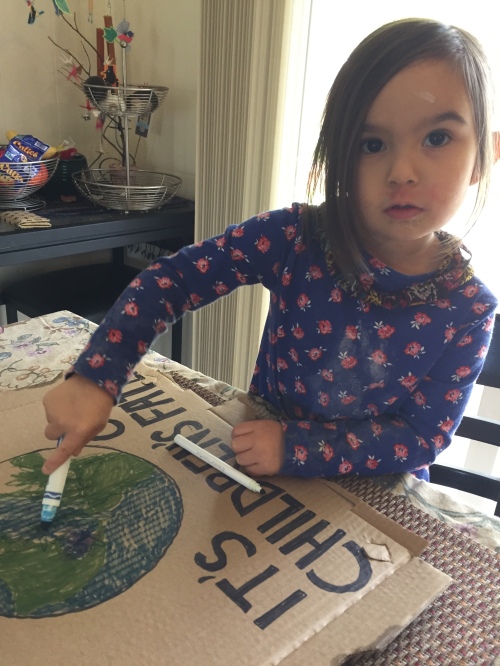
April 29, 2017…Granddaughter Calliope helps to paint her Mom’s sign for the Climate Rally in Eugene, Oregon. (In solidarity with People’s Climate March in DC and nationally.)
This is her protest sign, the one she made herself. I’m so proud of her. At four years of age, this is already her third protest.
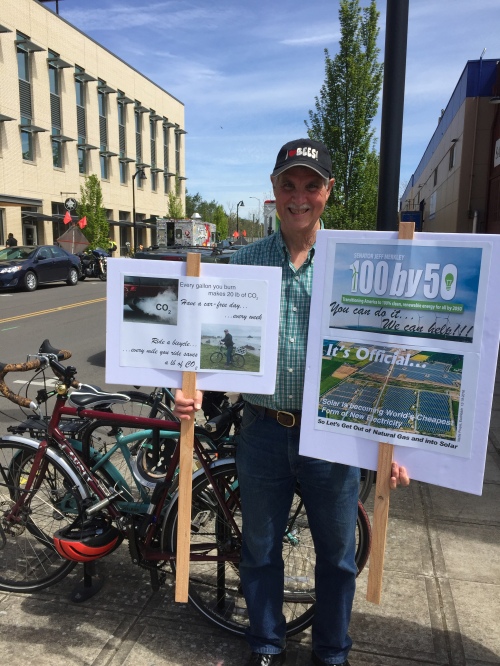
I don’t know if many people are aware of it, but when you burn a gallon of gas when driving, you are producing 20 pounds of carbon dioxide. If this bothers you as much as it does me, try having a car-free day each week. We started that about 10 years ago and actually got as high as 50% car-free days. That’s an average of 3 1/2 days each week using either a bicycle, walking, or staying at home. When I think about the planet that my generation will be giving to my kids and grandkids, I’m very ready to sacrifice a little to help their future out.
The following video was taken at the 350Eugene Climate Rally on the steps of The Federal Building in Eugene Oregon, April 29, 2017.
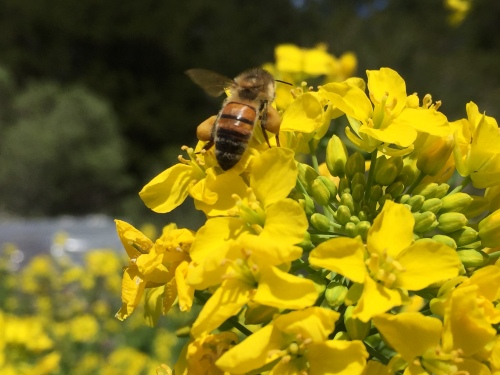
April 21…The turnips are blooming. Why is that important? Because the bees are getting the pollen. Pollen that is high in protein, with all the essential amino acids, and is highly digestible. Last October, we planted the turnips as a cover crop and intended the blossoms to mature early in spring, but we didn’t realize that the pollen was so nourishing. Apparently, the bees do well on it, so well it can lead to swarming. I just hope I can capture the swarm.
Pollen sacs full. (A lucky shot with an iPhone)
For several days (when it’s not raining) the bees have appeared on the front of the hive. I think they’re waiting for a sunny day. “Be patient, little critters, good weather is coming soon.”
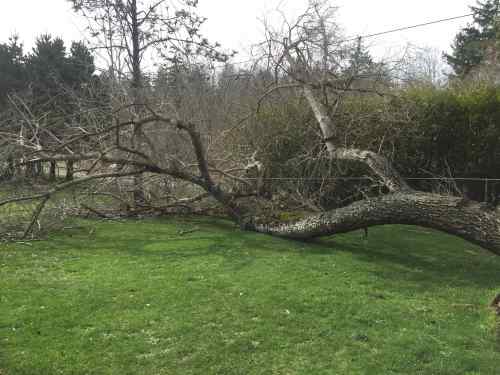
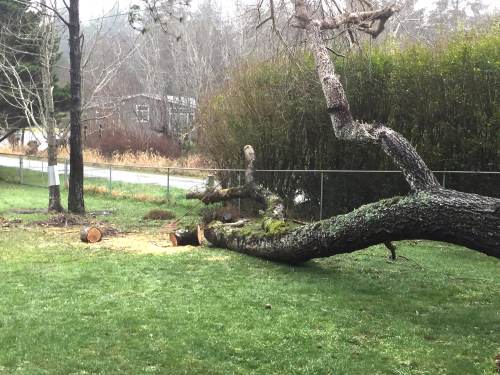
While I was looking over all the wind damaged trees, a City of Bandon ‘bucket’ truck drove by, turned around, and stopped. “Looks like you could use some help.” Kevin took care of the leaning eucalyptus tree while Mark started cutting the big one.
Thank you Mark and Kevin and the City of Bandon utility crew.
That left the bare straight part and the stump. I figured we could wait for the weekend, but my wife let it be known that it had to be removed ASAP. “The fence is open and Bailey (our old and very deaf dog) could get hit by a car.”
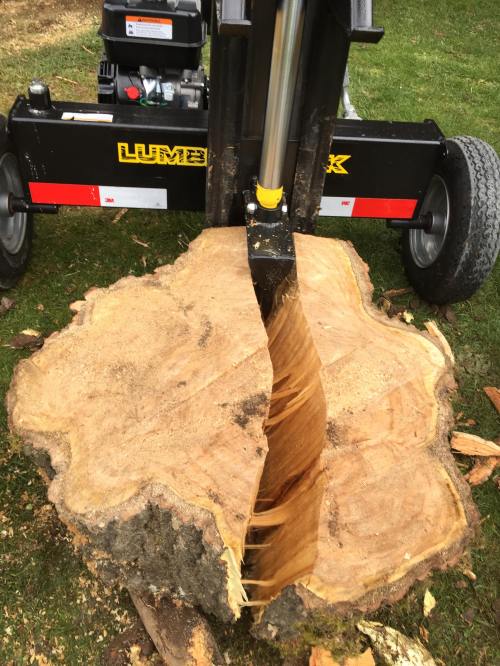
A rented log splitter did most of the work with the two of us wrestling the sawn rounds onto the splitting plate.
I love it when the splitter pops the ’round’ all the way through, but it doesn’t happen often enough.
Load after load gets carried away with our DR Power Wagon. It will carry 800 pounds (362 kg) of anything, but it’s fossil fueled. We want to replace it with a battery-powered version. If anyone has a suggestion, please comment. Cool hat, Sue.
That stump was stubborn, but no match for the two of us, even though we’re in our 70’s.
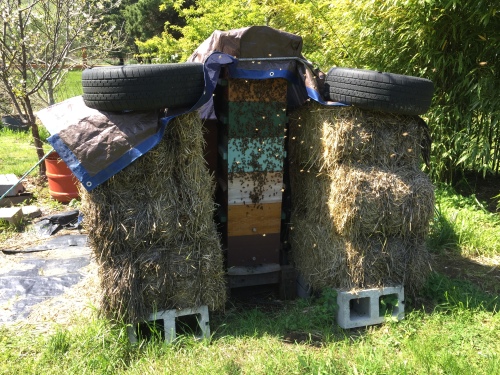
…but it’s pretty effective. This is my Warré hive winter protection from high winds driving copious amounts of rain against my hive. Since October, we have gotten 66.5 inches of rainfall (1689 mm).
A look through the observation window in December shows lots of natural honey comb.
I think this bright yellow pollen is from the Hooker Willow which thrives in soggy wet soil along The Oregon Coast.
I’ve been somewhat afraid to write about my bees. They seem to be doing fine with my efforts to protect them, but I didn’t want to jinx them. This is the end of February. The Hooker Willow has started flowering and bees are returning with bright yellow pollen, so I think they will make it. Also the gorse (Ulex europeaus) is blooming as it always does in February. The video shows bees on both.
Want to grow spinach? We have been wildly unsuccessful in growing it, but guess what…steamed turnip greens taste just like spinach. It turns out they are very easy to grow and are good for you too. This was supposed to be a mixture of several cover crop seeds, Fava beans, Winter Rye, and Hairy Vetch included. It looks like the turnips took over. Uh, I might have broadcast them a little thick. My “solar-roller water pump panel” is positioned for the afternoon sun. Gotta keep the flow going. 🙂
Turnip flowers in January provide nourishment for bees in the critical winter months.
October 8…This bed was planted August 1. Turnips grow fast. Plant them thick, then you can harvest the thinnings by steaming the greens. Leave a few to go to flowers in winter.
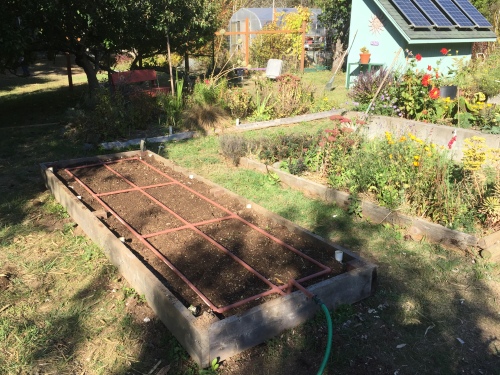
We’ve been getting three crops a year in our raised beds. This was lettuce last winter, then kale, now turnips. In between we bury crab shell when we can get it. This being October, that resource will soon be gone.
Oct. 10…My sweetheart made a delicious turnip soup for dinner this evening. These turnips were planted in early August. They grow fast!!!
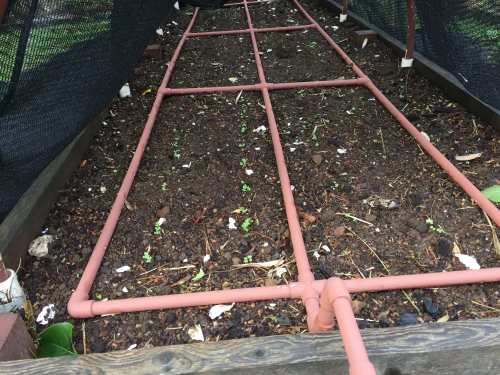
Oct. 8…just in case we haven’t planted enough turnips, here is another bed started…complete with drip water grid.
Oct. 15…Turnips are up already. The shade cloth is to protect the little darlings from the hurricane force winds and 12-18 inches (300-450mm) of rain that was forecast…didn’t happen, at least, not yet.
Turnip soup recipe
Chop an onion, saute in olive oil, add 4 to 5 cups of peeled chopped turnips, two garlic cloves (peeled and cut in half), add two teaspoons of smoked paprika, and teaspoon of thyme leaves. Cook until lightly brown, add three cups of vegetable or chicken broth, salt to taste. Bring to boil and simmer until veggies are cooked. Blend in blender, return to pan, add a cup of milk, or milk alternative.















 Adventures in Natural Beekeeping