In years’ past, we grew dozens of sunflowers of all types. This year…very few. Of the few that we planted, only four decided to grow. Of the four, only one was big enough to draw any visitors. This is the one.
My best sunflower this year
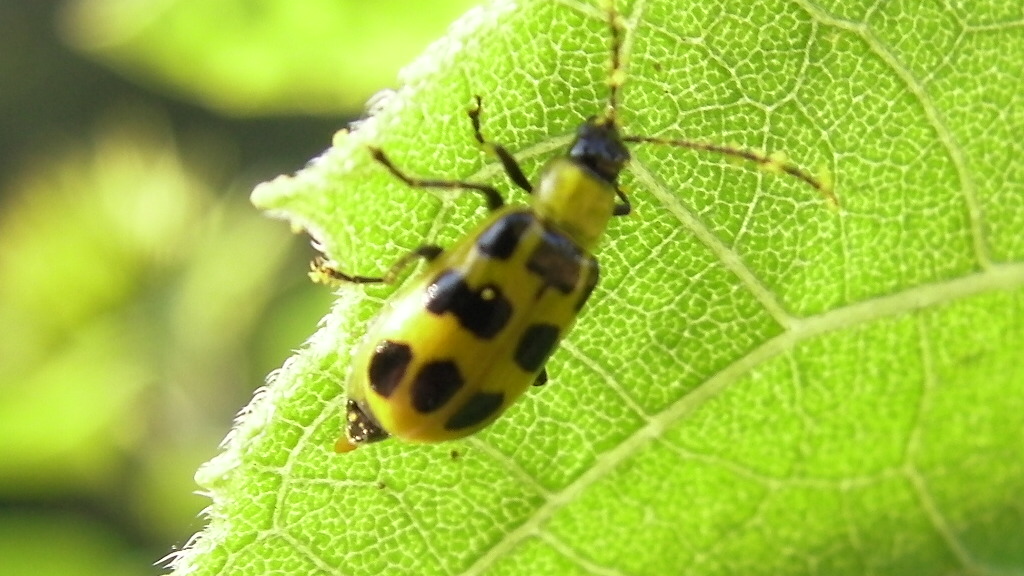
This might be the bug/beetle which appears in the video taken two days previous. It was on the flower part but jumped to the leaf while I was getting the camera switched on and focused.
Growing poppies is a long term affair. We planted these under lights in the house. After two to three weeks in a plastic bag to keep it moist, the very fine seeds have sprouted.
Poppies ready to be transplanted into bigger pots. The plants in the foreground are St. John’s Wort (Hypericum).
The poppy seed was planted in February. It is just now blooming in September. I think we’ll start earlier if we want poppies in spring or summer for the bees next year.
Here’s the beautiful result of our labor of love…
The poppy has finally opened up. I wonder when the bees will find it.
A couple of days after this first one opened up, we had a bee doing something strange (to me). It faced away from the center of the flower, beating her wings rapidly, vibrating the pollen off the stamen and onto her body. After getting a layer of purple pollen, she landed on the outside of the flower and groomed herself with her middle legs, pulling the pollen off her back and into her pollen baskets. It was incredible. I had my little pocket camera with me and got some video of it.
Quite a mouthful. This photo was taken the evening before.
The bees started being very active fairly early in the morning. I ran to get the video camera to document what was going on. They grouped up on the outside of the hive entrance. The group slowly moved up the right side of the hive and then under the nose. My wife thinks this was a bunch of drones hatching, because they look bigger. I couldn’t get couldn’t get a good fix on the eye pattern. The next day was normal activity. Any ideas? We welcome your comments.
Burying the very available crab shell and coffee grounds to spice up the soil is the first thing. Warre hive is on the left and Bee Beard carved log hive on the right. I’m in good company.
Potatoes…should we harvest now or leave them in to grow more? If I leave them in, the voles might eat them…I better take them out. Then I can plant buckwheat in both beds.
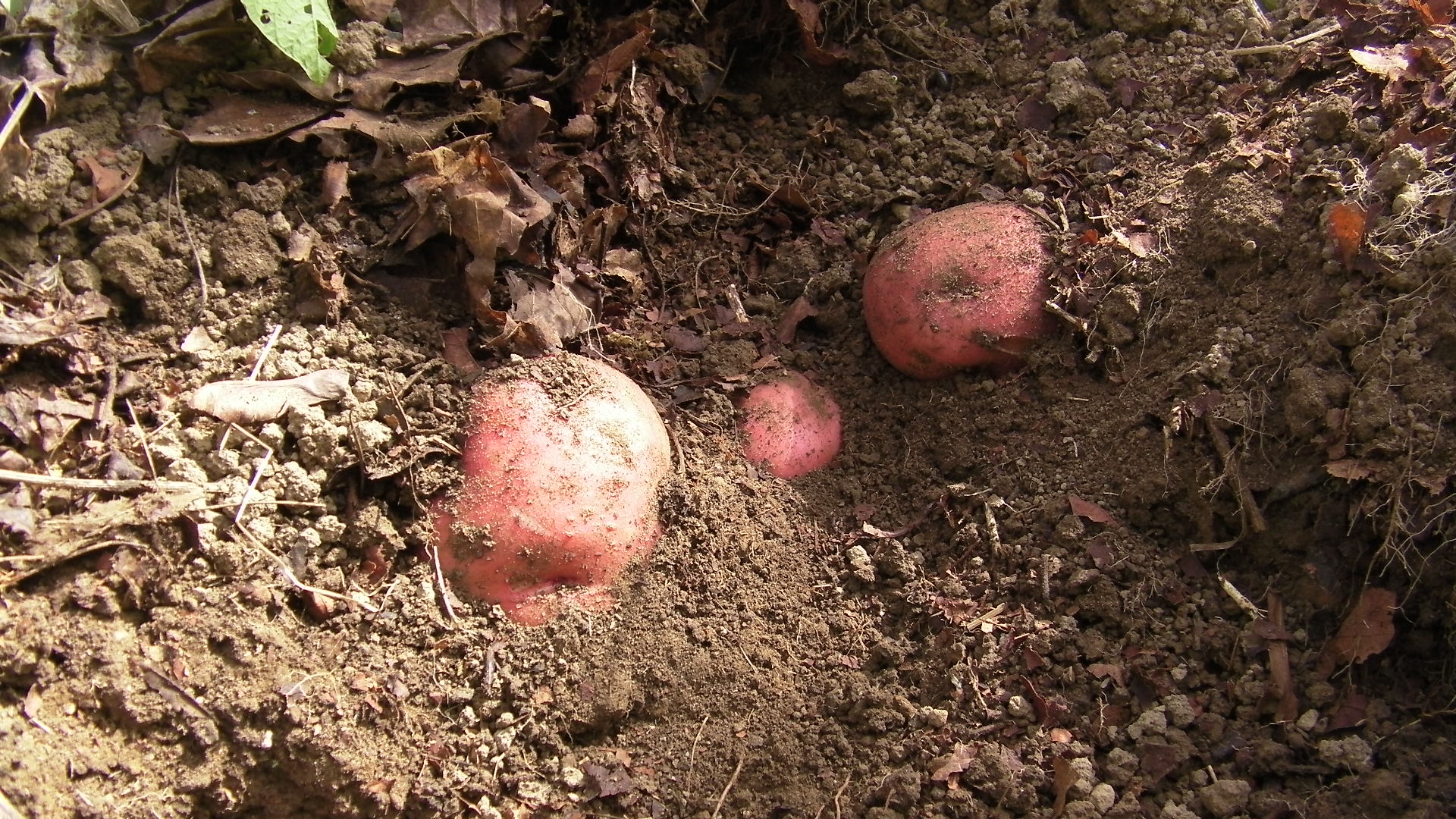
Red Pontiacs – Three at once
A mole tunnel…the moles dig the tunnels, the voles follow the tunnels to the potatoes. More than a few potatoes had been chewed on, so it was good idea to get them out of the ground.
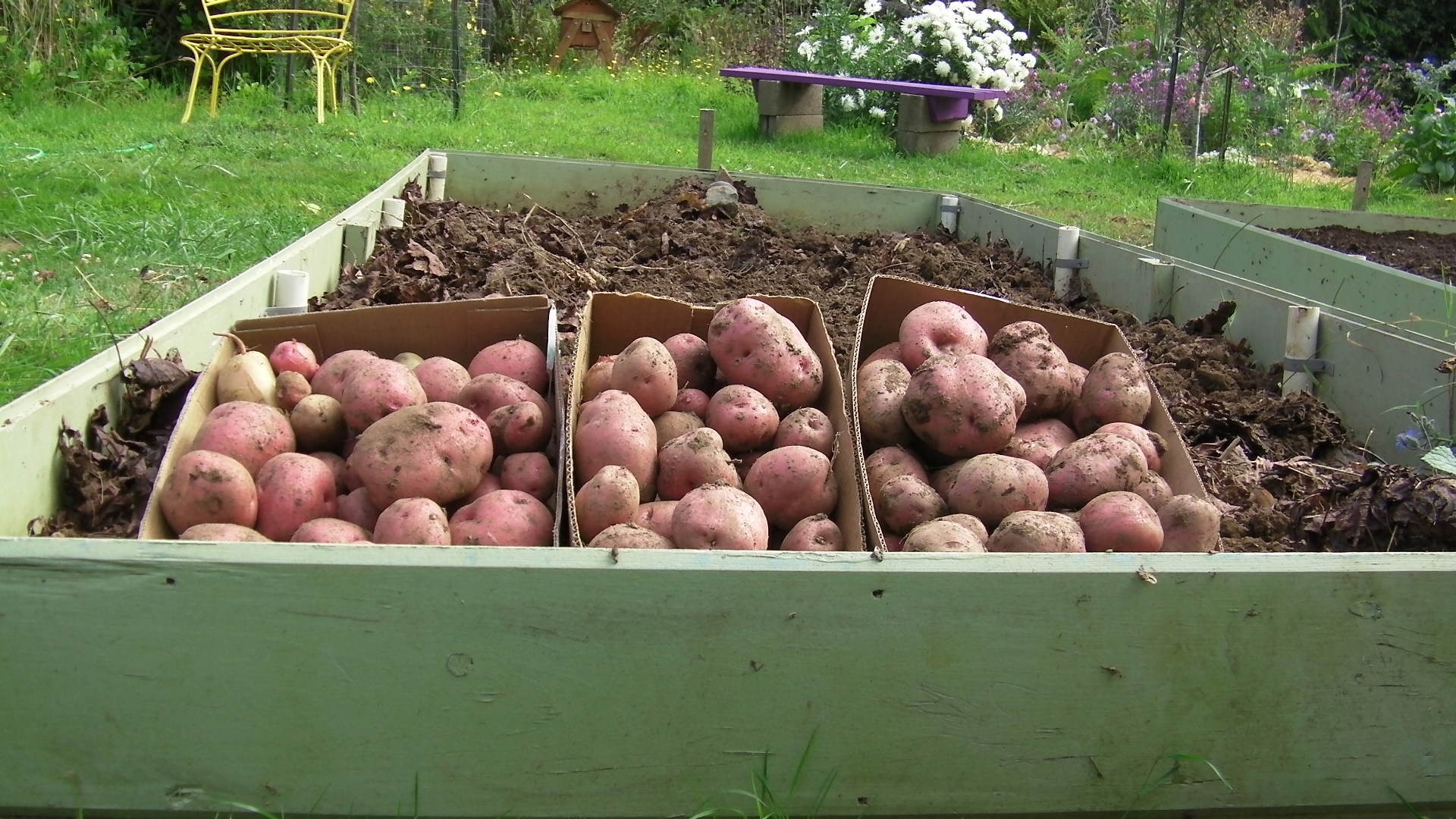
Some of the potatoes harvested from this first potato bed. We could have left them in to grow more, but the voles would have taken a big bite out of our harvest. This way we can grow buckwheat in both beds for the bees in September.
We’ve been fairly successful in the “no tilling” method for a few years. We think it’s important to use less manufactured energy and more physical energy. Is spading ‘as good as’ using a tiller? Probably not, but it’s important to be able to grow food without using fossil fuel for the possible time when we don’t have any.
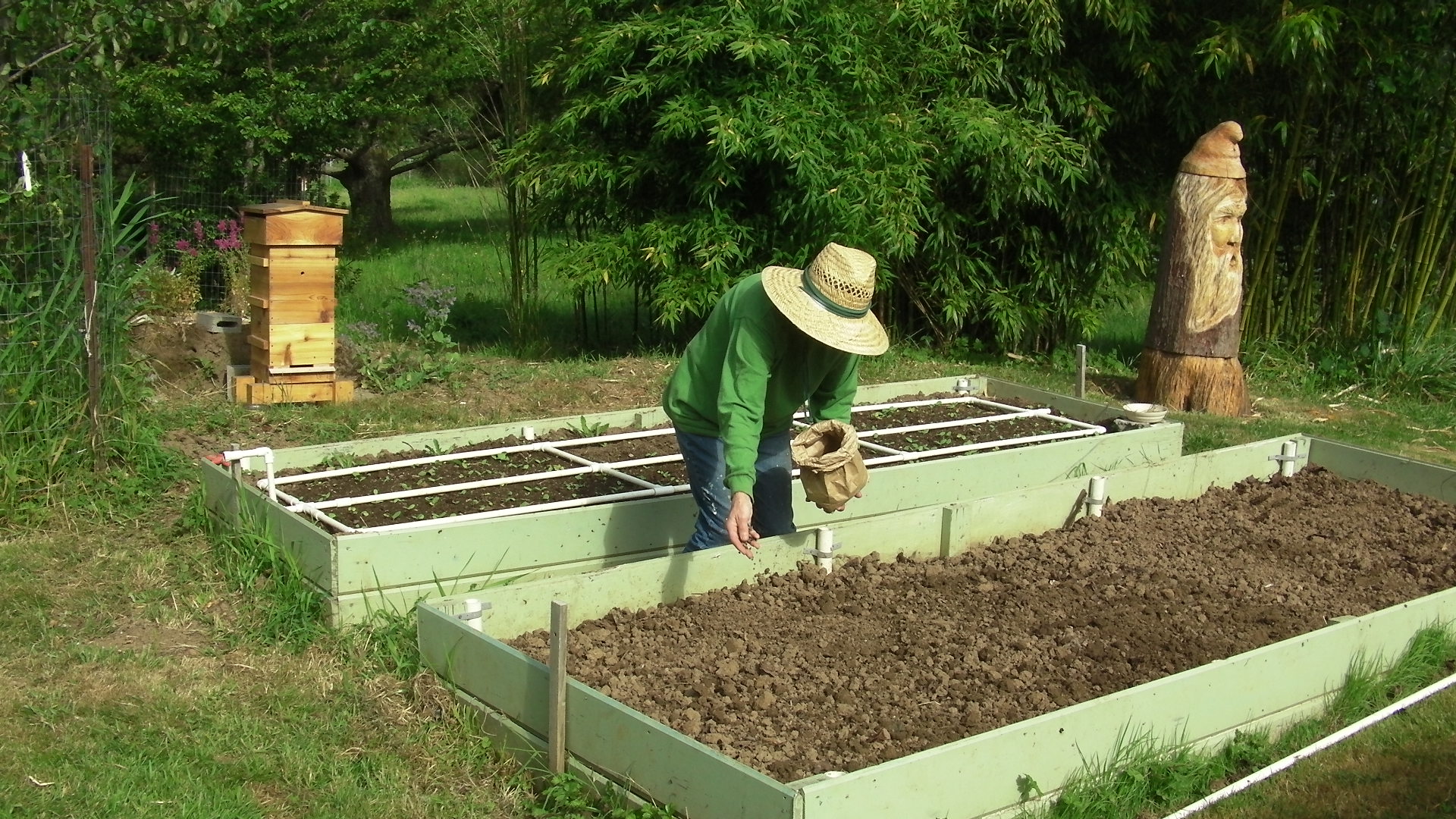
We have dug in crab shell, kitchen scraps (no meat), comfrey leaves, and coffee grounds to enhance the soil. Now we’re planting the buckwheat seed.
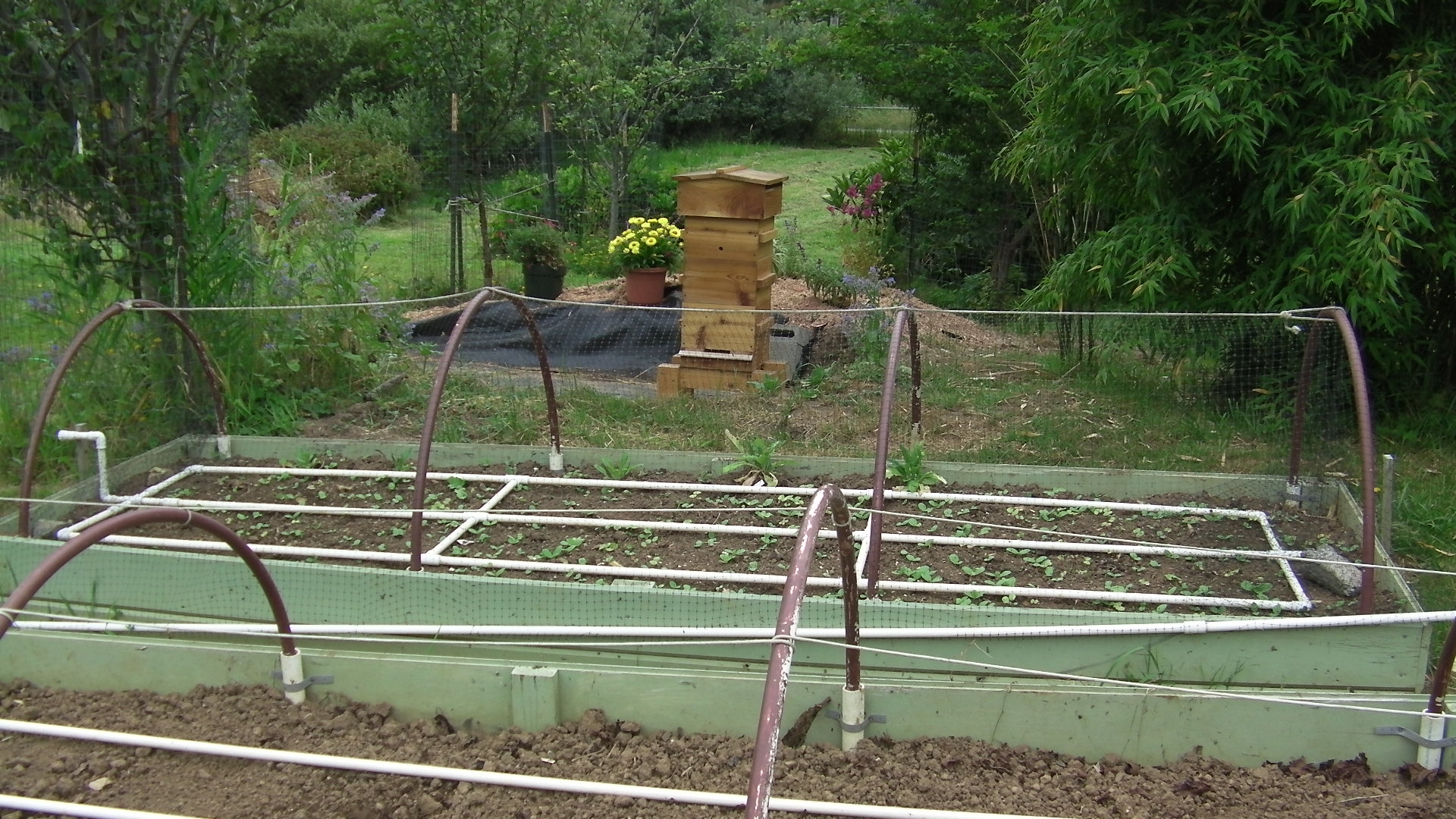
The drip irrigation grid and the deer netting are in place.
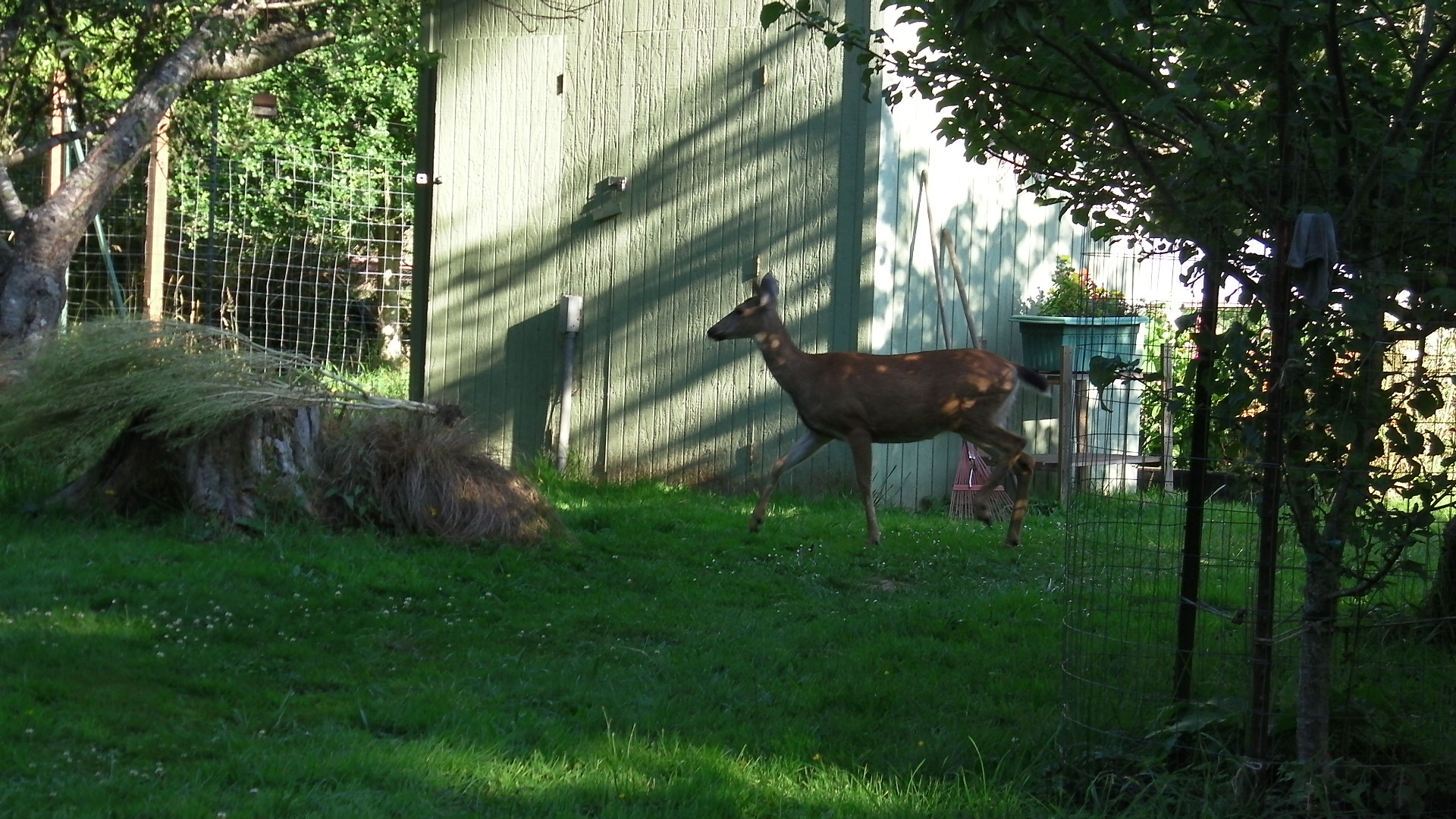
Why do we need deer netting? Because of her…and all her offspring!
According to this article by the Thomas Jefferson Agricultural Institute “…buckwheat crop seems to improve soil tilth, and is reported to make phosphorous more available as a soil nutrient, possible through root-associated mycorrhizae. Buckwheat flowers profusely, making it popular with bee keepers and an attractive crop in the landscape.”
Sept. 9, 2012…about 5 weeks after planting, buckwheat is looking good. Bees have been working the blossoms for a couple of weeks already.
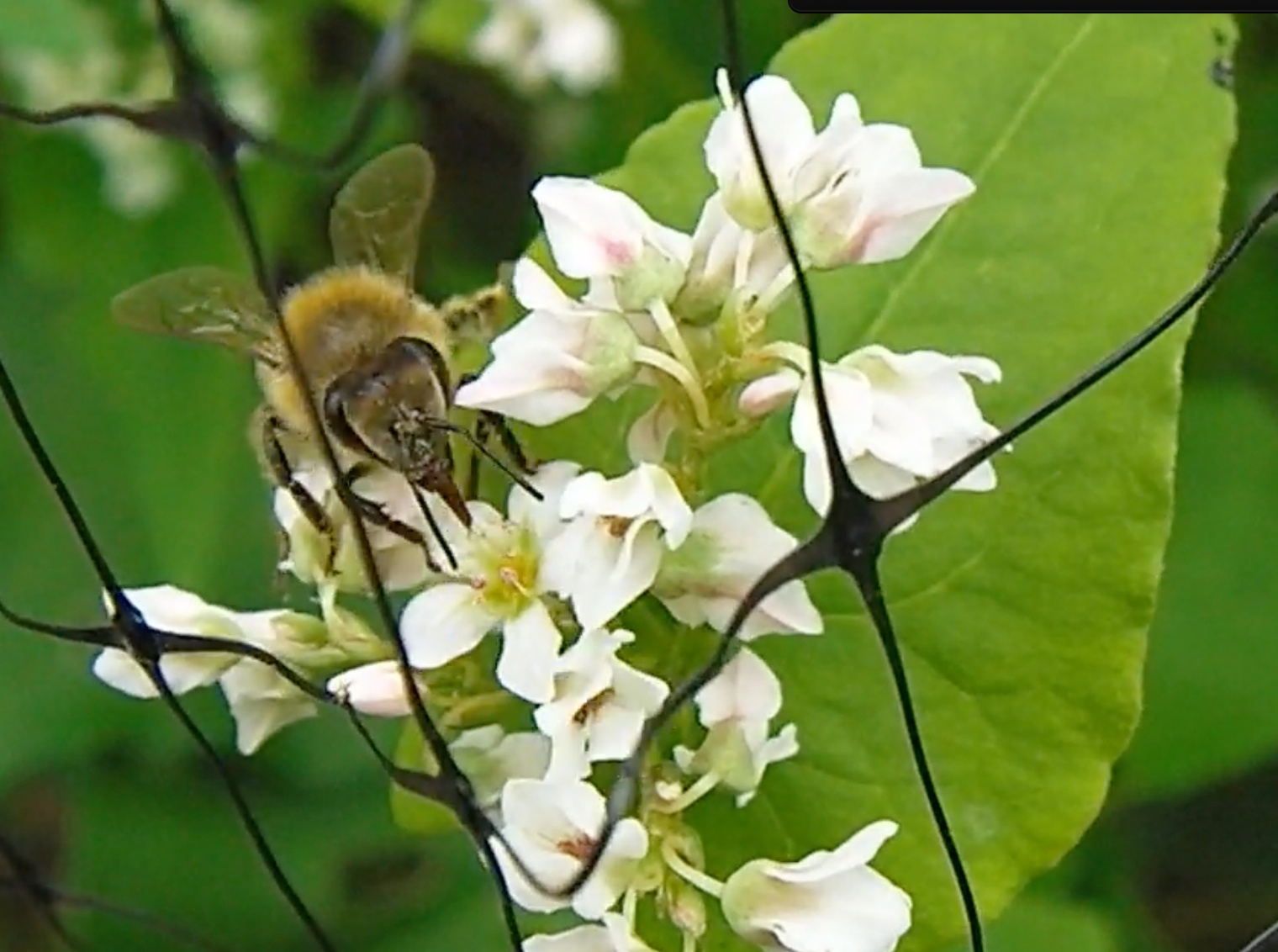
Sept. 9, 2012…Honeybees attending to the buckwheat blossoms under the deer netting.
A fly mimicking a bee on the buckwheat blossom.
My wife saved me the ultimate embarrassment of thinking I found some kind of new bee. “Honey, that’s a FLY!” “Ulp.”
This short video shows the progress of the swarm that was transferred from the bait hive to Bee Beard on June 2nd. Now after 7 weeks, viewing through the observation window, you can see the bottom of the bee cluster is below the level of the mouth entrance. Initially, bee beard would face southwest into the winter wind. For that reason, an alternate entrance was drilled towards the north rear. When we decided to locate Bee Beard facing east, that alternate entrance was plugged with tissue paper. To my surprise, the bees have just pulled out that tissue paper and you can see a bee flying out with a bit. In the slightly out of focus video through the observation window, you can see bees carrying out bits of paper. Also seen are bees carrying pollen from blackberries and St. John’s Wort…my bees won’t suffer from depression!
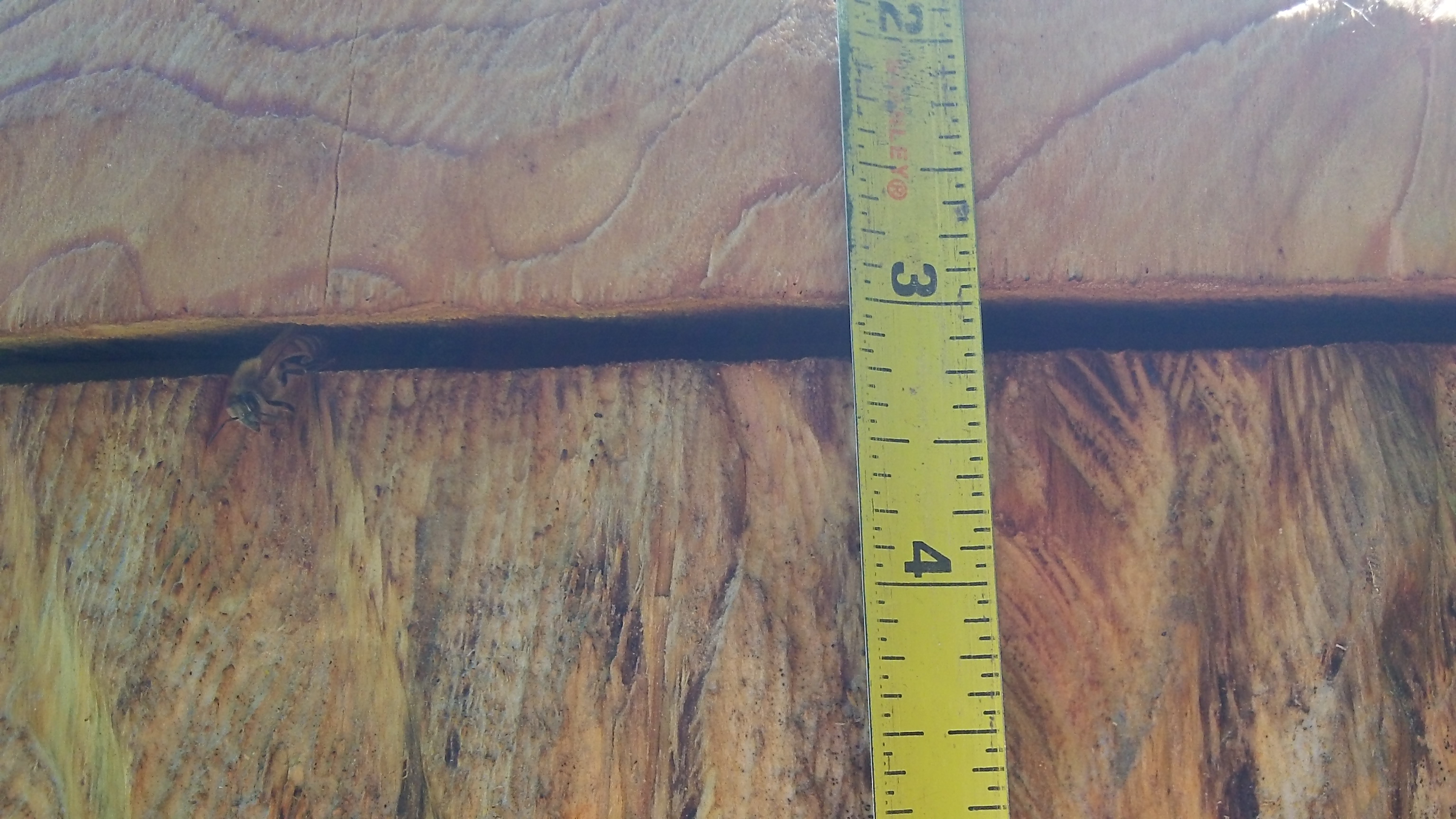
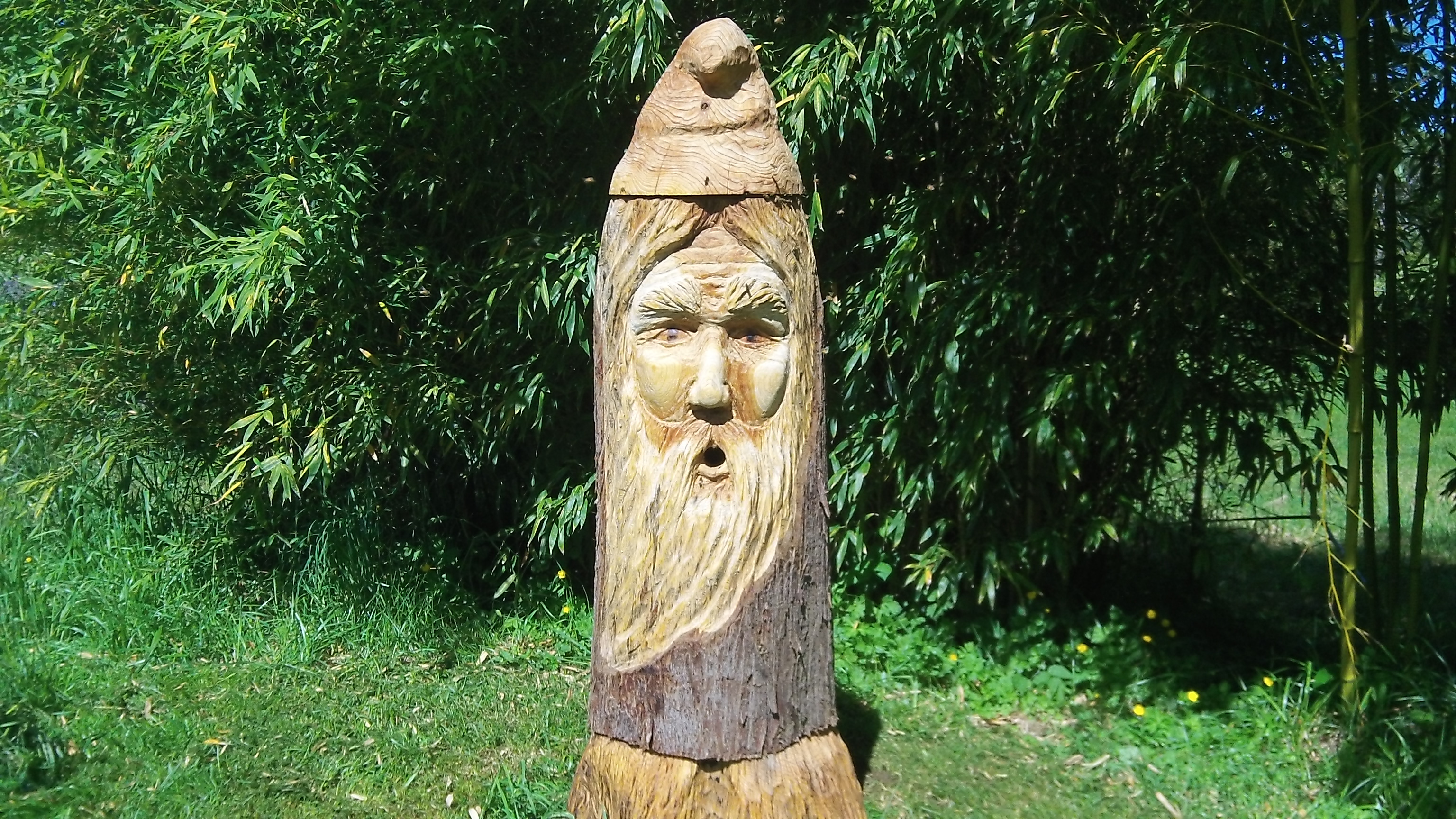
Bee Beard sports a great entrance hole, but the bees use the slot between the hat and the top of head most of the time.
I don’t understand it…I give them a beautiful 1.5 inch (3.81 cm) diameter entrance hole in my log hive, yet they insist on using the small slot between the hat and the top of head.
The entrance the bees are using is less than .25″ (about 6 mm) even though a beautiful round entrance hole was provided for them below.
A short video can be seen here showing the bees entering through narrow slot between hat and top of head, followed by a shot looking through the observation window to see the natural comb. This was shot 17 days after the transfer from bait box to log hive.
The creation of Bee Beard was influenced by many different people. Hal (The Story of Hal’s Bee Trees) was the main instigator. He started his first log hive around May or June 2011. I was impressed that a swarm had actually picked his log hive to live in. I liked his hands-off log hive credo…
“BEES WILL NOT BE MOVED, MEDICATED OR ROBBED OF HONEY
THE COLONY MAY SWARM AS DIRECTED BY NATURE”
I wanted to try the same thing, but not being retired I knew I wouldn’t be able to spend so much time hollowing it out. I looked up log hives on the web and came across Gaia Bees. I emailed Michael Thiele who gave me directions on hollowing out the log. It was about this time that a new beekeeping friend, Terry Kelly of Berkeley, a writer, top bar beekeeper, and mushroom log grower, started sending me packets of bee articles he liked. My log was partially hollowed out when another packet of articles came in the mail. The very first thing I saw were copies of Slovenian Bee Hive Art. Not only were there paintings but there was a face carved on the front of a hive that served as the entrance to the hive. The bees entered through the mouth, nose, and eyes into the hive. It took all of 10 seconds to decide I wanted to do something like that on my log hive.
I shared my idea of a wood carving with my wife, and she suggested I try the new chainsaw wood carver in town. I talked up the idea with Brian and Zada Vorwaller. He offered some suggestions and we came up with Bee Beard. His wife, Zada videotaped the carving and my son-in-law, Jim Montgomery edited, sped it up, and made it you-tube acceptable.
I wanted feral bees if possible, but commercial hives are placed in the bogs near me between late May into mid July. I knew I had to populate the hives before the bog bees got interested. How to get feral bees became an obsession. After reading McCartney Taylor’s book on Swarm Traps and Bait Hives, I built 9 bait hives. Hung them mostly on private property. I want to thank Bernhard Zaunreiter (see Swarm Trapping 2012) for posting a photographic “how-to prepare bait hives” post on the biobee.com forum,” and answering my bait hive questions.
I finally was rewarded after placing two boxes on or near feral bee hive trees. On one of the weekly inspections, both had caught swarms. This bottom tree supplied Bee Beard.
The transfer of bees from bait hive to Bee Beard was quite an adventure, but the bees are settling in now and the itching is subsiding.
I want to express my appreciation to Phil Chandler for creating biobees.com forum. I’ve got so much to learn and this is a very friendly, positive and informative place to do that. Thanks to those stalwart friends who gave me encouragement during my dark days of no bees, when I started regretting not ordering package bees and despairing that I wouldn’t get ANY bees for another year. Mobeek, Bugscouter, KittyLabyrinth, newwoman, baz, and jaywoo kept me going.
This short video shows the bees entering through the hat. I left a little gap in the quilt box to make it easier to pull out. I think that’s where they are going. A few enter through the mouth entrance. I’m hoping when the comb gets built down that far, they will use the mouth entrance more.
I noticed the bamboo is shading the hive too much in the afternoon…the Warre Hive, on the south side of the bamboo works 1-2 hours longer, so I’m going to trim back the bamboo to get more sun in late afternoon. After all, that could spell the difference between making it, or not making it.
Saturday brought the usual “check the bait boxes routine”, sigh over no bees yet, and daub some lemon grass oil on the outside. The first box I looked at was on the feral tree on private land. “WOW, I’ve got bees and they’re bringing in pollen. That means they’ve got a laying queen.” What do I do now? I’ll check the other bait hive across from the park…”WOW, that’s got bees too, and they’re are also bringing in pollen. Yikes, I can’t handle two at once.” I talked with Hal who advised me to wait until all the foragers came in. That would be another two hours. Went home to get my wife so she could provide moral support.
At 8:15 pm we stuffed some paper into the entrance hole and duct taped it securely. Got back around 8:45 pm. Should we stick them in now or wait til morning? We might get rain in the morning and it’ll only take a few minutes, let’s just put them in now. Plan is to unscrew the lid of the bait box, lift out the bars, put them in the top of Bee Beard log hive, put the quilt box in and pivot the hat back in place.
Since I had just had a successful swarm retrieval two days prior, I had confidence this would take about 15 minutes then we sit down for a cup of tea and congratulate ourselves.
The transfer did not go as planned…I didn’t suit up properly, it was almost dark, and as soon as I started to remove the lid I knew I was in trouble. Wife says…”sounds like they’re mad.” I tried gently lifting the bars out, but had to jerk them a bit. The bees went ballistic. Then the stings started. They got up into my bee suit between the veil and my face, up my pant legs, and on my wrists. At least I found out I’m not allergic to multiple bee stings, although I’m itching a bit. I had to vacate the area with the box lid part way open, the top of the log hive open, and our confidence shot.
All night I’m trying to formulate a plan of action for the next day…wondering what the heck I was doing…how did I ever think I would be able to pull this off, are these bees going to attack my wife and I when we’re working in the garden? What about our pets? Why did I want feral bees? What was I thinking?
Next day I called Shigeo from the Coos County Beekeepers Association. We talked about the incident and about the other bait hive which I was NOT about to get. He says to call Randy. Well, I know Randy, he’s awfully busy with his regular job, plus the last count of swarms he had gotten, was 23 and that was a week ago. He probably doesn’t need any more. I’ll call Del, another club member. We talk for awhile, he builds up my confidence and says “call Randy.” I call Randy who luckily happens to be working with the bees in the blueberry farm on the coast. (my area). Randy says he’ll be over as he finished up early on the blueberries.
I better get ready. Find the smoker. (never been used), light it up so it looks like we know what we’re doing. Very soon, Randy and Loni were driving in. “Hey I got my smoker lit up, do you want it?” “Don’t need it with suits, besides the bees don’t like smoke.” They zipped up their veils, walked confidently up to the hive, bees still circling angrily. Within a few minutes, they emptied the bait box of the remaining bees, got the bars into the log hive, installed the quilt box and pivoted the hat in place. They said the bees will settle down in a while and not too worry too much about working in the garden, they’d get used to you, but if they go through a dearth, they might get a little testy. We were much relieved.
It was nice to see a husband and wife team working with bees. They have worked together for about 20 years so know exactly what to do to put things right. Their business name is Oregon Mountain Wild Honey.
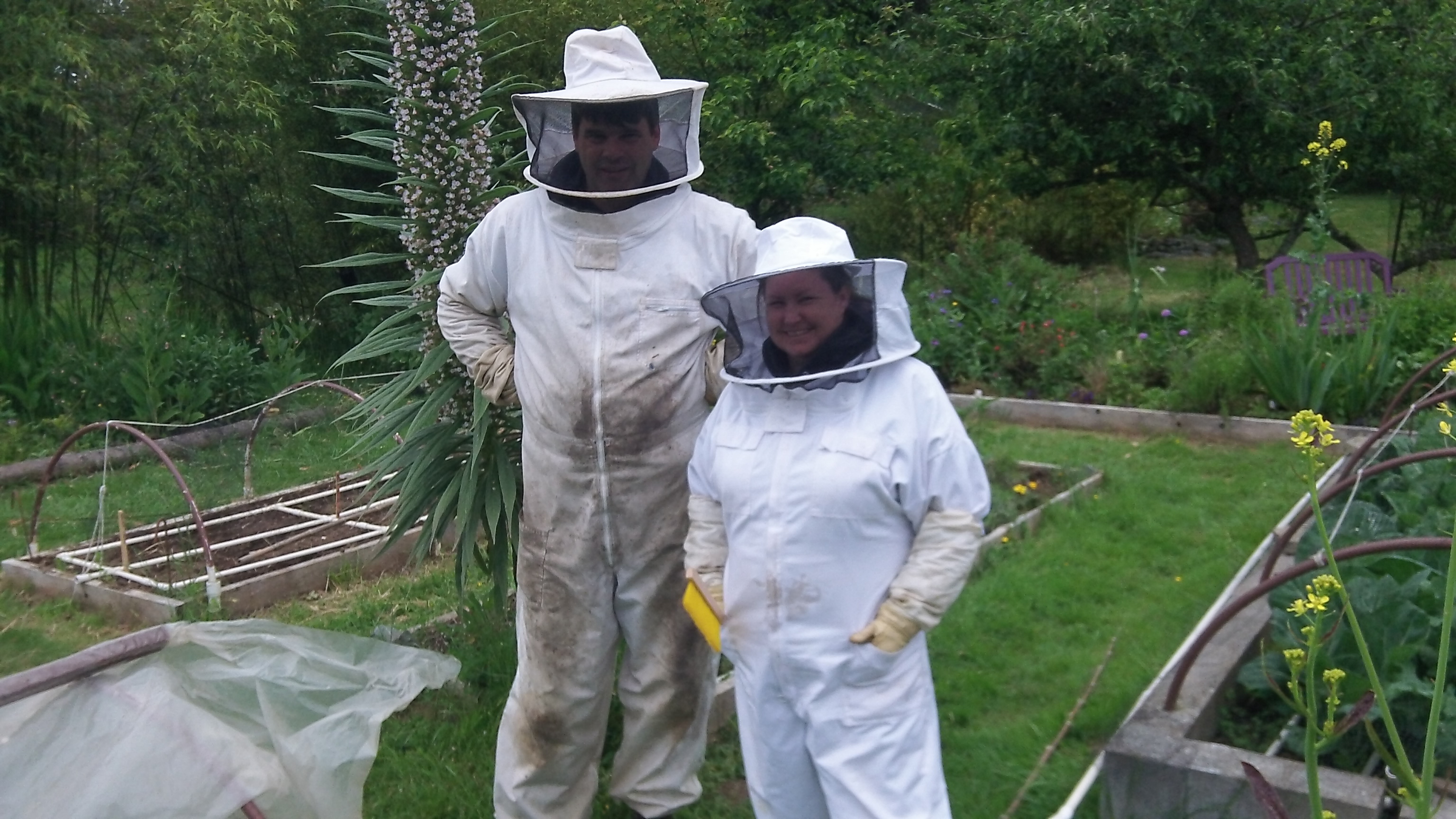
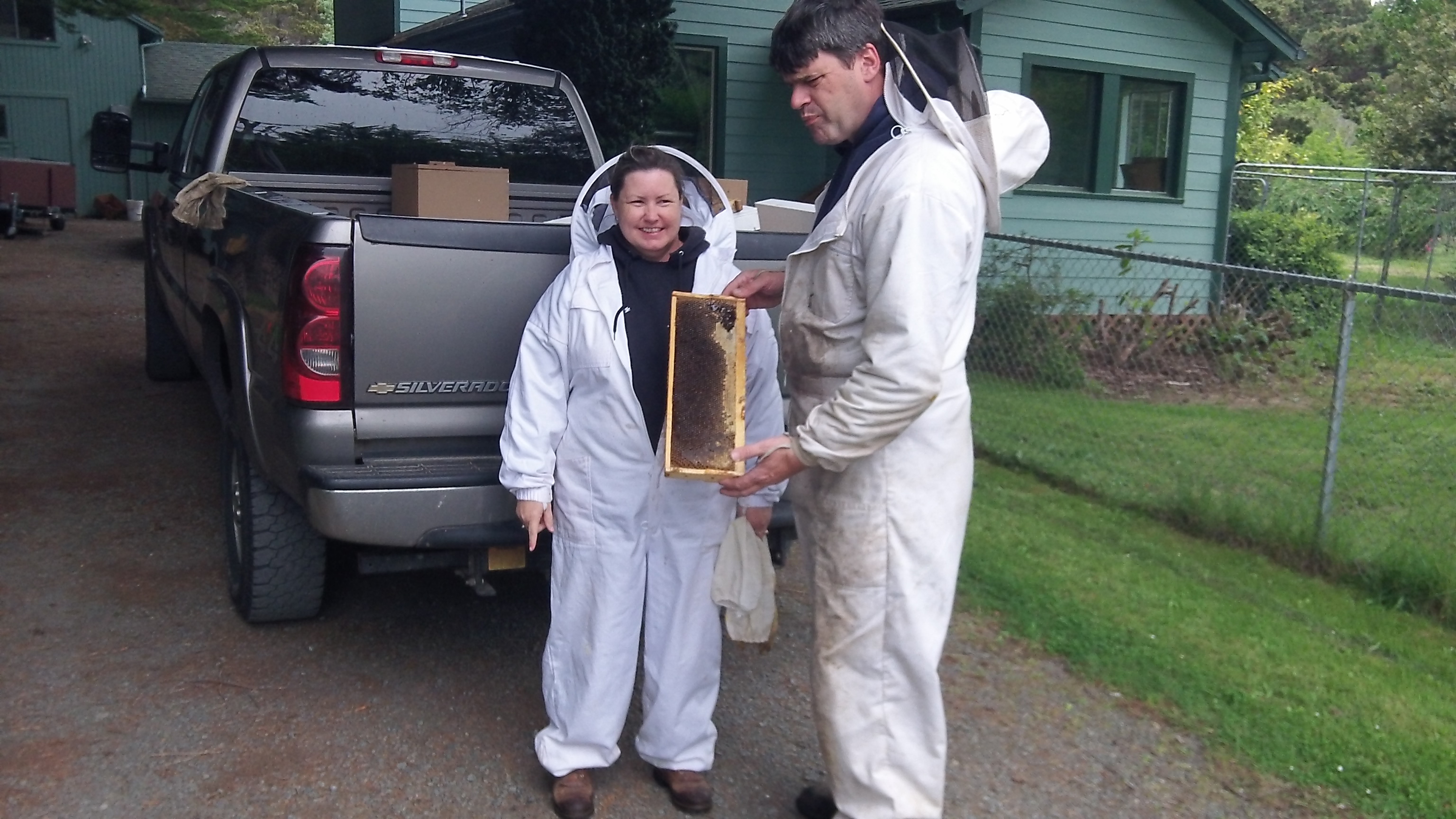
Randy and Loni after getting bees into Bee Beard
Randy and Loni give us a taste of their blueberry honey, fresh off the comb
A short video of Bee Beard can be seen here… Bee Beard Gets Bees
What flowers to plant/buy for our area of Zone 5? These flowers have done well for us…
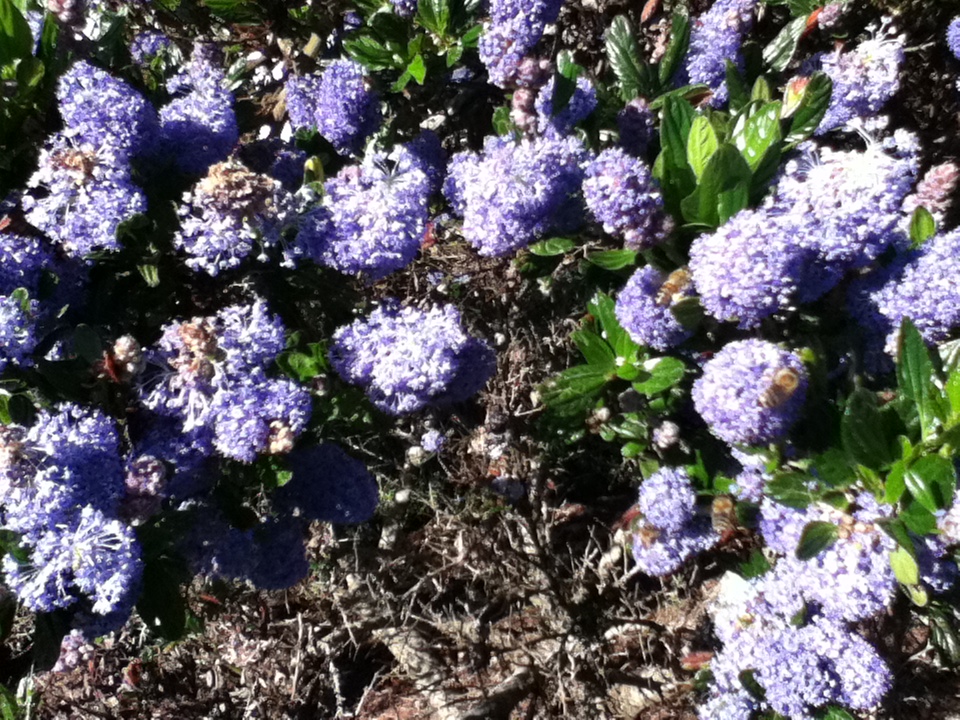
Bees love California Lilac which provides early nourishment for the bees
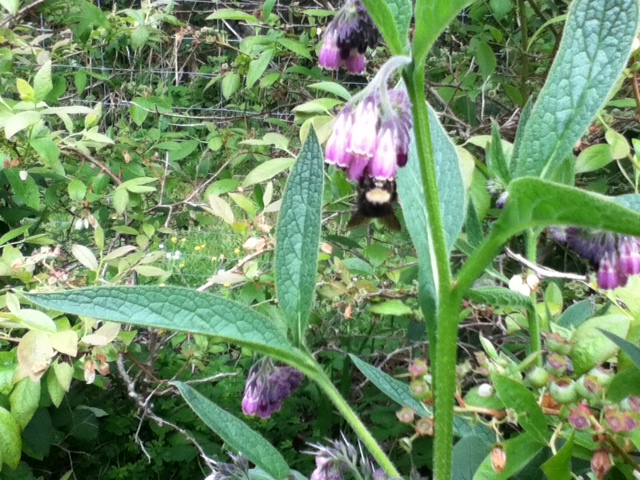
Bumble bee on the Comfrey, which can be considered invasive, but provides food for the bees.
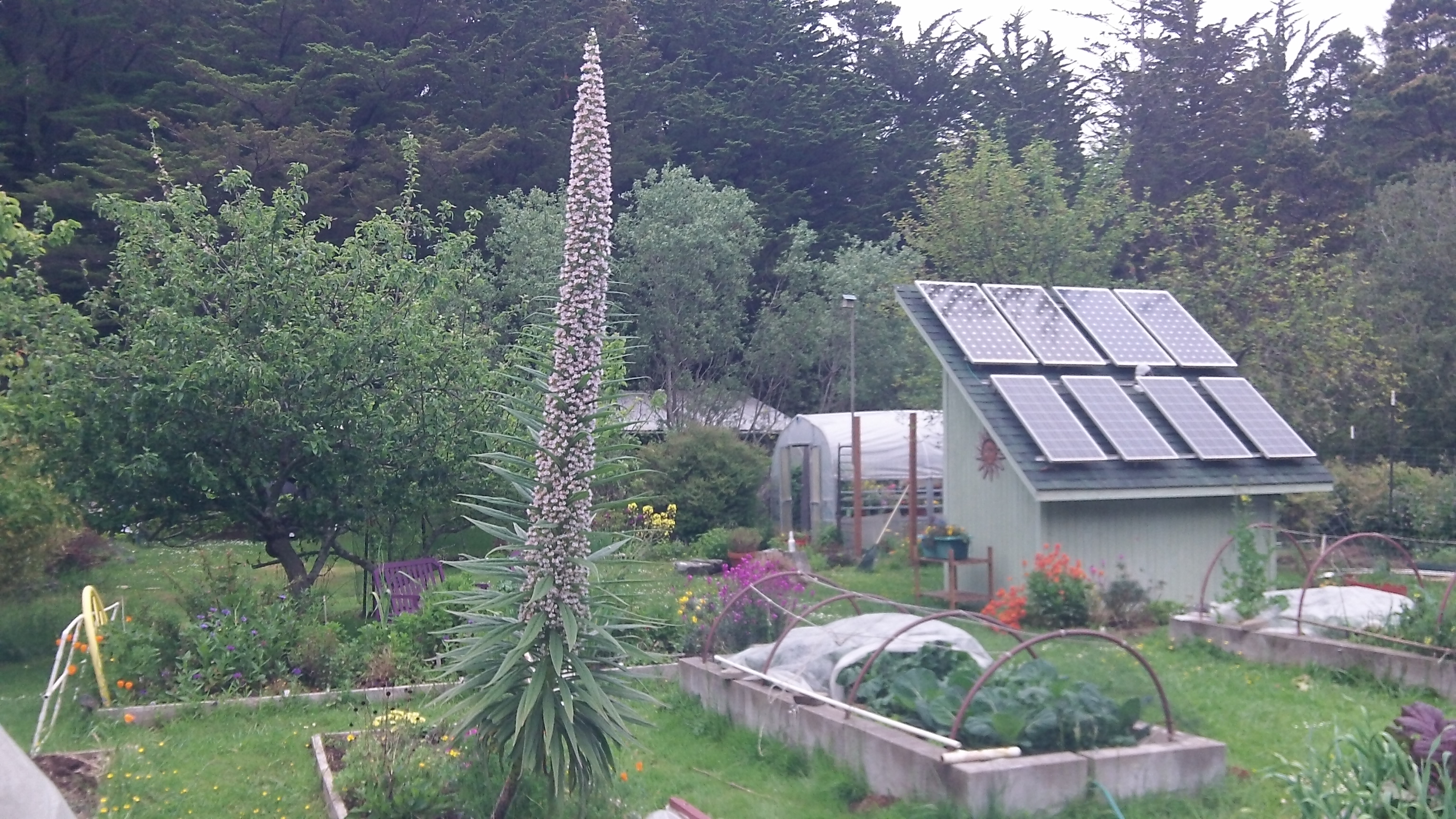
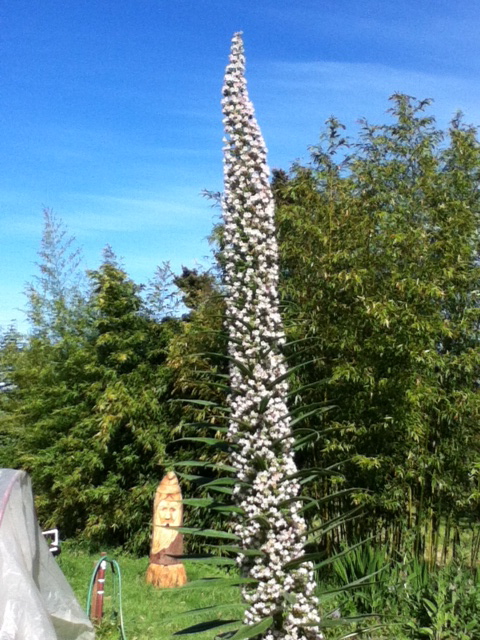
Echium plant grew from 2 ft (.6 m) high last year to about 10 ft (3m) high this year
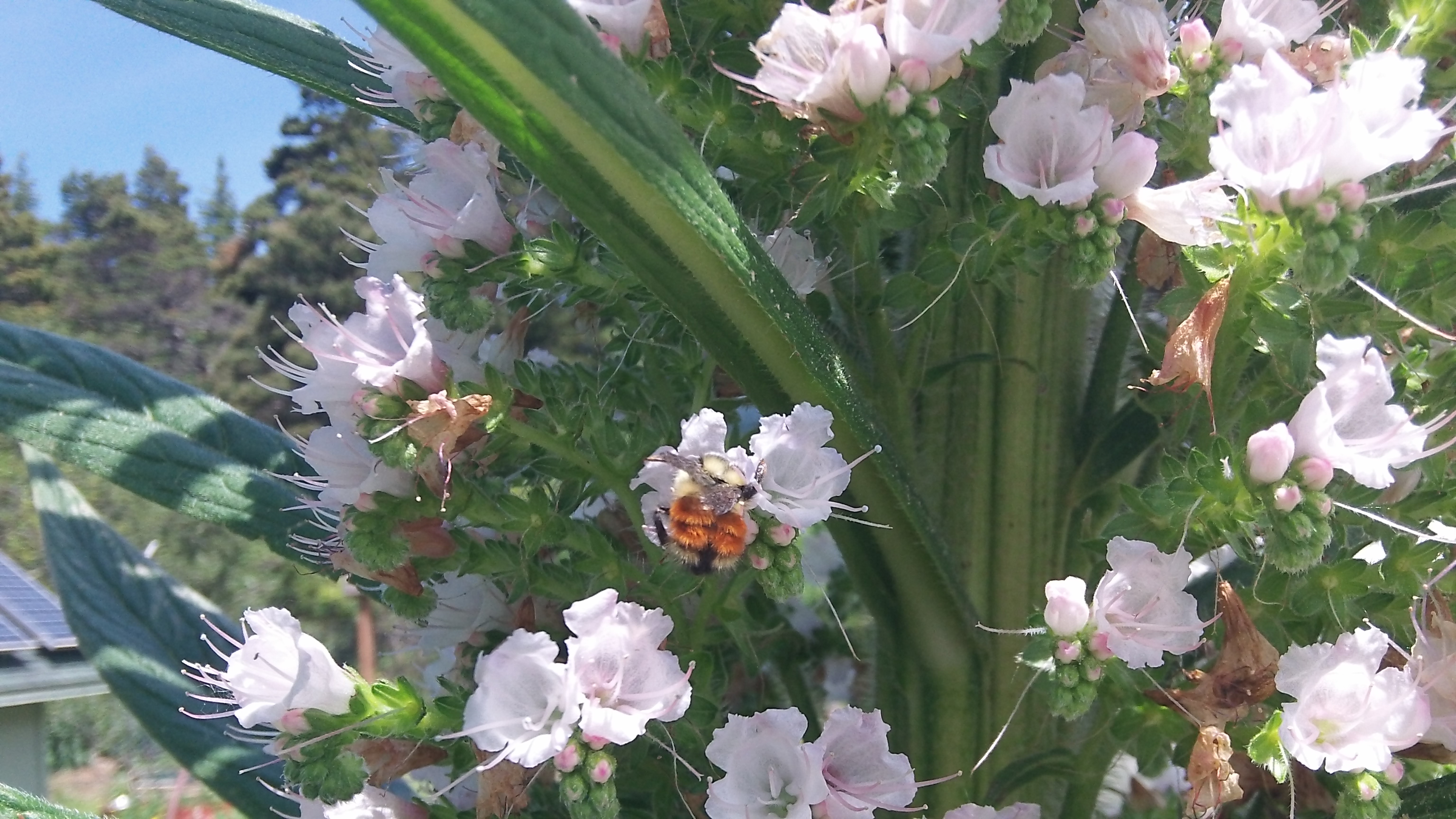
Bumble bees go for the Echium in a big way
SIX BEES ON A SINGLE BLOSSOM
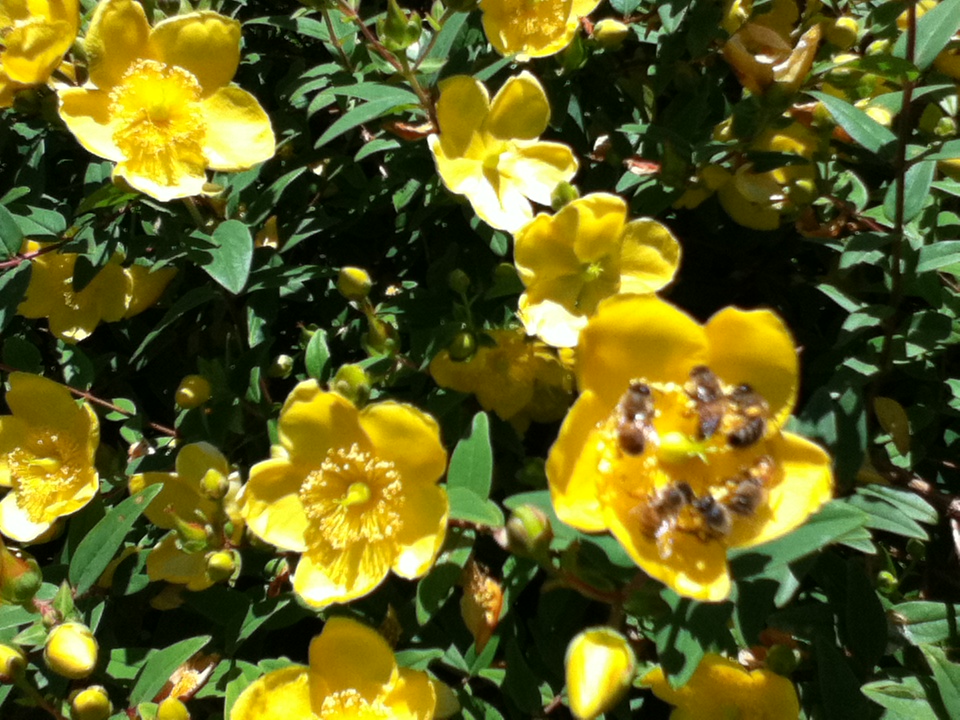
Bees go crazy on these blossoms (which I was under the impression were Island Bush Poppies) as can be seen in this fuzzy photo of six bees on a Hypericum. It’s covered with bees mid June to late July.
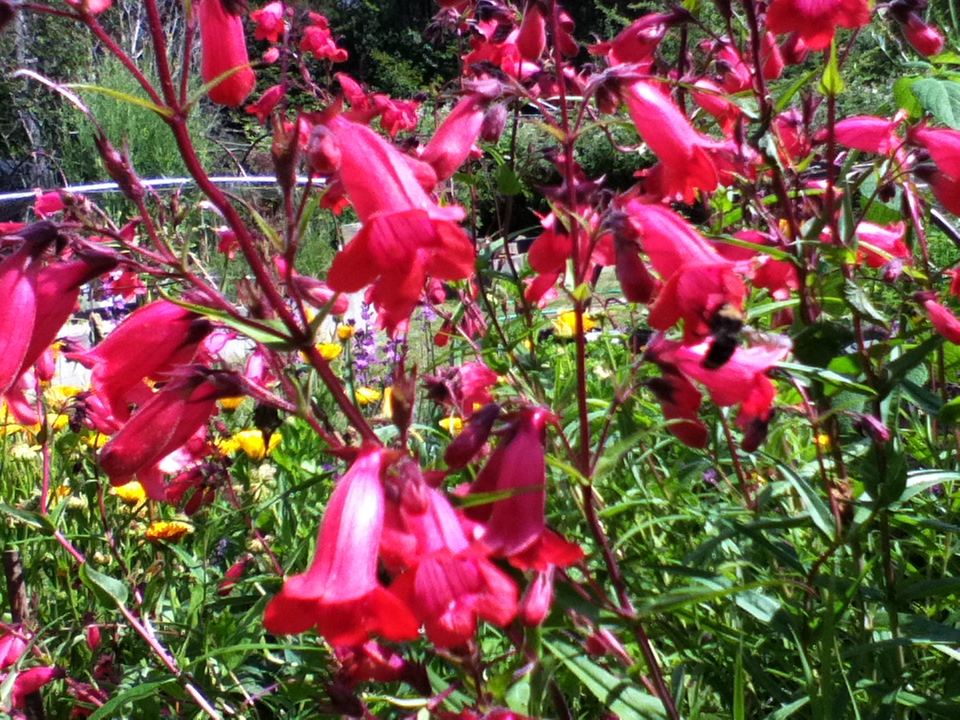
Bee diving into Penstemon blossom. These start blooming June.
Dahlias, blackberries (main Oregon crop for bees), sunflowers, wall flowers, rosemary are also good bets for bees, as well as cotoneaster which grows wild and provides food late in the season.
These are plants we’ve had in our garden. I’m sure there are many more. Please fill free to add to the list in the comments.









 Adventures in Natural Beekeeping