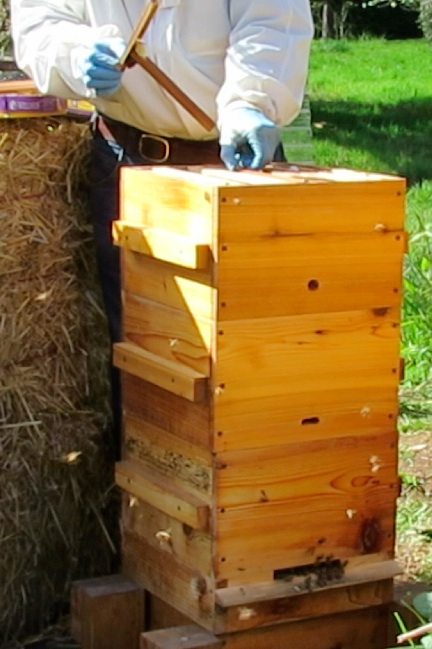
My first Warre is the one on the left. It’s the one I was really worried about not getting through the winter. It wintered over with only one box which is now on the bottom.
I don’t know why I was so skeptical when people talked about getting honey bound. I guess I never thought I’d get ANY honey at all because the summers on the coast are so windy and cool. Our main goal was to provide a place for the bees to live, let them pollinate our flower and vegetable garden, and just take pleasure in watching them do their thing.
When we captured a swarm last year to inhabit the Warre, it was a small one which seemed to build the first box very quickly and then just stopped building. I wintered over with just one box and on the advice of many more knowledgeable people, fed the bees a dry sugar paddy.
Bottom box (#1) over wintered successfully. So we added box #2 in February.
On February 15, I added a second box. When the bees wouldn’t fill it, I added some comb ladders on March 24th. The bees immediately started building comb which is full now as can be seen below.
Box #2 As soon as the comb ladders were added, the bees built fast so the queen could lay. When it was 3/4 full, I added a third box.
When box #2 was 3/4 full we added box #3, but comb was getting scarce so I tried using t-posts with a melted wax coating to act as a ladder. Small pieces of comb was ‘welded’ to the top bars.
Box #3…adding t-posts with small bits of comb ‘welded’ to them on April 2nd.
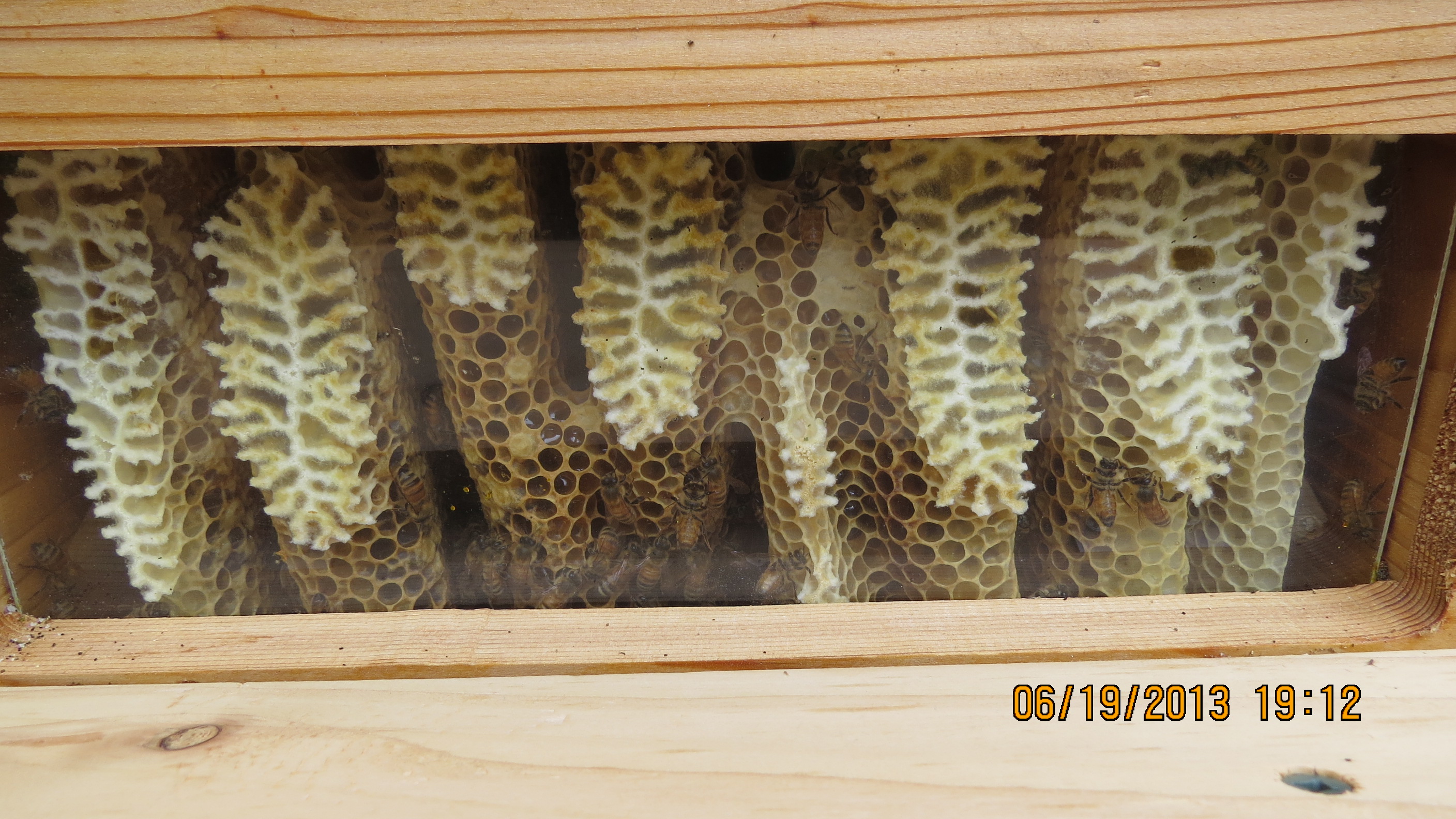
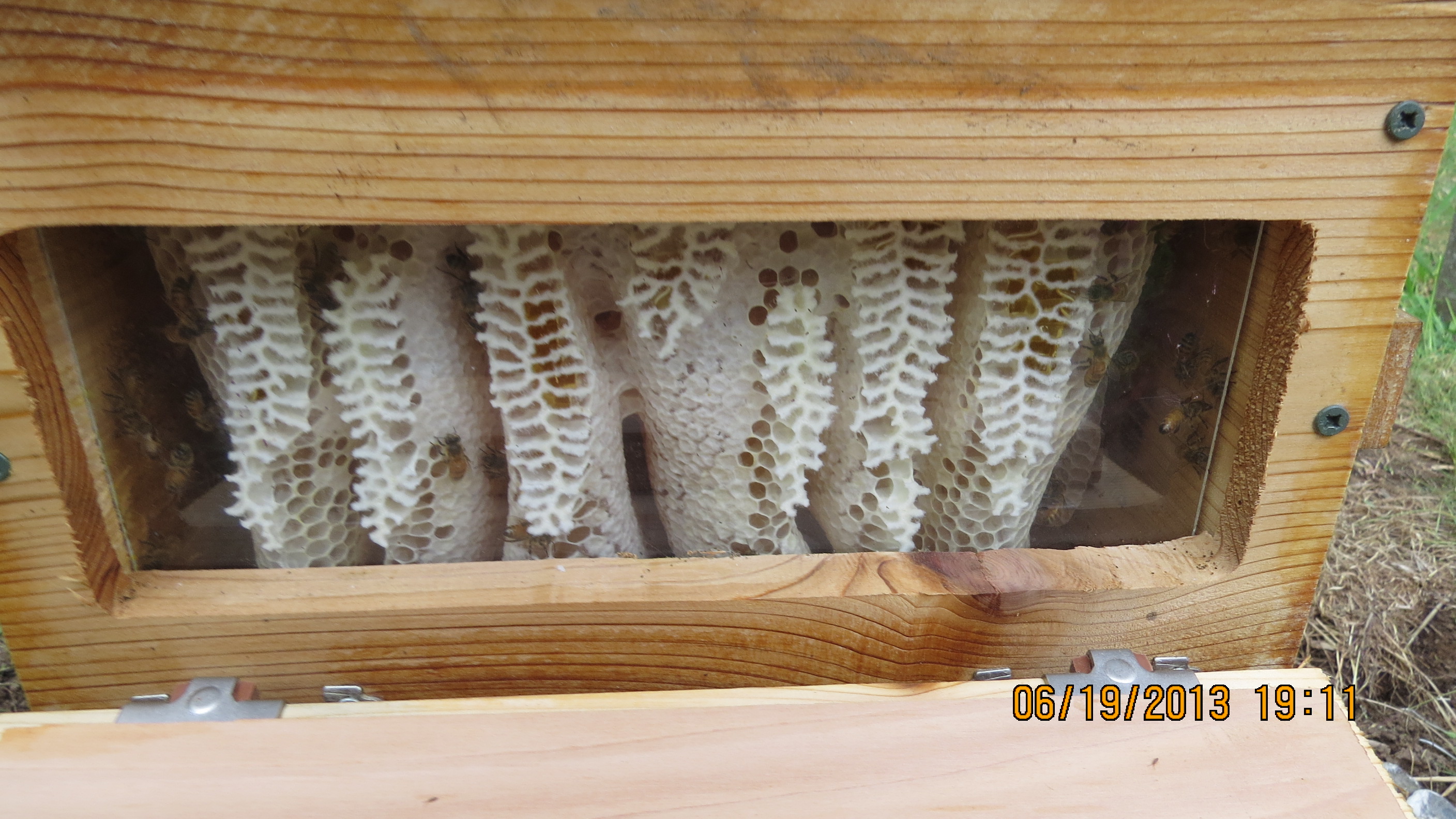
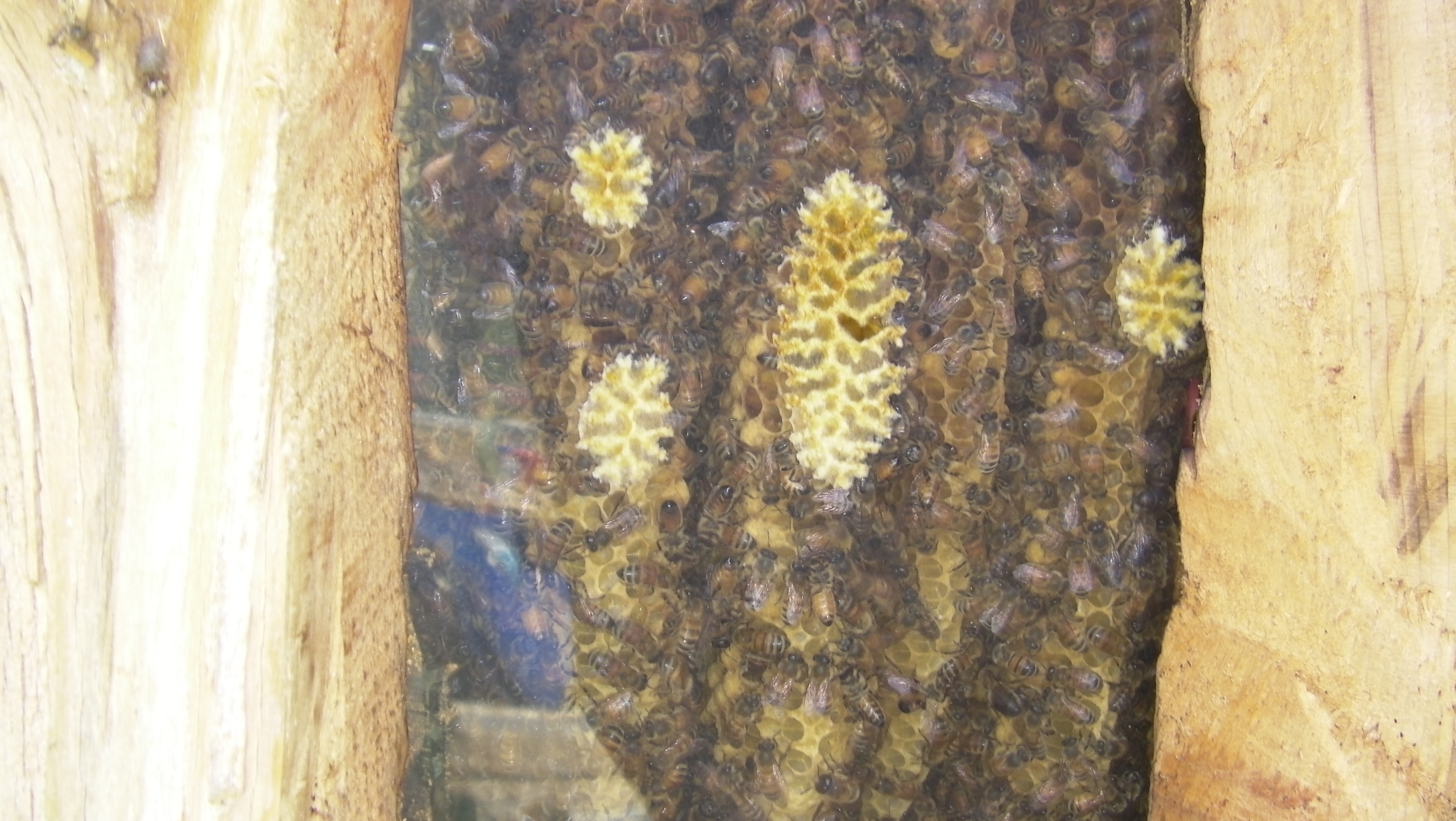
Box #3 built up so fast we added Box #4 on May 1. But now we have this honey bound problem as can be seen below…
Box #3 is so full of honey, it’s blocking the queen from getting into the top box. The t-posts worked well.
We didn’t realize we’d get any honey…and really didn’t want to take any…UNLESS there was an excess while a nectar flow was on. Oregon’s big nectar source of blackberries is going on right now, so we will put this box #3 on top and the empty box #4 will be inserted between #1 and #2. If they build that out, I’ll get to harvest the honey.
This is actually a fly…I didn’t know that while I was filming it, but I kept it in the movie so you could see the tongue. I’m wondering if it inspired ‘Alien.’
This is the tail end of the kale flowers. In April, the bees were so busy on the kale you could hear the happy humming. In June when I’m finally posting this, the kale has been pulled and hung so the seed pods can dry out.
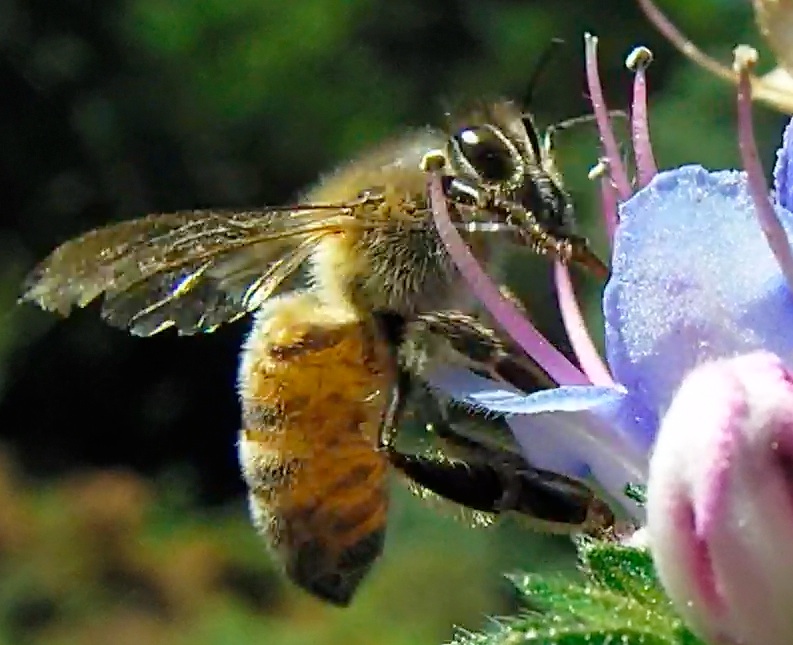
We’ve worked up a flower garden near the bee hives. This honeybee is working an Echium which was given to us by Shigeo who was very helpful with his “Big Dog” chainsaw carving out my Bee-atrice log hive.
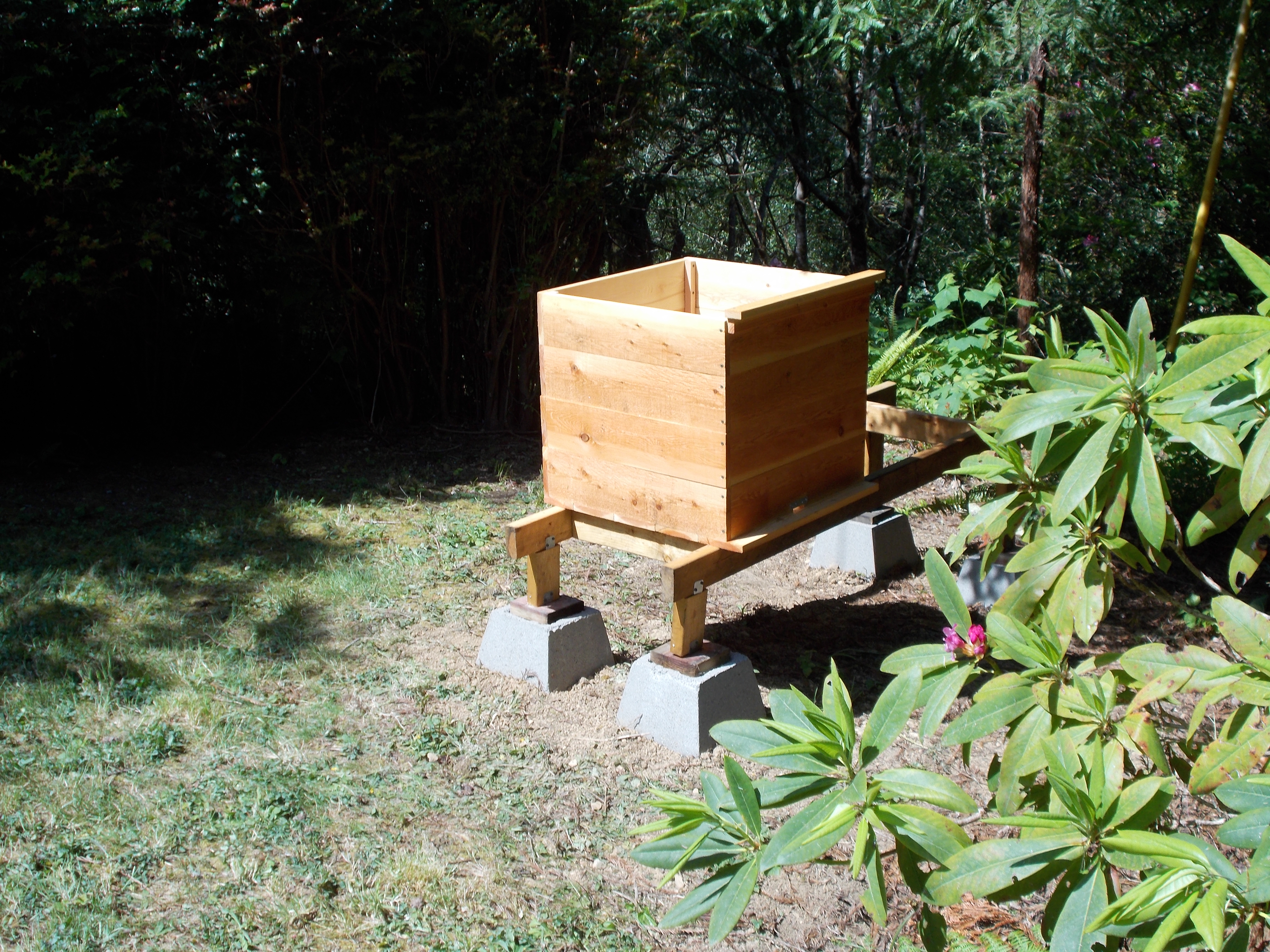
Vernon’s Perone hive, showing the brood box (24 inches in length, width and depth), one super and the roof. Construction was of Douglas Fir with the exterior thin-coated with linseed oil. Materials cost about $140 including the concrete footed mounting frame and a sheet of galvanized metal for the roof.
When my first Warre hive was threatening to swarm, I knew I was in trouble. I didn’t want any more hives but I wanted to give it to someone who would really appreciate a prime swarm. I found out about Vernon through the new bee keeping network of Oregon South Coast Beekeepers Association…he had just built a Perone hive. He wanted a swarm rather than package bees. That was me a year ago. The bees swarmed on Mother’s Day, May 12, 2013. We handed him a bucket of bees a day later, but I didn’t want to leave it at that, I had never seen a Perone hive before and wanted to see how big it was…I wanted to make sure our bees had a good home.
He sent me these photos and his details…
The plans I used to construct my hive are on-line:
The authors are from Chile so the useful dimensions are in metric. Perone insists that the internal dimensions of the brood box be 57 X 57 X 57cm, which is 184.5 liters. Each of his supers is 32.5 liters. Whenever I converted to English units I adjusted the measurements slightly for convenience. My brood box is built of 1 X 6 inch lumber, which of course actually measures 3/4 X 5 1/2 inches.
Stacking 4 boards on edge gave me a brood box 22 inches in height (not including the floor which is 3/4 inch thick). The outside dimensions for length and width were 24 X 24 inches, so the interior dimensions were 22 1/2 X 22 1/2 inches
Scrap lumber sticks placed inside the brood chamber to help support the expected massive comb loads.
The height of my supers is 4 1/2 inches rather than the 4 inches recommended by Perone. I measured my bars in metric (24 cm height and width, which is about 15/16 inches) and cut them on a circular saw from 2 inch cross-section stock.
There were 49 bars: 17 bars for the brood comb spaced 9mm apart, and 16 bars each for the two supers, spaced 10 mm apart.
Perone insists that the brood comb bars be 9mm apart because he feels this helps the bees maintain optimal brood comb temperature to fight infestations. Also, that spacing is preferred by the queen, so an excluder isn’t needed to keep her in the brood box.
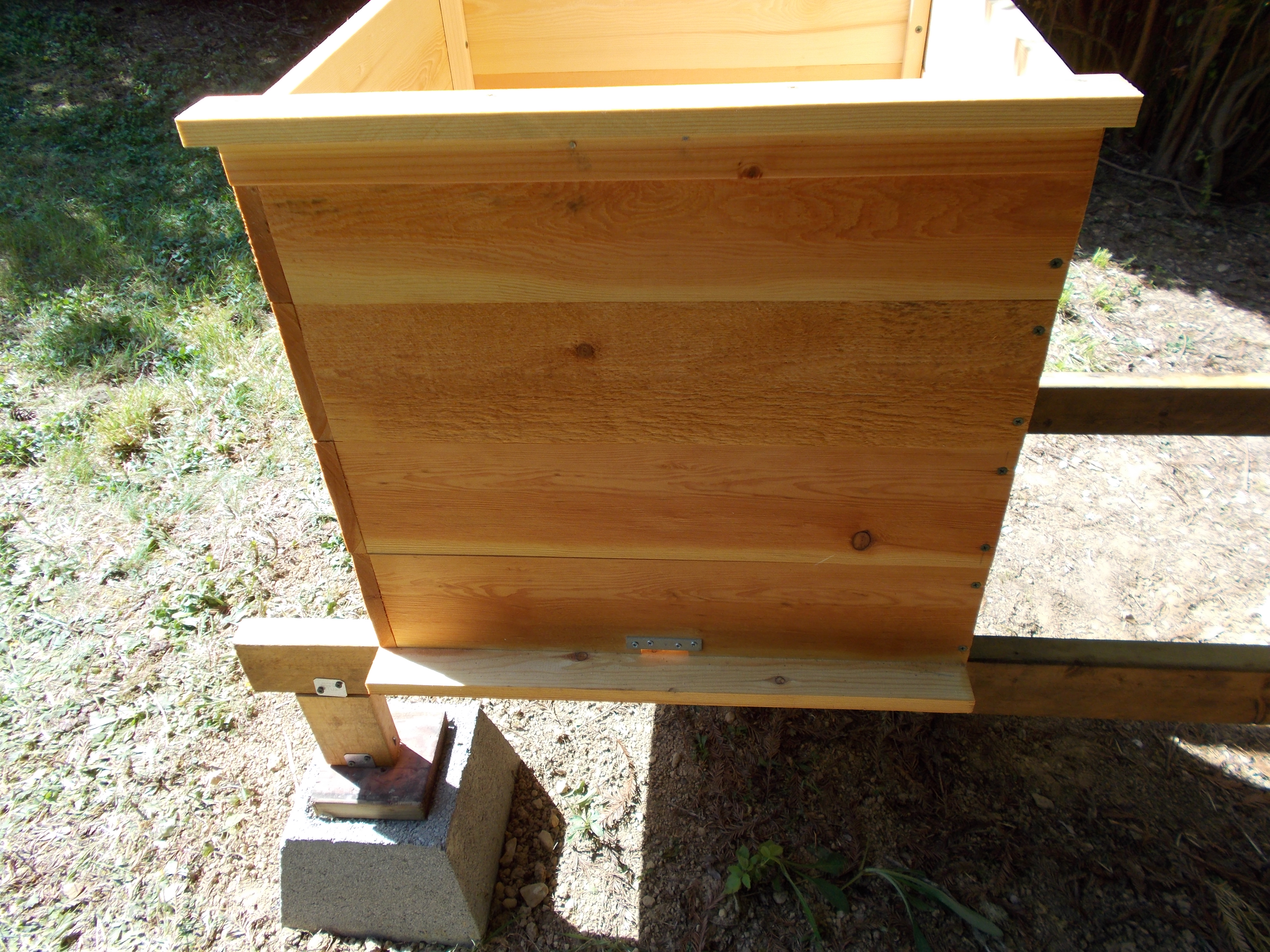
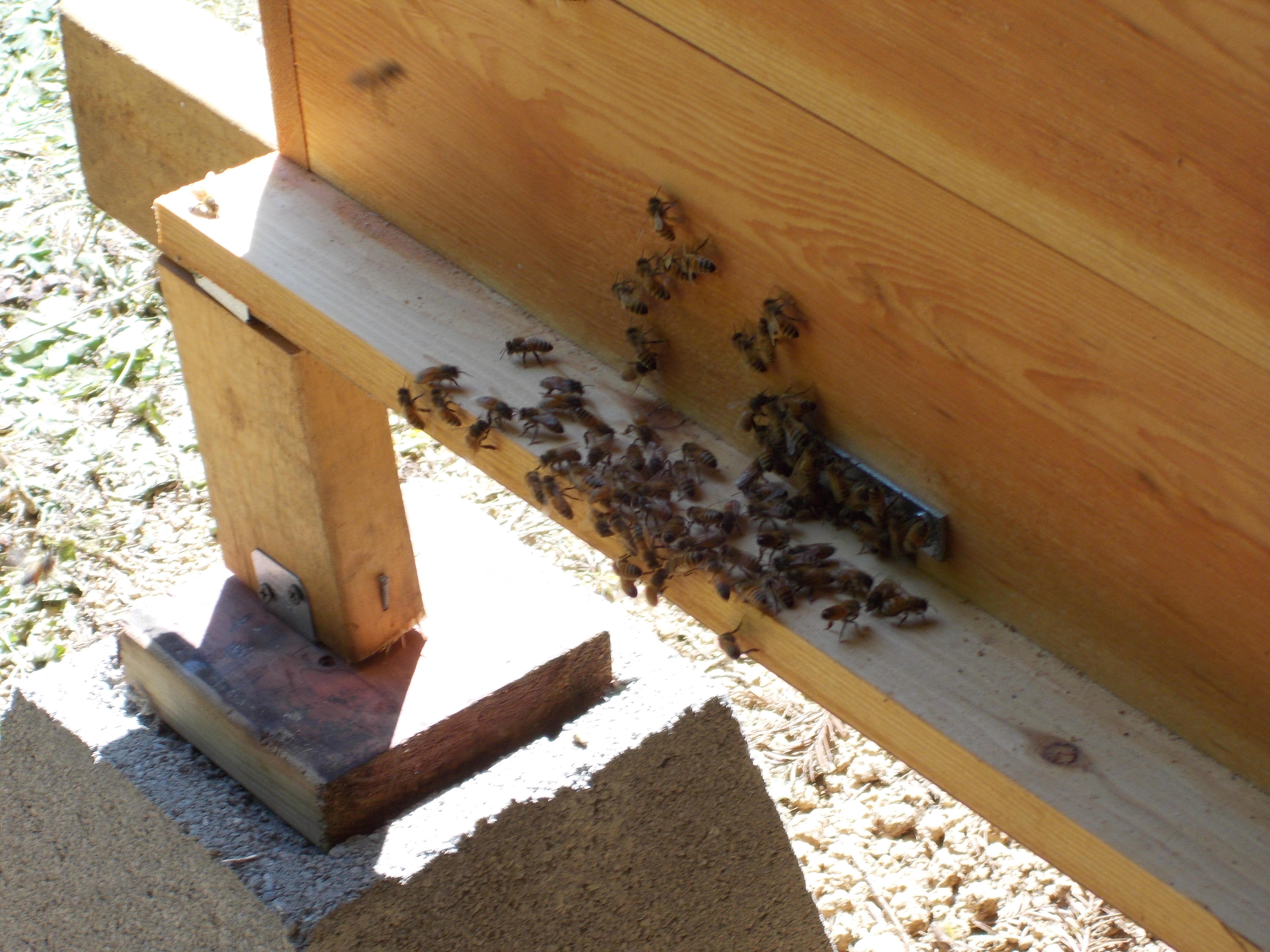
Note the lower entry and 2 inch deep landing strip. The metal strip above the entry is a mouse guard. The upper landing strip is also attached to the brood box.
My gabled roof has a 5 1/2 inch peak and the ridge is 31 1/2 inches long. The roofing is made from 1 x 6 inch boards and is covered by galvanized sheet metal.
Side view of the hive just after the swarm dump. Everyone’s confused!
It wasn’t long before scouts returned and started their waggle-dance.
I asked Vernon if he would consider shooting a video of the bees…
This video was shot on May 23rd about 9 days after installation.
Some updates below…
On Aug 3, 2013, at 10:50 PM, Vernon Strength <eurekawriters@yahoo.com> wrote:
Today I removed the super from my Perone hive and had a chance to look down through the brood box grid bars. The attached photo shows that the bees have been building weird comb: rather small, all in the southeast corner, cross-combed to the extreme, and the comb cells between the bars are oriented “up.” After almost three months the population of the hive seems about the same as the original swarm.
Obviously, my inclusion of a super from the beginning was a dumb idea. The colony isn’t going to come close to filling their brood box by winter, much less a super. My only defense is that I believed the South American beekeepers’ claims of rapid proliferation in the first few months.
Now the roof lid is directly over the brood box bars, almost touching them, so maybe the bees won’t be able to move over the top of the bars so easily to produce vertically-oriented brood cells. That might reduced cross-combing, too. Still, it’s already August and I don’t think there is time before winter for the bees to change their ways and build enough aligned combs towards the center of the grid. They will have a hard time increasing their numbers significantly in their present nest, which may also be hard for them to heat in winter. I can’t think of anything else to do now that I’ve removed the super. Unless you have any suggestions I’ll follow the Perone philosophy and let the bees figure it out.
Vernon
On Aug 26, 2013, at 12:42 AM, Vernon Strength <eurekawriters@yahoo.com> wrote:
The population of the Perone hive colony seems to have increased significantly in the last few days, based on the unprecedented numbers entering and leaving the hive entryway. Maybe they’ve increased their numbers for a last big food gathering push before winter. It’s still a mystery what they are foraging on; they still fly straight up and over some big trees and disappear when they leave the hive, and they return from the same direction. Lots of bumblebees have foraged around my house, but zero honeybees.
Last time I gave you an update I was concerned that there was so much cross-combing, and the comb was smaller than I’d expected. It appears that the oddball comb has produced lots of brood though, the comb is ugly but functional, so I’m going to follow the Perone approach and leave the bees to gather their own supplies. If this colony doesn’t make it through the winter I’m going to feel like a murderer.
I’ve started building another Perone hive using lessons learned from this first one. The main difference is a 11in X 16.5in observation window. I’m going to mount the new hive on the same platform with the first one, but probably the entry will face in the opposite direction so the bees won’t get confused about which entry to use.
Ciao,
Vernon
November 26, 2013…I took my new & improved Perone hive to the beekeeper’s meeting in Gold Beach last Thursday and got a lot of interest. In fact, Del is thinking of using something similar while he’s in the Peace Corps. The new version has two large picture windows so I won’t be completely in the dark about activities inside the hive the way I am now. The day-before-yesterday I checked the first hive when the weather was damp and in the low-to-mid 50’s and there were no signs of life. I put my ear to the side wall but could hear nothing, so I lightly rapped it with my knuckles and three bees came out to see what was going on. I concluded that the hive was simply hunkered down inside due to foul weather. Really, I’m not sure what the temperature was outside, though I have two thermometers that weren’t cheap. It’s nearly impossible to find a mercury thermometer anymore: The alcohol substitutes are safe but inaccurate. When I compare thermometers at a store they always show different readings (i.e., two different thermometers of the same make & model may have readings over 5 degrees apart). The Italian bees we are keeping are apparently notorious for taking the day off when it’s coolish outside. My friend Steve Sottong of Eureka recovered a swarm he claims was about 3X the volume of mine. His bees are little and black, probably the species native to Great Britain, and they forage when it’s in the high 40’s.
Del suggested again that I feed my bees. His idea had some appeal: Hang a Christmas candy cane from a top bar using a string or thin flexible wire. Of course, once I do that I no longer have a “pure” Perone experiment going, so I’m torn. Maybe the foragers are still finding nectar. Lots of ivy grows around my neighborhood, and some weed flowers still persist.
November 28, 2013…Well, my (inaccurate) thermometer reads 61 damp degrees and my foragers are out in moderate numbers, moving verrrry slowwwly. The bees appear healthy so I’m attributing their lethargy to the cool moist weather and perhaps advanced age. I can tell the bees I’m seeing are all experienced veterans because they approach the small entryway so accurately. The inexperienced foragers I observed in mid-summer came in crazy-fast and usually crash-landed on the runway, sometimes banging their heads against the hive walls or landing on other bees. Anyway, nothing worrisome to report regarding the colony.
Vernon
January 24, 2014…The Perone bees are busy foraging this morning, taking advantage of the unseasonable 64 degree F. (17.7 C) temperature. I’ve still never fed them. Hopefully they are finding nectar someplace (the myrtle trues seem to have buds).
Vernon
Solarbeez says…Hi Vernon, I’m so glad you decided not to feed. I’ve been reading Michael Bush’s book, “The Practical Beekeeper.” He talks about the pH of the hive. When you feed sugar, it raises the pH of the hive which makes it more susceptible to nosema.
The only hive I’m feeding is the Warre, but I’m going to discontinue that. I never took any honey, but I CAVED IN to the temptation to feed them dry sugar. The other two hives are not getting fed and they seem to be fine.
Here’s another Michael Bush quote you won’t see anywhere else… On Page 435…
“Pathogens?
Even some seemingly pathogenic organisms such as Aspergillus fumigatus which causes stonebrood, supplants worse pathogens, in this case Nosema. Or Ascosphaera apis which causes Chalkbrood but prevents European Foulbrood.”
Thanks for the update.
Pat
January 26, 2014…The Perone bees are collecting from a different pollen source today, a golden yellow variety.
January 26, 2014…The only flowers I see in my yard are on these myrtle trees, which locals also call pepperwoods or bays. Of course, my bees never forage around my yard so I don’t know their actual pollen source.
February 10, 2014…Vernon says, “After a few days of rain the foragers are again out in force, and they are collecting more golden-yellow pollen than ever. This winter has been so warm and dry I’m not sure the Perone hive is getting an adequate test.”
Vernon’s entries:
February 19, 2014…Drove to Crescent City this afternoon and Queen Anne’s Lace weeds were blooming all along the road.
February 22, 2014…The foragers are out today in about the same numbers I saw during the summer. It’s likely the colony considers that Spring has arrived. A few dead or dying workers were on the ground below the entrance, probably over-winter bees that have been replaced by the next generation. I believe the queen started laying during the mid-January warm spell. About 20% of the foragers are bringing back golden-yellow pollen, which Carla believes comes from Myrtle trees. Odd that our west coast winter has been so mild while the east coast has been frigid and stormy.
March 27, 2014…
I’m hoping to finish my second Perone hive this weekend. Will send photos when I do. I also want to write a summary of my conclusions after taking a Perone hive through the winter without feeding or treating or helping them in any way. My friend Steve in Eureka lost 5 of his 6 Langs, including the one that housed the huge swarm I wrote you about (small, cold-adapted black bees from northern Europe). He’s looking into setting up a horizontal hive.
Of course I’m in need of a swarm. Please let me know if you hear of one available.
Vernon
March 27, 2014…Pat’s reply
My congratulations on getting through the winter without feeding or treating. I welcome your conclusions on that. I understand your second hive will have an observation window. You’re going to love it.
My log hive has bees that are fanning. I think they might be getting crowded. Last year the first swarm was on a hot 80˙F day on March 31. If the weather settles down, that could happen again this year. The first swarm has been promised away for a swarm swap. I’m debating whether to keep it (if that person’s hive isn’t ready) or give it away to try to get different genetics. I’m hoping my other log hive will attract a swarm without me interfering.
If Vernon sends photos, I will post them here.
April 26, 2014 Lessons Learned
Last May I introduced a swarm of moderate size into a Perone mk2 hive. The colony survived the winter and appears to be thriving. Since the hive has no observation windows I infer colony condition by watching the numbers and behaviors of individuals who venture out.
The hive is located in mixed woodlands on the northern California coast, USDA plant hardiness zone 9b. Winter was warmer than usual this year, with only one hard freeze. While it may be argued that survival through a mild winter isn’t an adequate test of the Perone design and philosophy, it remains that beekeepers in my area with carefully-tended Langstroth hives reported roughly the same high losses this year as previously.
Hopefully the success of my hive will encourage others to try Perone hives. I strictly followed the Perone approach of benign neglect.
I never fed my bees. They were industrious foragers and didn’t appear to need any sugar water. At times it was difficult to resist feeding, because experienced beekeepers I respect advised me in the strongest terms to either feed my bees or watch them die. They cited seasonal stoppages of nectar flows (while flowers were in bloom) and pollen production (when pollen.com warned allergy sufferers in my area of high pollen counts). Swarms were represented as particularly vulnerable to starvation. My bees proved the experts wrong. Apparently feeding is so strongly entrenched in our beekeeping culture that it will persist superstitiosly no matter what.
Hive inspections. I never opened my hive to check the condition of the comb. Typically beekeepers open their hives at least monthly to check for diseases, monitor comb development, and discourage swarming.
Disease treatment: I never observed disease syptoms in my Perone bees. Of course they were given the “preventative medicine” of a Perone hive. The design of the Perone hive discourages disease through a more natural, healthful, undisturbed environment, and the relatively large populations of Perone colonies encourage thorough hygiene and robust reactions to parasite infestation. However, I do kill every yellowjacket I see.
Monitoring comb development: The only apparent benefit of monitoring comb is that it’s fascinating for the beekeeper. The removeable frames or top bars of more traditional hives encourage maniputation of comb positions. For example, one of my colleagues found that some of his Langstroth hives were “honey bound.” These hives had a few brood frames located between frames of mostly honey, which he said inhibited the development of more brood. In response he moved the honey frames to outside positions to encourage more brood nearer the center. My colleagues often switch frames between hives. For example, if a hive is producing more brood and less honey than what is considered optimal a honey frame is brought in from another hive and exchanged for an “excess” brood frame.
Drone cells and queen cells are often destroyed, as they consider worthless. Most destroy the “swarm cells” of developing queens to avoid population reduction in their hives due to swarming. Many “re-queen” (killed the queen and introduced a new one) when brood development doesn’t meet their expectations.
These are the same beekeepers who report 30-40% losses or worse over the winter and attribute the survival of my colony to luck. I never inspected the comb in my Perone hive—for all I know it may be “honey bound” and full of drone and swarm cells—but it seems to be working.
The value of swarms: The swarm introduced into my Perone hive appeared very organized from the beginning. Foragers quickly set out in all directions, returned in an excited state, and congregated for waggle-dancing on the landing platform in front of the hive entry. After the first day the foragers I observed always left my yard and returned from the same direction. From this I infer that the foragers quickly found an optimal feeding area and returned to it regularly thereafter.
Last week I introduced a 3 pound package of purchased bees into a second Perone hive. So far these bees appear disorganized compared to the swarm. It took several hours for the package bees introduced inside the hive to discover and regularly use the single entryway, compared to about 20 minutes for the swarm. And I never saw the package bees waggle dance. Now, after a week, the foragers continue to meander around, each in her own direction, without urgency.
My theory is that a swarm is more specialized to establish a new colony than most beekeepers appreciate. The swarm population seems to be made up of an appropriate number of workers specialized to perform each of the needed functions. It’s known that individuals carry enough supplies in their bodies to begin the processes. By contrast, package bees are shaken off frames pulled from established hives without regard for the functions the workers are currently performing. Then they are packaged with an unfamiliar queen and shipped off with some syrup to eat. What an awful start for a colony! In this first week I’ve observed a disturbing number of dead bees from the package bee colony.
Other hive maintenance. My hive is mounted on concrete foundation blocks that settled over the winter. The hive is no longer level. After some consideration I decided not to level the hive. There are no rigid frames in a Perone hive, so the bees are free to angle their comb building to adjust for settling. Returning the hive back to level would require the bees to readjust.
I just love standing on this bridge and seeing all the work Hal and Patti have done. It’s so beautiful.
Hal called me up last week to say he took some video of a bee swarm flying INTO his unoccupied bee log. I’m thinking “Well, that’s a first. Whenever I see a swarm, they are flying OUT of something…like a hive.” I had to see this. While I was there I shot some photos of all the work they have done. I draw inspiration every time I visit. It was here that I learned about sedum and what a wonderful bee loving flower that is. There is so much color here, so many flowers. It surely takes hard work and dedication to keep everything looking so good.
When I first saw all the bees sipping nectar on these sedum, I knew I wanted a bunch. It’s clear it’s nectar they are after…I didn’t see a speck of pollen in their pollen baskets. This photo was shot at Patti’s garden in September 2012
It didn’t take long for the bees to set up home. They swarmed INTO this log, April 18.
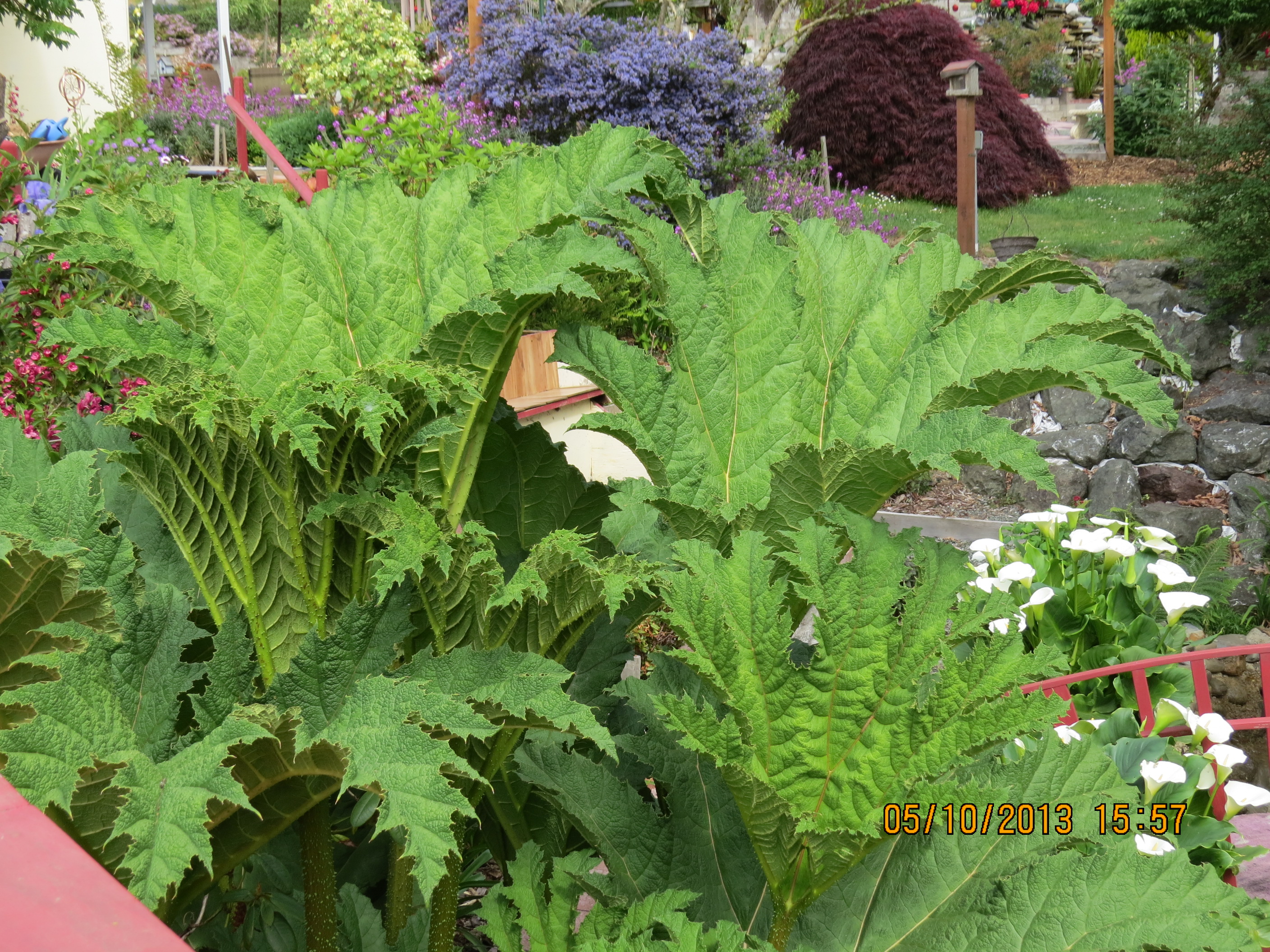
Patti’s gunnera is growing under the bridge
Hal and Patti on bridge, May 10, 2013
This video shows the swarm of bees moving INTO the vacated log hive. Hal explains what is going on as he shoots the video on his iPhone.
All this is natural comb, built in less than two months from when the bees swarmed INTO the log hive.
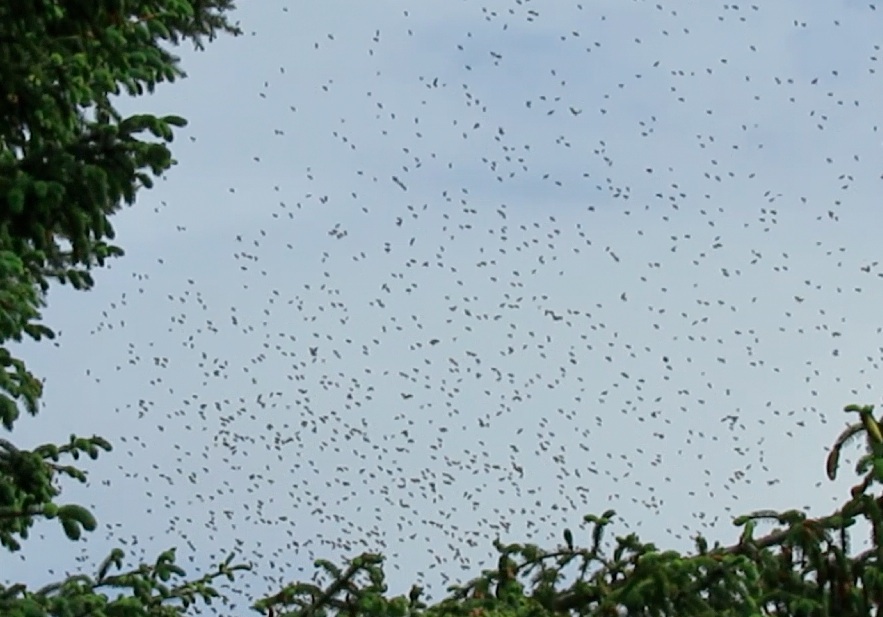
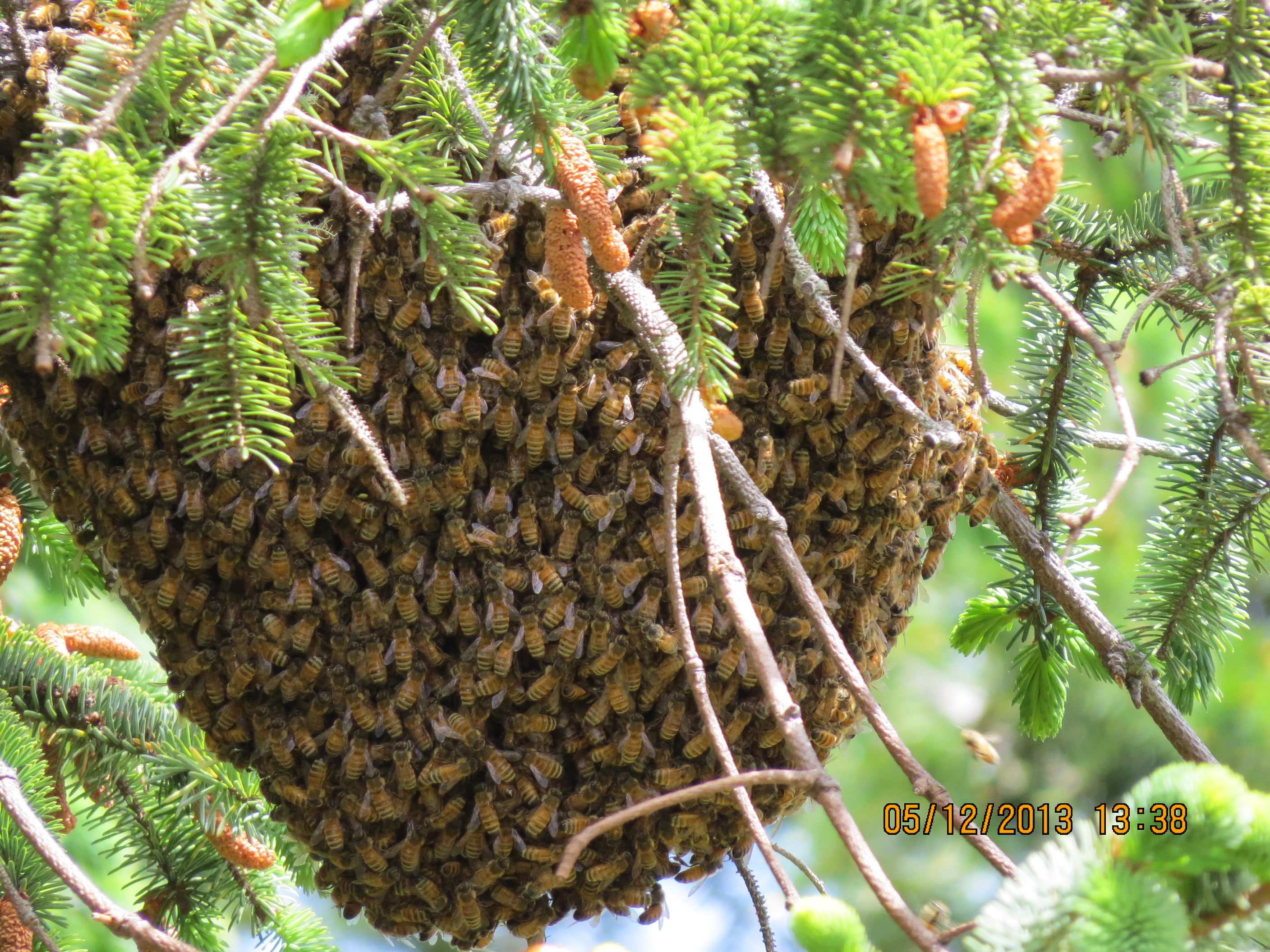
My daughter, son-in-law and new granddaughter were visiting us on Mother’s Day. It was about noon, we were eating lunch…my wife spots this horde of bees. “It’s a swarm!” We all rush out to see it. I think it probably came from the Warre hive that’s been threatening to swarm for over two weeks. Son-in-law says, “What can I do to help you capture it?” My wife says, “Oh, thank you, Jim, I didn’t want to have to do it.”
We let the bees coalesce on a branch.
They settled down into a nicely shaped swarm about 12 feet (4 m) up.
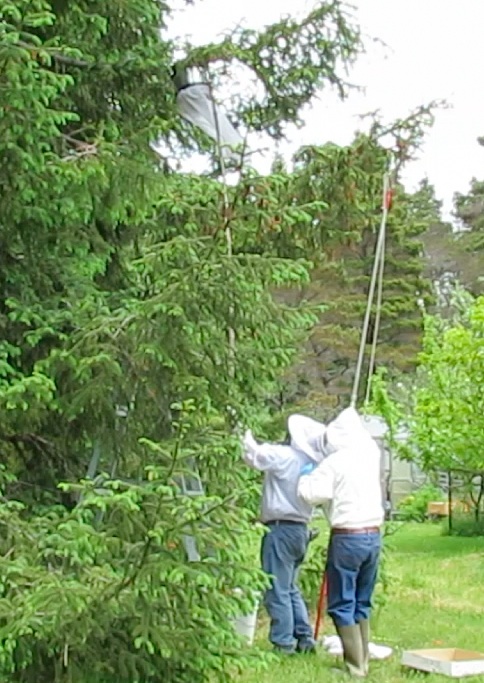
This calls for the Steinkrauss-Morse swarm retriever
A Bucket of Bees
“The queen is over here…” Bee stick their abdomen up in the air to fan the pheromone letting stragglers know where the queen is.
It was a win, win, win. My son-in-law, Jim Montgomery provided much needed assistance in corralling the swarm, my daughter was able to capture the whole event with the camera, and my wife was able to spend more time with our granddaughter.
Where did the bucket of bees go? Well, I would have liked to put it into Bee-atrice log hive because it’s a ‘prime’ swarm, but Bee-atrice was already occupied. I found someone who didn’t want package bees. He has built a Perone style hive. It’s a BIG hive. I like his attitude…”The Perone hive is built for the bees, not the bee keeper. It’ll hold about 150,000 bees. I’ll let them build their own comb.” We arrange for the ‘hand-over,’ and meet at a very scenic state park along the Oregon Coast.
Vernon built his own Perone hive. He brought the framework holding 17 top bars where the bees will build their natural comb. He held it up so we could see how big the hive will be. In the background you can see why I wanted to live on The Oregon Coast.
Bee-atrice is looking good. Okay, the yard sign on her head isn’t too flattering, but it was all I could come up with in a hurry. We will fix that later.
When Bee-atrice became aware of her beauty she developed a real attitude. Her long golden hair, the color of the setting sun, a beauty mark on her face, and the fact that she was carved out of a hard wood by a professional wood carver made her vain. In conversations, the iPod would always be pulled out to show how she was carved. She would tell people. “I’m special. I was carved out of myrtlewood which only grows on the Oregon Coast and in the Holy Land.” We told her the brochures weren’t exactly true, myrtlewood also grew along the California Coast, and the kind in the Holy Land was a different variety. She would counter with the fact that “Myrtlewood” is the only wood still in use as a base “metal” for legal tender, “besides my mouth was carved ‘open’ so I can sing.” I think she fashioned herself as some kind of diva or something.
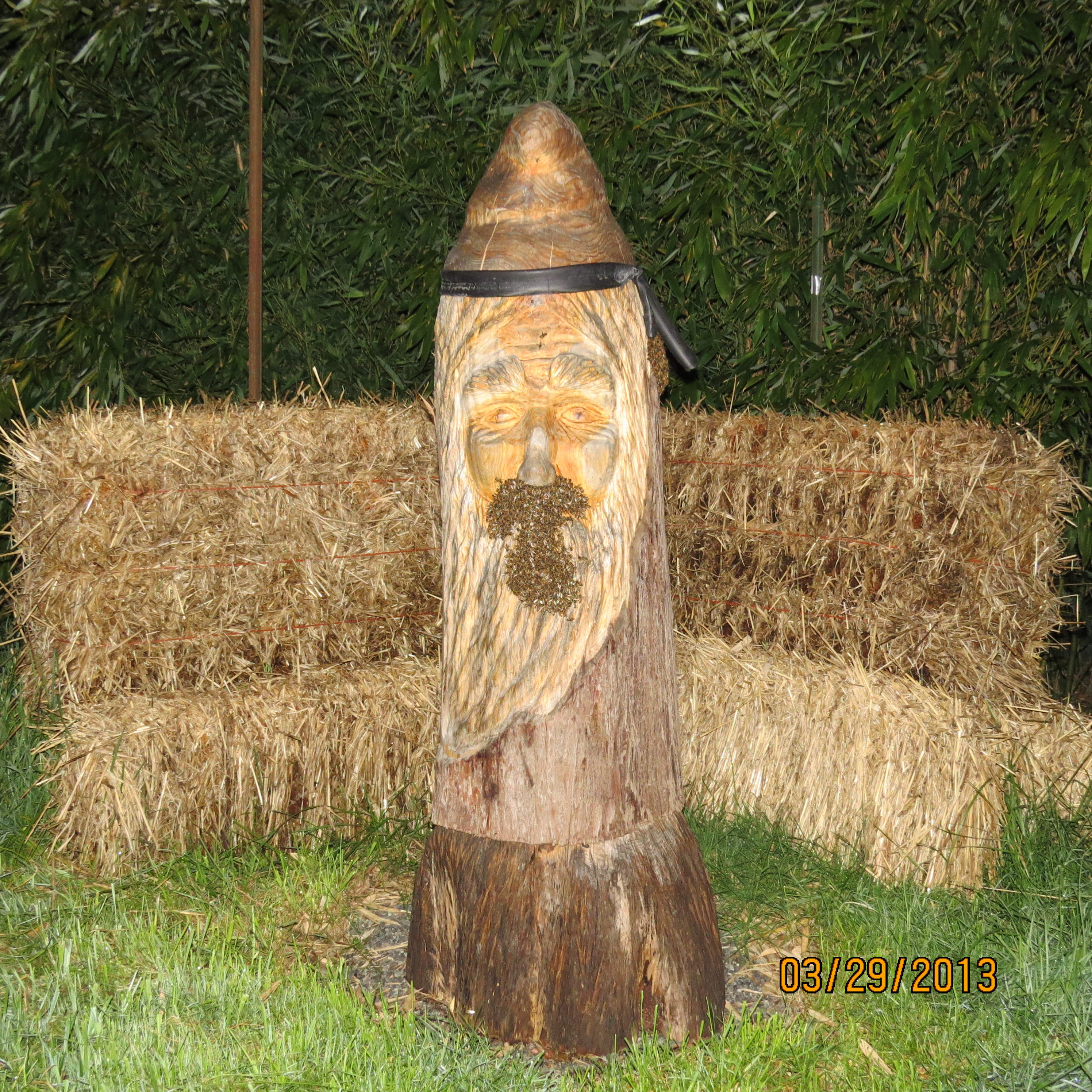
We decided to place her near Bee Beard. We just figured they’d hit it off because they had so much in common. One look at Bee Beard and she realized her open mouth was carved to let bees pass in and out. She was shocked and humiliated…stomped off in a huff. I couldn’t figure it out. Bee Beard has never complained about anything, not even once. He’s been through a whole year of wind, rain, and bees. It’s true we’ve never smoked him or bothered him much, I just figured Bee-atrice would be the same. Not so…“I don’t want to be next to him and I don’t like bamboo.It attracts wasps. “ We ended up promising her a one of a kind Easter hat and face her into the sun so it could shine on her beautiful golden hair. She gave in to the flattery, but there was no way she would agree to be near Bee Beard or even to look at him.
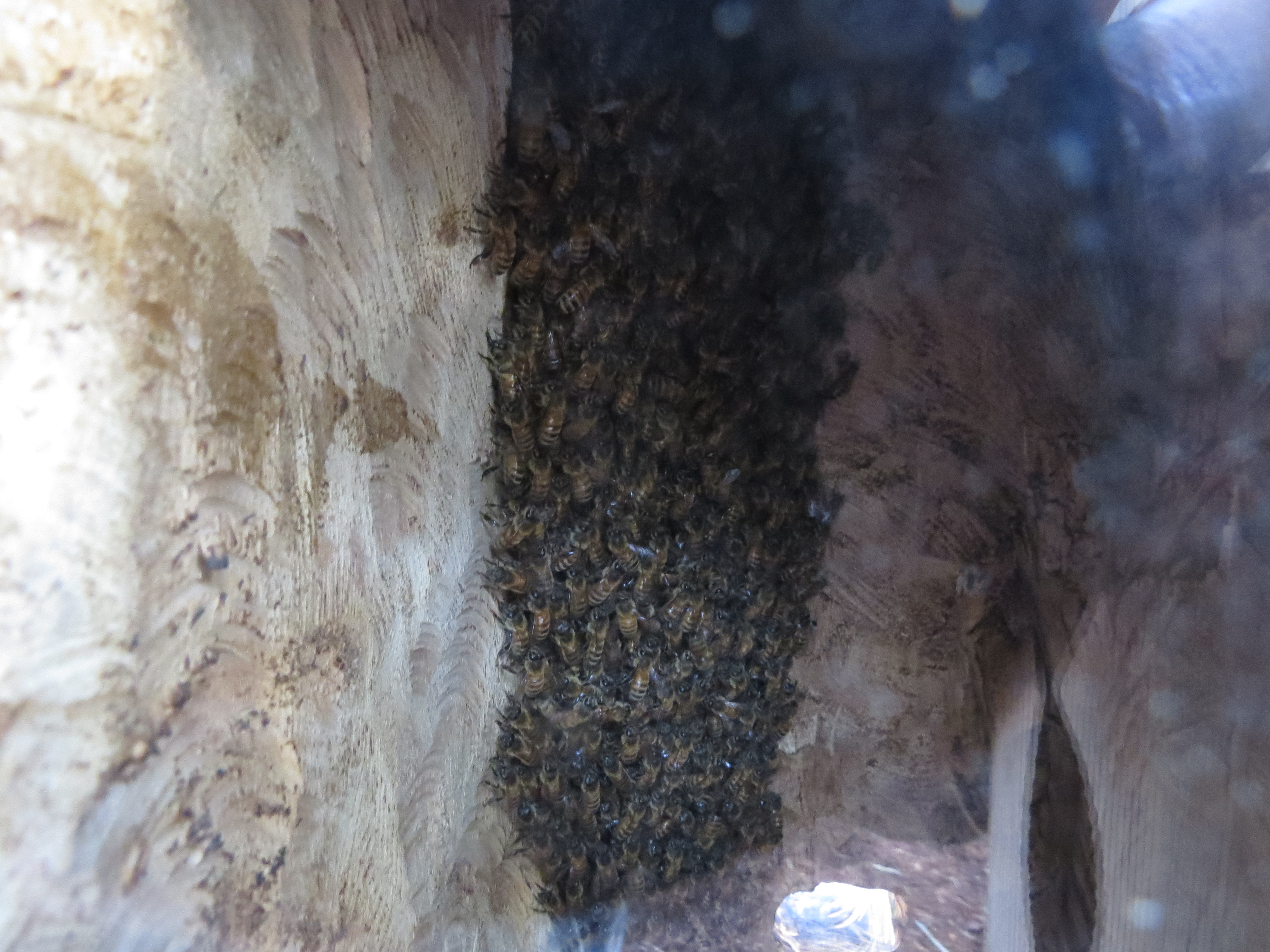
The bees first couple of nights were spent here in the corner of log.
I’ve always wanted to note the temperature of the hive.
I’m surprised the temp is only 83 F (28 C) I wish I could see inside better, but I’ll have to wait until the combs are visible in the observation window.
A short video show bees already bringing in pollen on Day 6
I thought I had some time to finish my second log hive before another swarm would take place. Not so. On April 18 two more swarms came out. These are cast swarms…more than likely the queen has not been mated yet. What to do? I had already used my back-up Warre and there were some work responsibilities staring me in the face…deadlines that couldn’t be put off any longer because “people are depending on you, Pat!” Okay, I’ll get the deadlines done first and get the bees figured out in the morning…it rained all night. My wife suggested I adapt a bait box. Last year after reading McCartney Taylor’s book on swarm bait hives, I had built nine swarm bait boxes and placed them in different spots hoping to attract a swarm. I was successful in two of them. One I gave away and lucky number 7 went into my new log hive.
After some initial resistance, I realized she had a good idea. The box is already built. I just need to add some Warre length top bars…it’s also a good size of 40 liters as recommended by Tom Seeley in his book “Honeybee Democracy.”
First job is to wax up some top bars…
Painted melted wax on top bars
Three waxed top bars installed into former swarm bait box after scorching the inside.
The above picture shows only three top bars. I added a total of 12 because I wasn’t sure when I’d get another Warre and at the time I wanted to be able to add these bees to my next log hive if I ever get it done. I also tapped some panel nails in to keep the bars from sliding when I tilt hive with bees into the tree. The bars have a slot for the nails, so they will lift out easily.
I like the idea of a ‘quilt box,’ so I cut another bait hive down to make one.
Hardware cloth on the bottom keeps the burlap ‘quilt’ from getting glued to the bars. That way the sawdust won’t spill into the brood box.
I drilled several holes into the quilt box covering them with screen. That way the hive can breathe and keep the hive scent. I used myrtlewood sawdust for two reasons…feral bees live in myrtlewood trees and I had a lot of it left over from hollowing out my next log hive. Actually some of my bees came from a feral hive in a myrtlewood tree last year.
I’m beginning to think bamboo is the ideal swarm catcher…this is the fourth swarm to land in it.
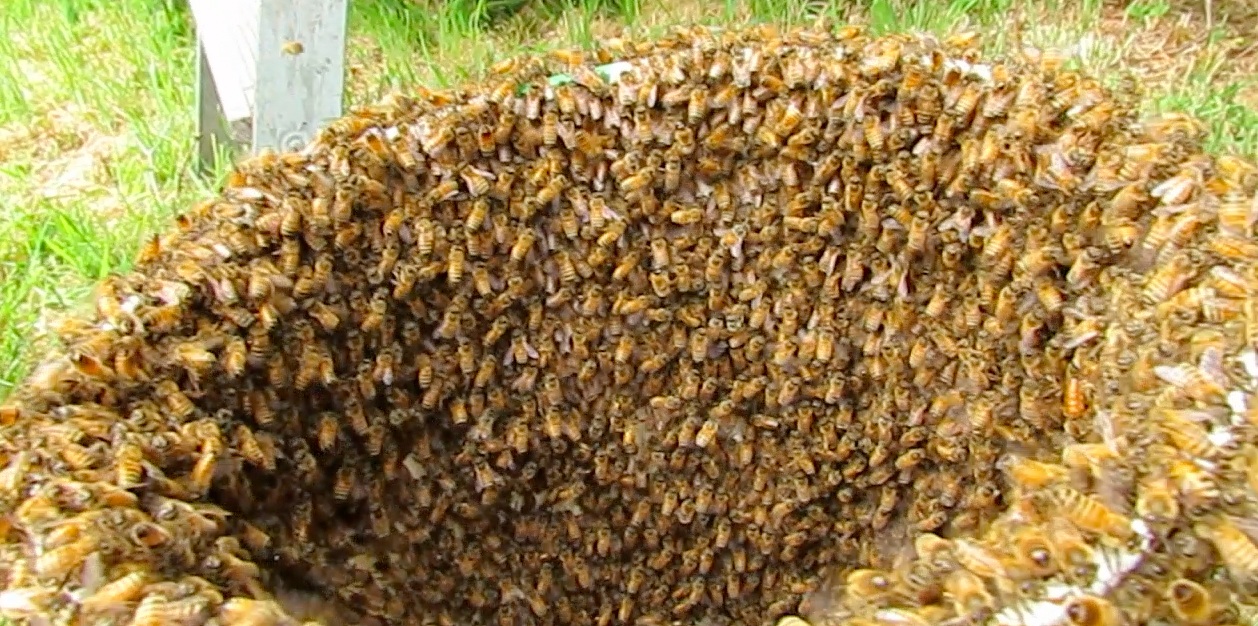
After bending branches and snipping them, we managed to get the majority of bees into the box.
This is what we were waiting for…Bee Beard’s Prime Swarm, but it was waaay out of reach
When we started keeping bees we read that a healthy hive will swarm, at least once every year. Our goal was to get through the winter without feeding, medicating, or miticiding. The swarm would be our sign of success. On a warm day March 30th, that’s what happened. We heard the loud buzzing, came out to witness the bees heading up to the top of a nearby spruce tree. I even tried ‘tanging,’ banging a spoon on a pan to create noise so they wouldn’t go far and would form near the ground. I was wildly unsuccessful. This would have been the swarm to get, but it was clearly out of reach.
Swarm #2, April 17 is within reach
Swarm number 2 is withing reach, but the 2nd log hive isn’t ready for it yet…I’ll have to stick it into the ‘back-up Warre.”
Let’s try out this bamboo swarm catcher so I won’t have to use a ladder
Well I ended up using a ladder to cut the bamboo and let the swarm drop into the white sail cloth basket.
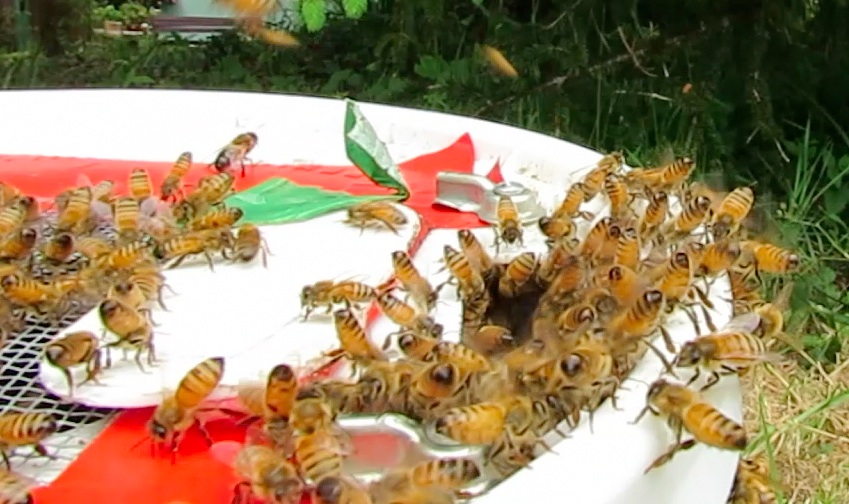
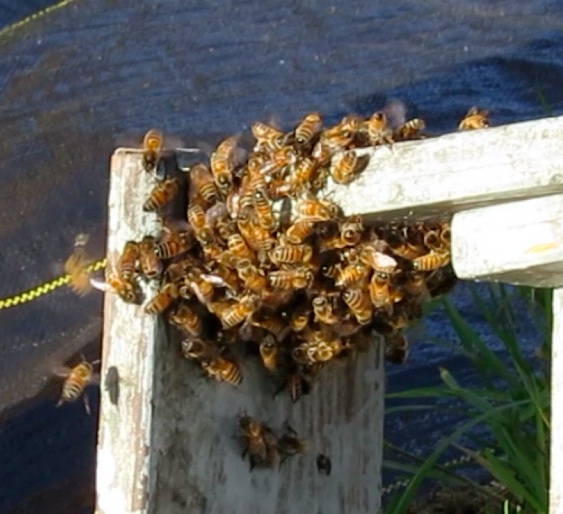
My wife noticed some bees on the ladder…we brought it near the hive for them to crawl in, but looking closer, we noticed they were fanning. The queen must be here. We gathered them up and placed them into the hive.
After the bees were dropped in, we added the top bars with comb attached…hoping they would stay attached once I hung them in the hive.
Top bars with old comb melted on. Quilt box in background
I had already built the sugar frame shown below.
1/2 inch hardware cloth will hold up sugar if using newsprint.
Premixed sugar laying on a couple sheets of blank newsprint for the Warre hive #2
We slid the sugar frame into place.
Sliding the sugar frame into place
Next comes the quilt box.
Top it off with the roof. Matt Reed of beethinking.com, you made a nice hive kit.
Bees flying orientation flights.
April 23…through the observation window we can watch the bees working. No new natural comb can be seen yet, but it won’t be long.
Last year I discovered a new bee-loving flower. My wife and I were visiting with Hal and Patti when I spotted a bunch of bee activity on some reddish blossoms. Patti said it was Sedum. I had heard of it, but I’ve never paid much attention to it. Now that I’m keeping bees, I’m all ears when it comes to flowers that attract bees.
So we bought some from our friendly nursery…bees started working it as my wife was carrying the potted plants out to the garden.
The plants will winter over, but protect them from the deer which will eat surely eat the blossoms as we found out.
This sedum has wintered over and is on it’s way to flowering in September. This time I’ve got it inside a deer fence.
I shot some video of the bees working the sedum. It’s a good time to plant some now hint, hint…:-)
On a hot day in late March, the bees step out for some fresh air and dancing.
It’s unusably warm on the Oregon Coast today.
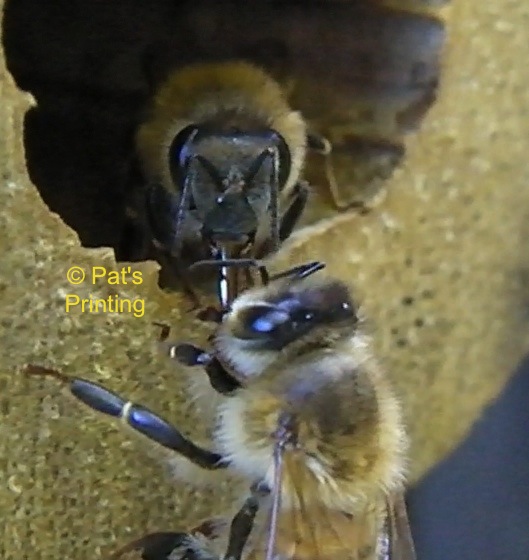
The lower bee has been fanning for awhile. While I was photographing, this other bee came out and fed her? I don’t know if that’s what it is, but from here, that’s what it looked like.
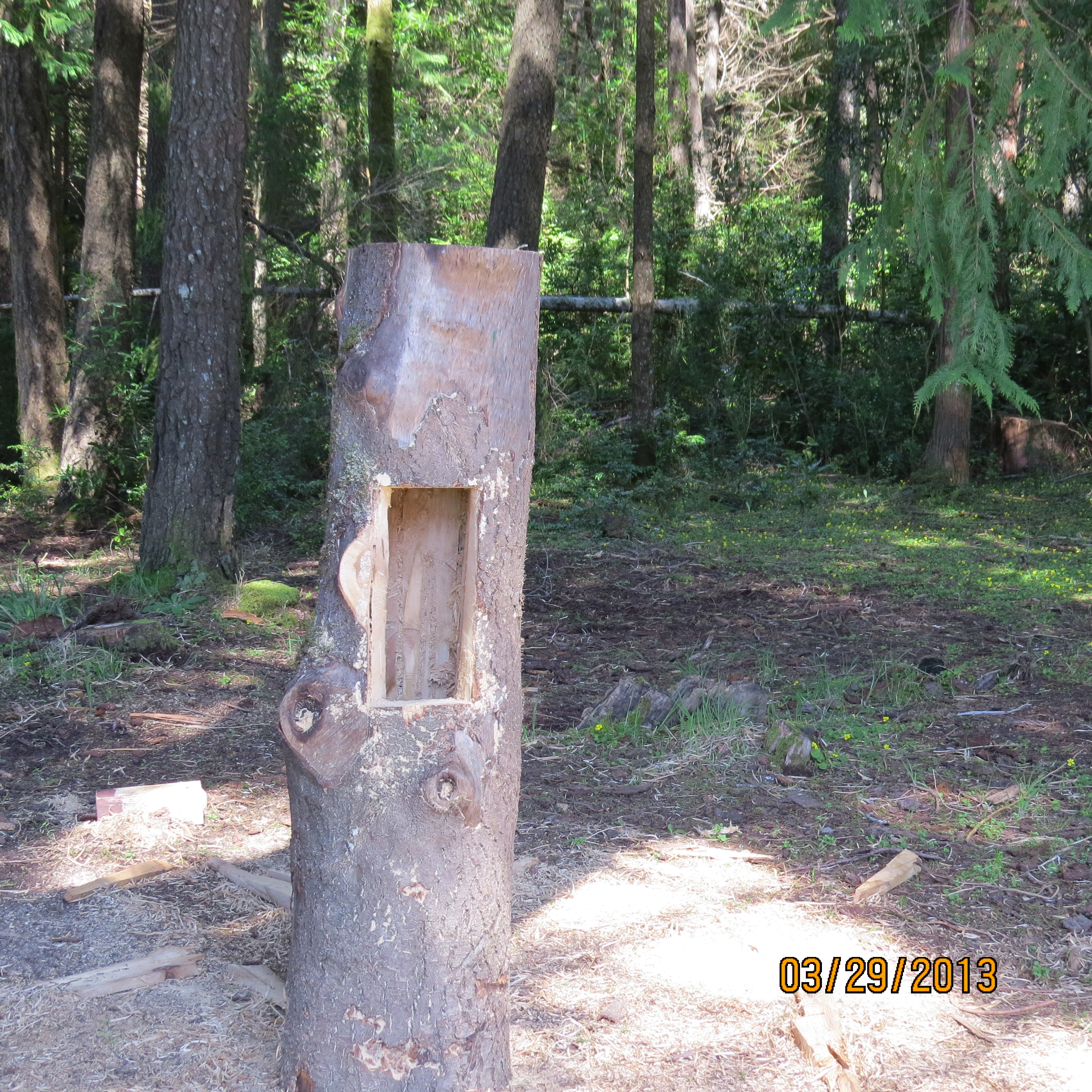
Pat’s next log hive progresses…much work still to be done before ready for bees.
Some bees are still outside the hive, at 10 pm. and 49 deg. F (9.4C)





















 Adventures in Natural Beekeeping