The new Echium Bee Bed is filling in well. From the colorful lobelia in front to the tallest Tower of Jewels echium plant, they all attract bees.
July 3…The Hugelkulture bed is looking so much better since we weeded, planted, and mulched with compost and wood chips.
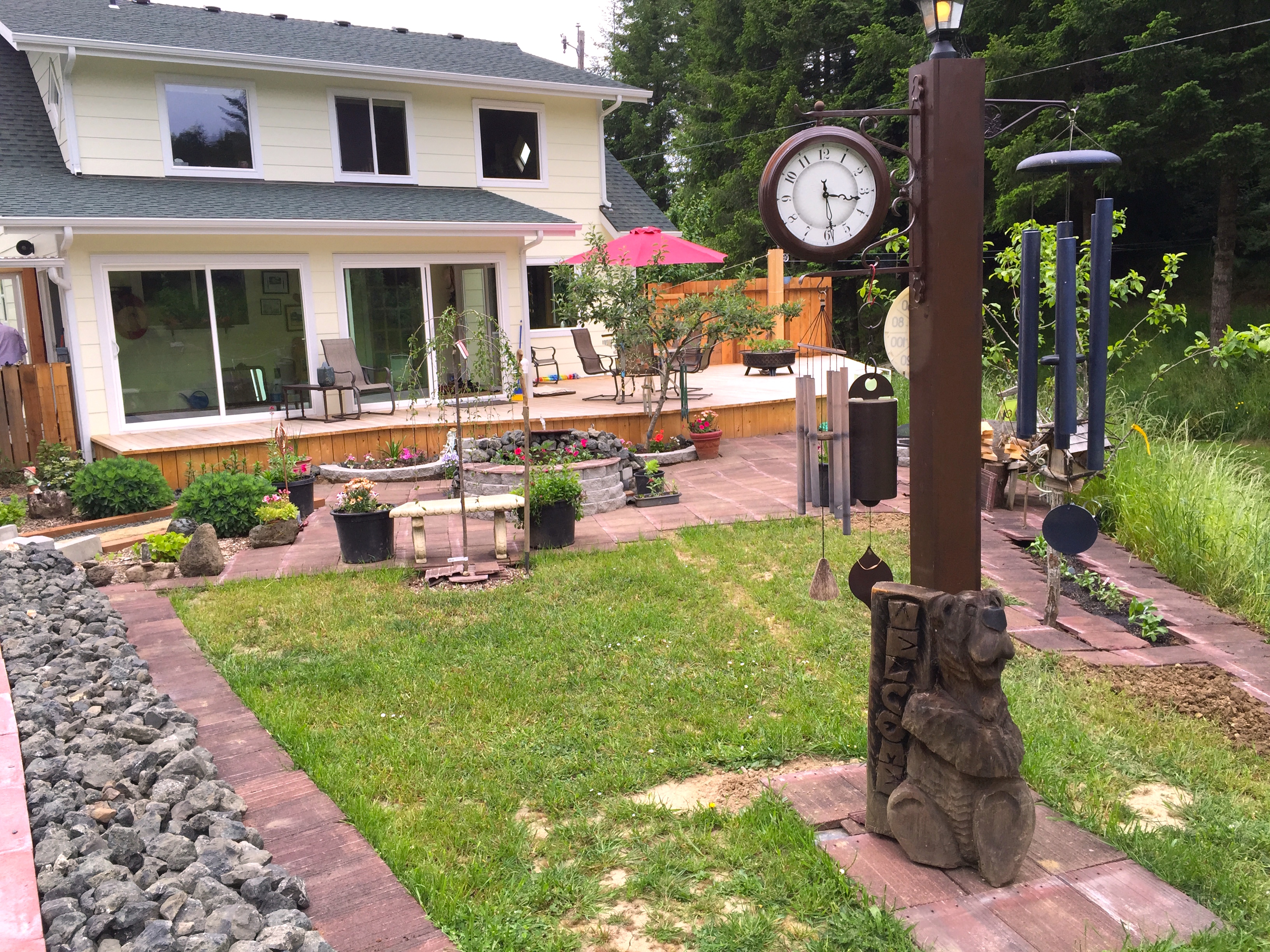
A view from our garden bench in July reveals the garden in full glory.
July 3…The dwarf sunflowers are open and attracting bees already. It’s older siblings can only watch with envy.
This deer seems to be asking me the question…”What are you doing out here at this time in the evening, this is MY time?” In the video you’ll see why she looked up…she picked up the sound of the camera’s zoom lens. Their hearing is phenomenal, but luckily their eyesight isn’t that good. I’m standing in the sunlight just a short distance away, but she can’t see me very well.
Arrrgh! Deer damage!
I’m not sure if there’s any reason to net what’s left of these potatoes. They have been stripped of their leaves by the ‘cute’ deer. 😦
I mulched this corn in the morning…by the afternoon, the deer had already sampled it. A temporary fence is now in place to protect it…I hope it recovers.
This tomato’s only crime was to be planted at the end of the bed where the deer could reach it easily.
Planted from seed last year, these Hollyhocks have survived the deer twice. We’re so happy to finally see the blooms, but we’ve yet to see any bees on them.
Another look at the swarm after removing some branches.
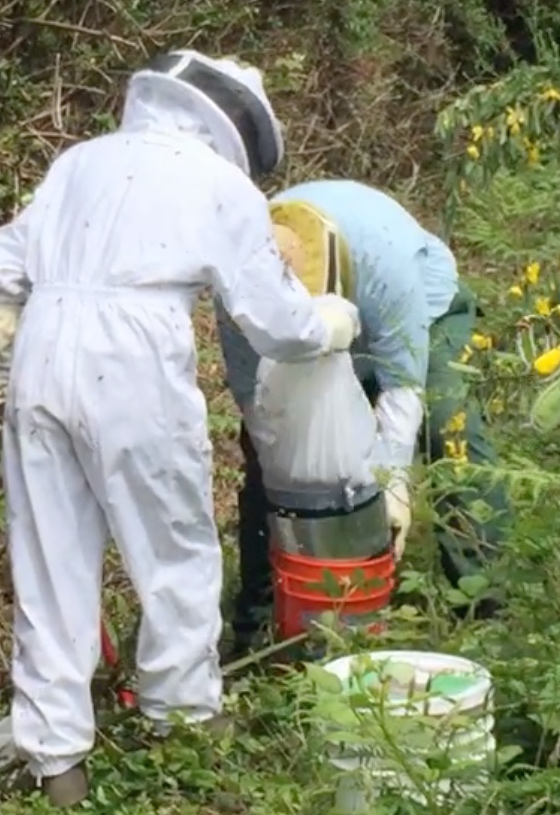
Using a stick of bamboo, I positioned the Steinkraus-Morse Swarm Catcher as close as I could. Steve slowly lifted the branch and yanked it down hard. Most of the bees fell into the sack, some missed and landed on the white sheet below.
That sack was heavy, heavier than any other swarm I’ve ever caught. I had to be careful not to crush any bees when I flipped it over into the bucket.
First bucket is full.
After another catch in the sack, this second bucket was full. The rest of the bees were clinging to the branch, so I tried out my homemade bee vac for the first time…
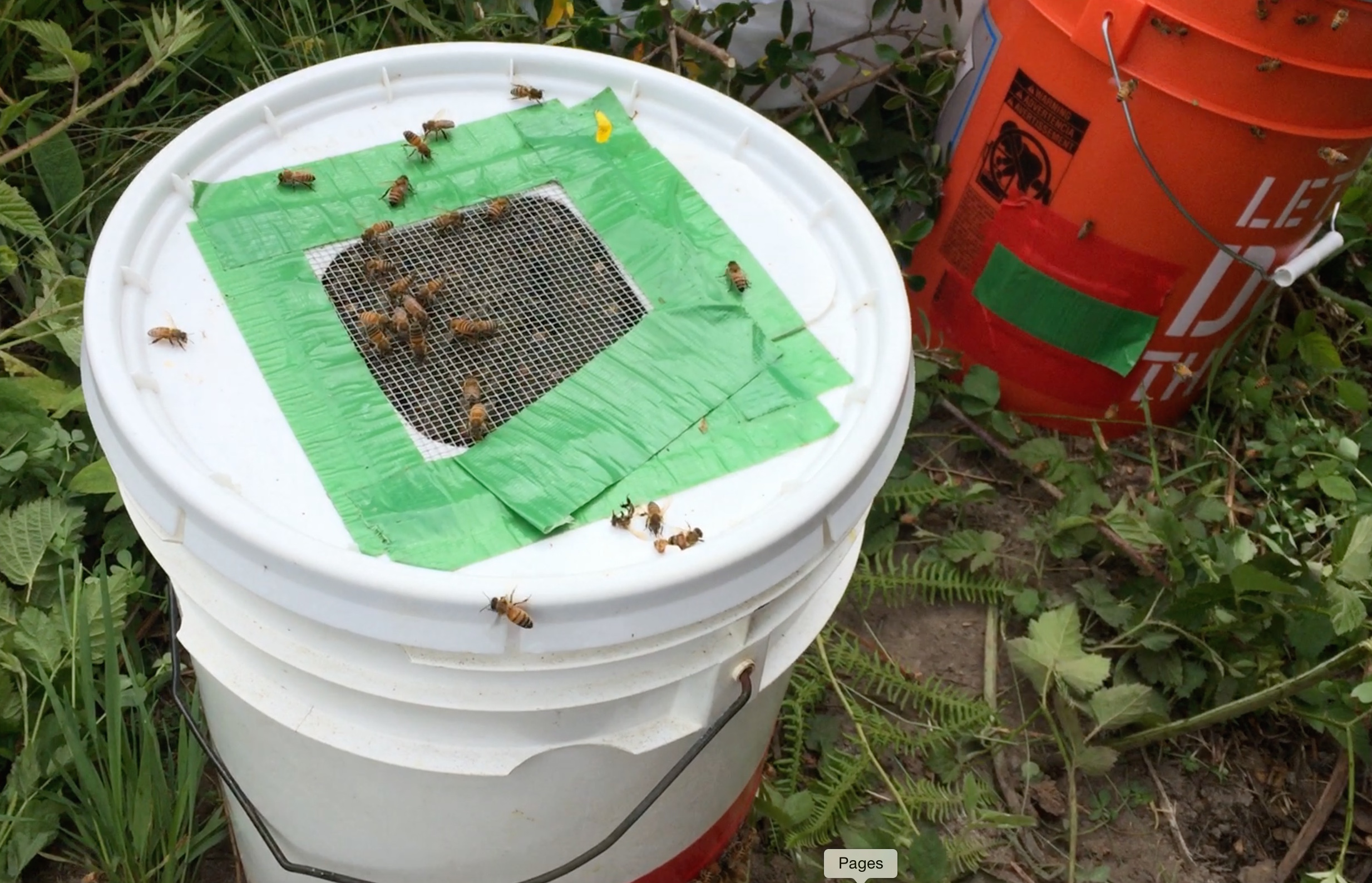
…which I recently built using a vacuum made for a 5 gallon bucket lid. I used a dimmer switch (as seen to the right of the bucket) so I could adjust the suction to avoid harming the bees. I’m happy to report that no dead bees were found. The dimmer switch worked perfectly. Plans were found at beesource.com .
Judging from the bees gathered on the outside of this bucket, I think it’s safe to say, the queen is within.
Big Swarm has a new home.
June 18, 2015…Steve writes, “Just an update, “girls” doing well. Happy pollinators week!
The above swarm worked out well, but it was only after we abandoned our efforts to try to bag the swarm below.
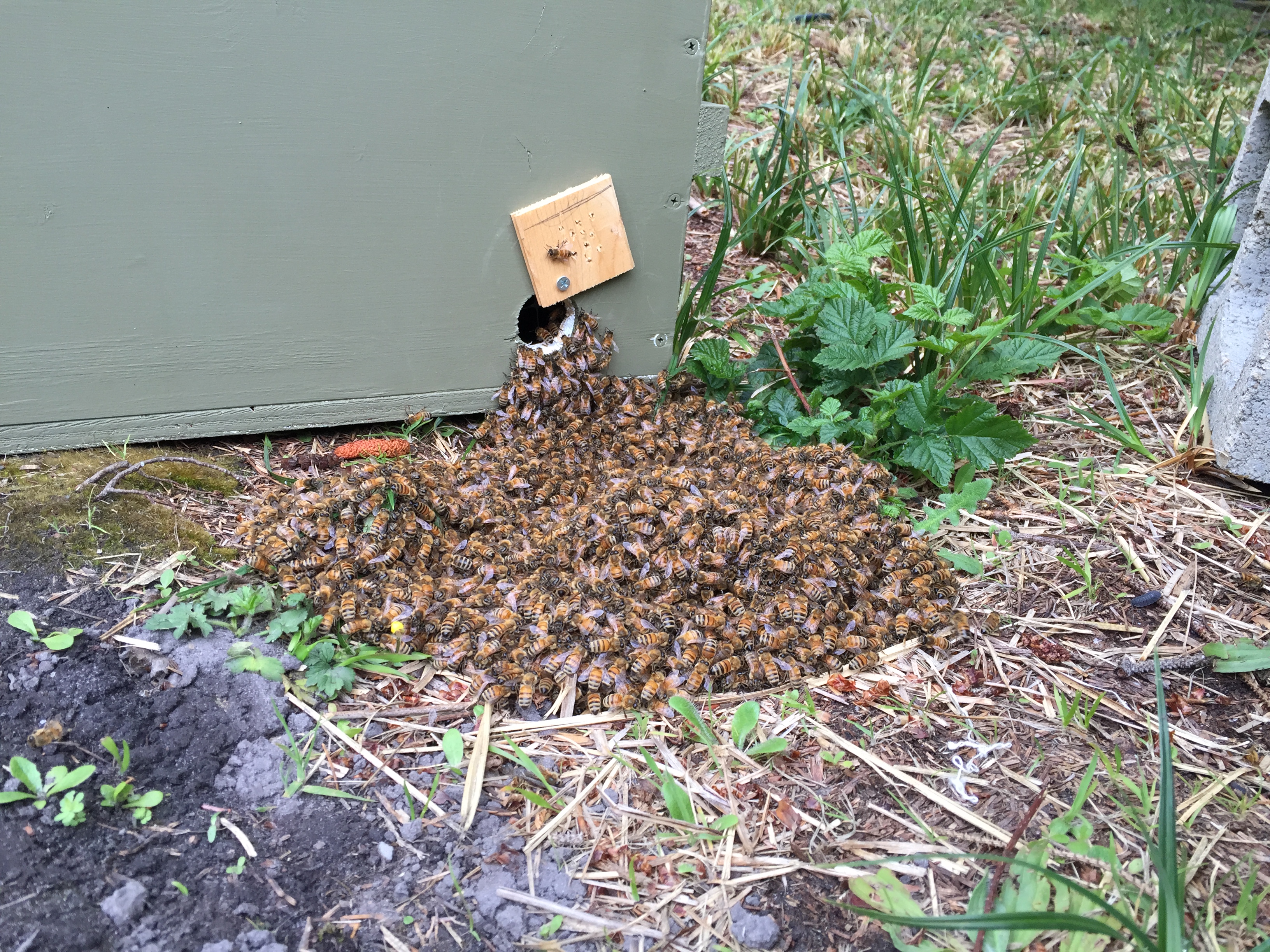
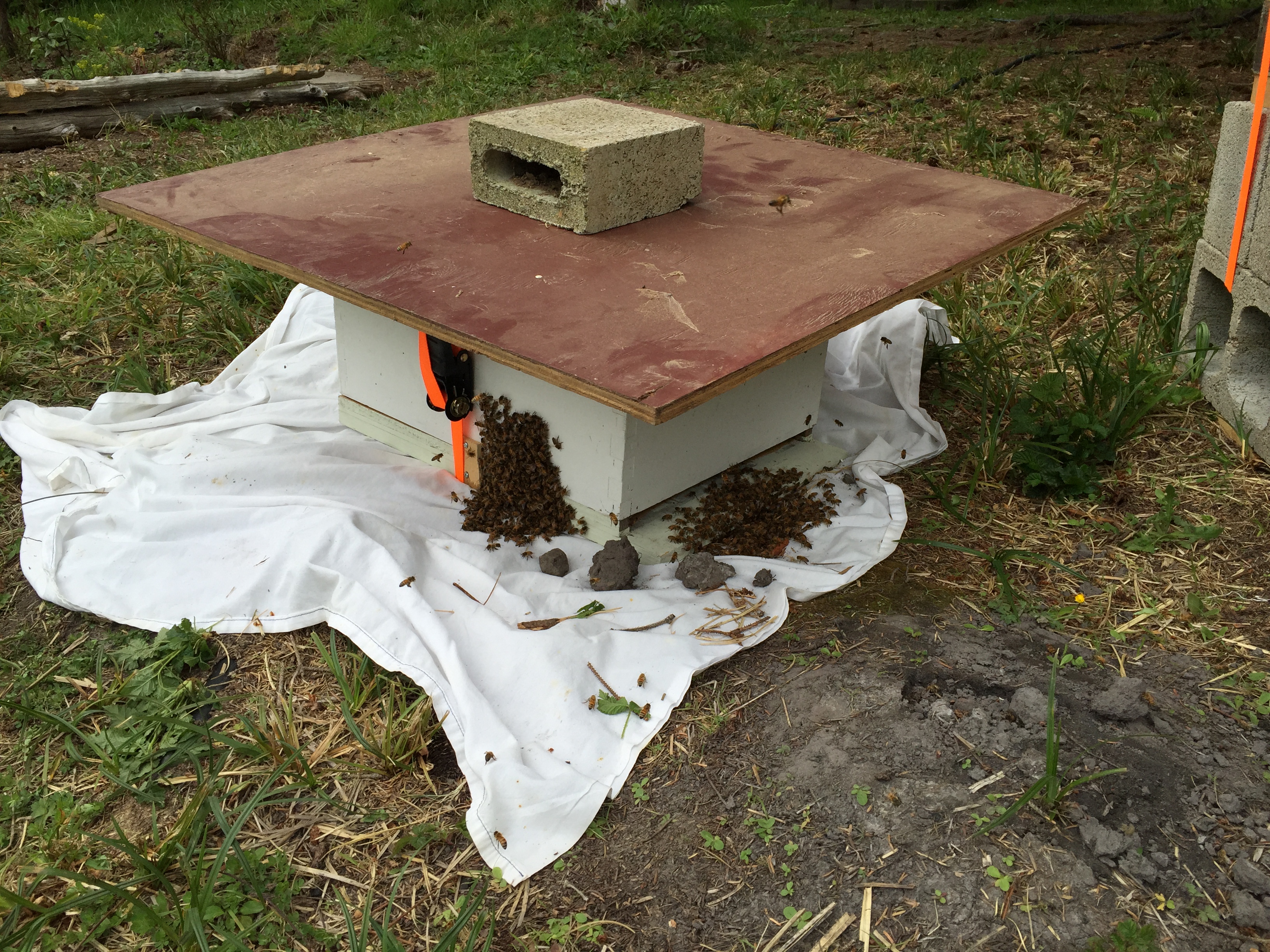
This was a ‘pancake’ swarm,’ lying on the ground in front of a recently occupied Warre hive. Are they going in? It looks like it…but they decided against it.
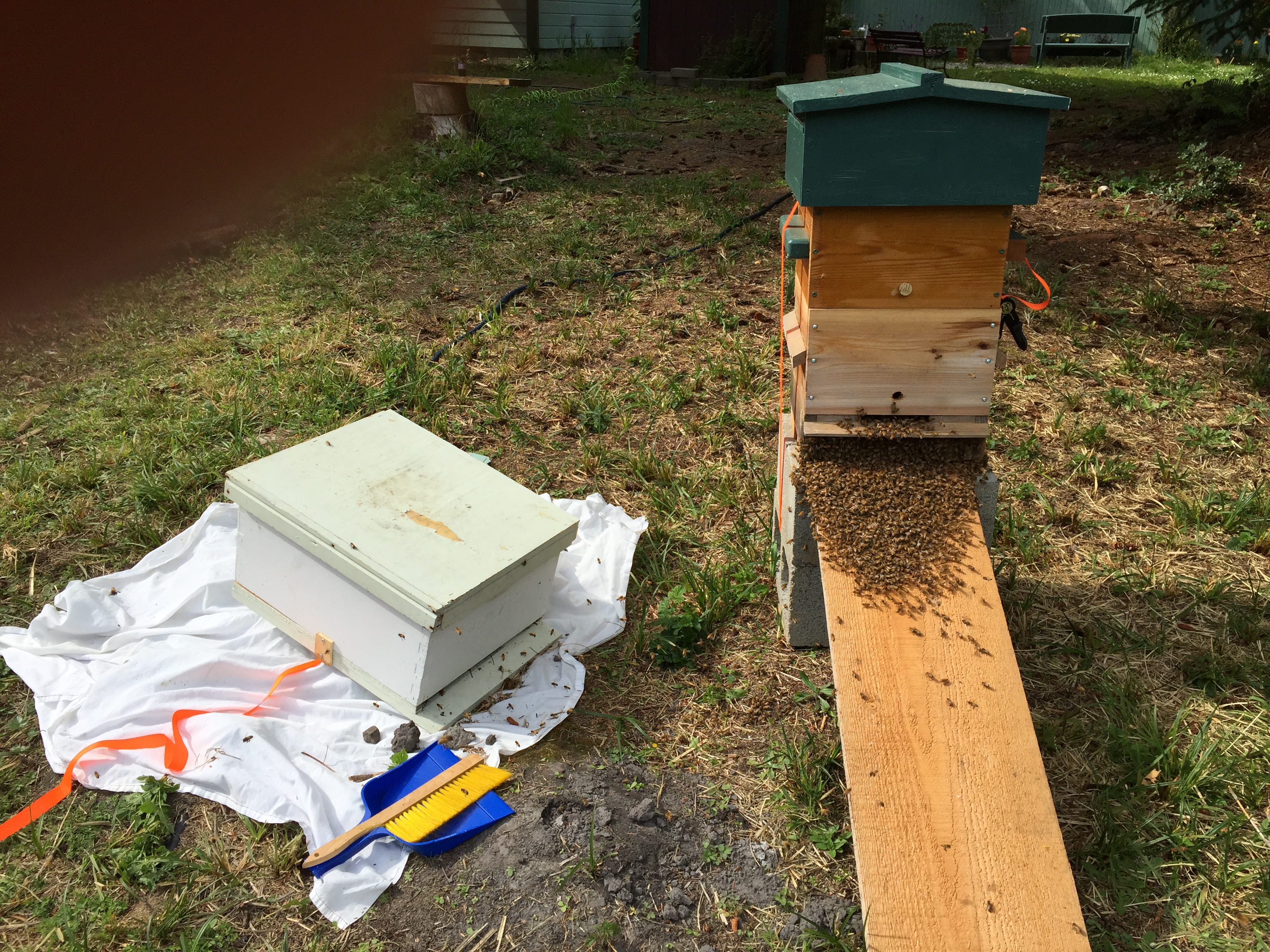
I replaced the bait hive with Steve’s Langstroth hive, then tried sweeping them into a dust pan and dropping it into the Lang…not so fast, they break for the Warre hive.
I figured, “okay, they made their choice,” but a couple of hours later, I found them going back to the Lang.
…eventually grouping up on the SIDE of the hive.
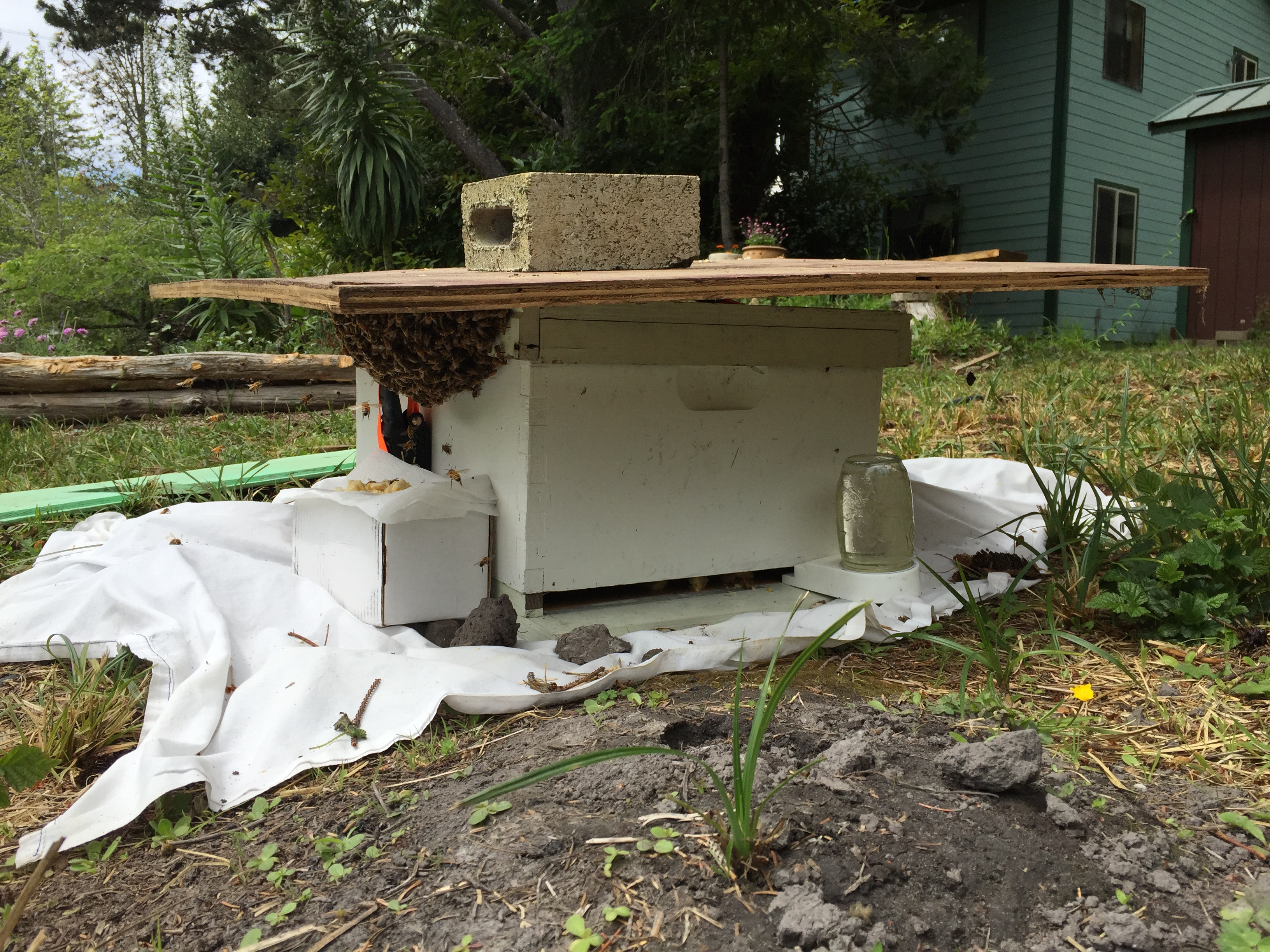
Since the swarm had been without water or sustenance for a few days, I provided some sugar water to try to entice them into the Lang. They would have to go into the hive to access the sugar water. That ought to work…it didn’t.
A day later, the bees moved over here about 5 feet away. I set up some moss water…
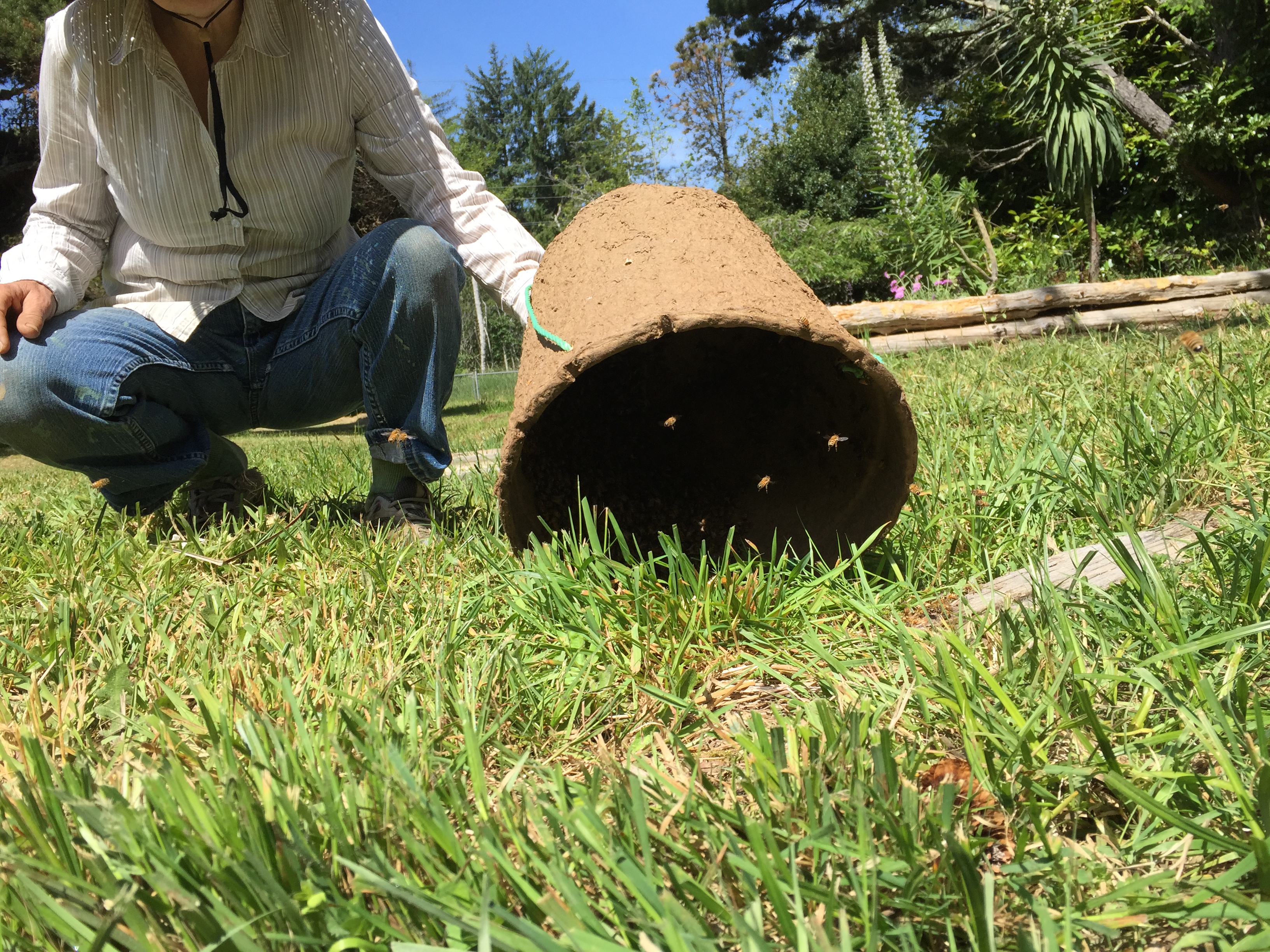
…and an inverted swarm catcher. I called Steve saying I didn’t think he would want this little swarm. It’s possible that it’s a cast swarm with a virgin queen that can’t fly. Four days later we get the swarm call for the one in the escallonia hedge. We both agree we’re glad we waited.
Long Live the Bees! My daughter sent me this photo as seen on one of her walks in the “Friendly Street” neighborhood. When I visited Eugene, I made an effort to find out the story of the sign. The kids who live here attend the school where Jen Hornaday has donated a bee hive as a school project. In learning about bees, the kids have found out about their importance in nature, importance to our food supply, and how important it is to grow gardens in a poison-free environment. Hence the sign.
Friendly Street, Eugene, Oregon.
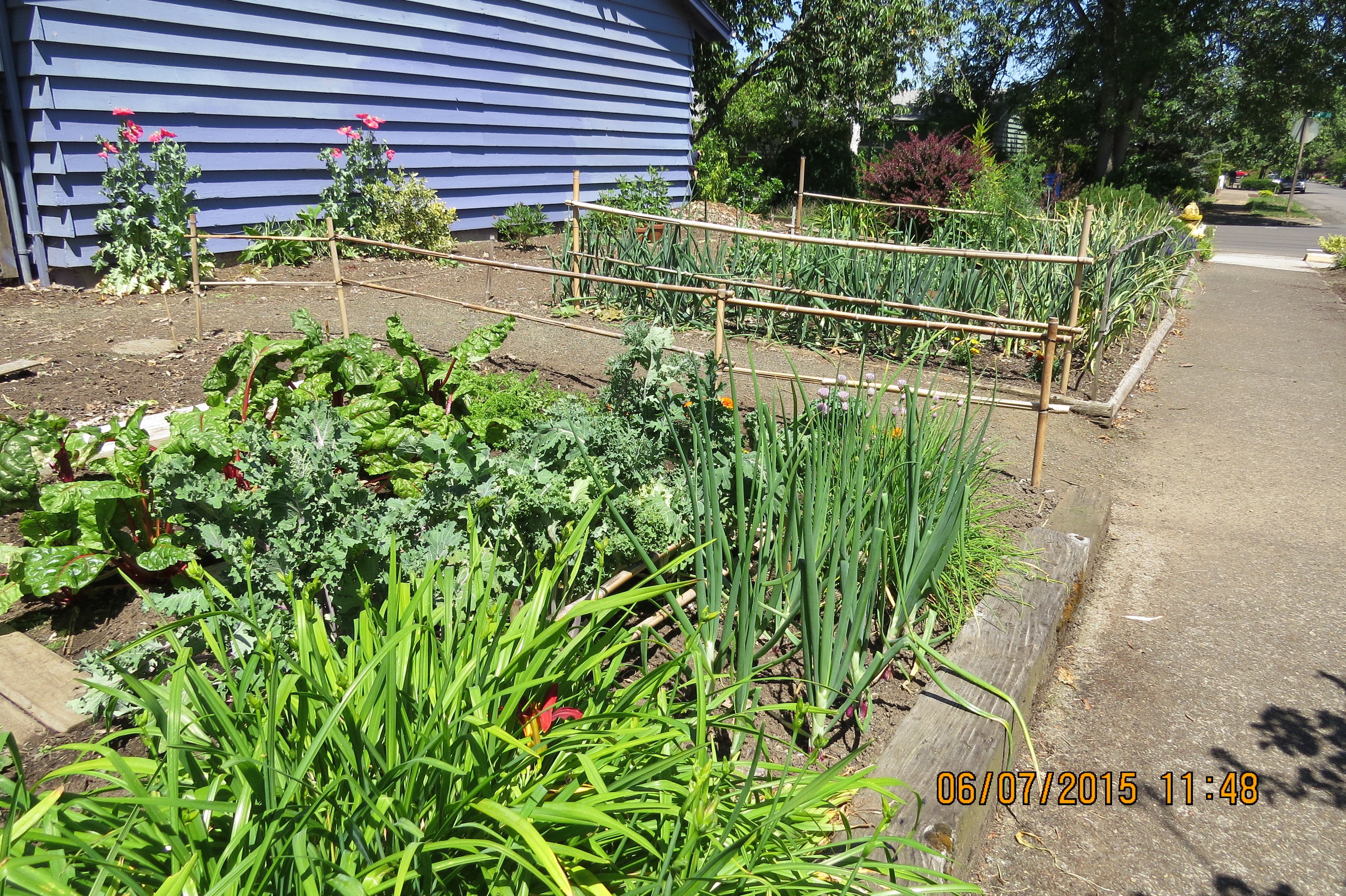
In walking through the Friendly Street neighborhood, I noticed quite a few gardens in front yards.
This is Scott’s garden. I was particularly impressed by his ambitious poles for pole beans. I wonder how he will pick the beans at the top.
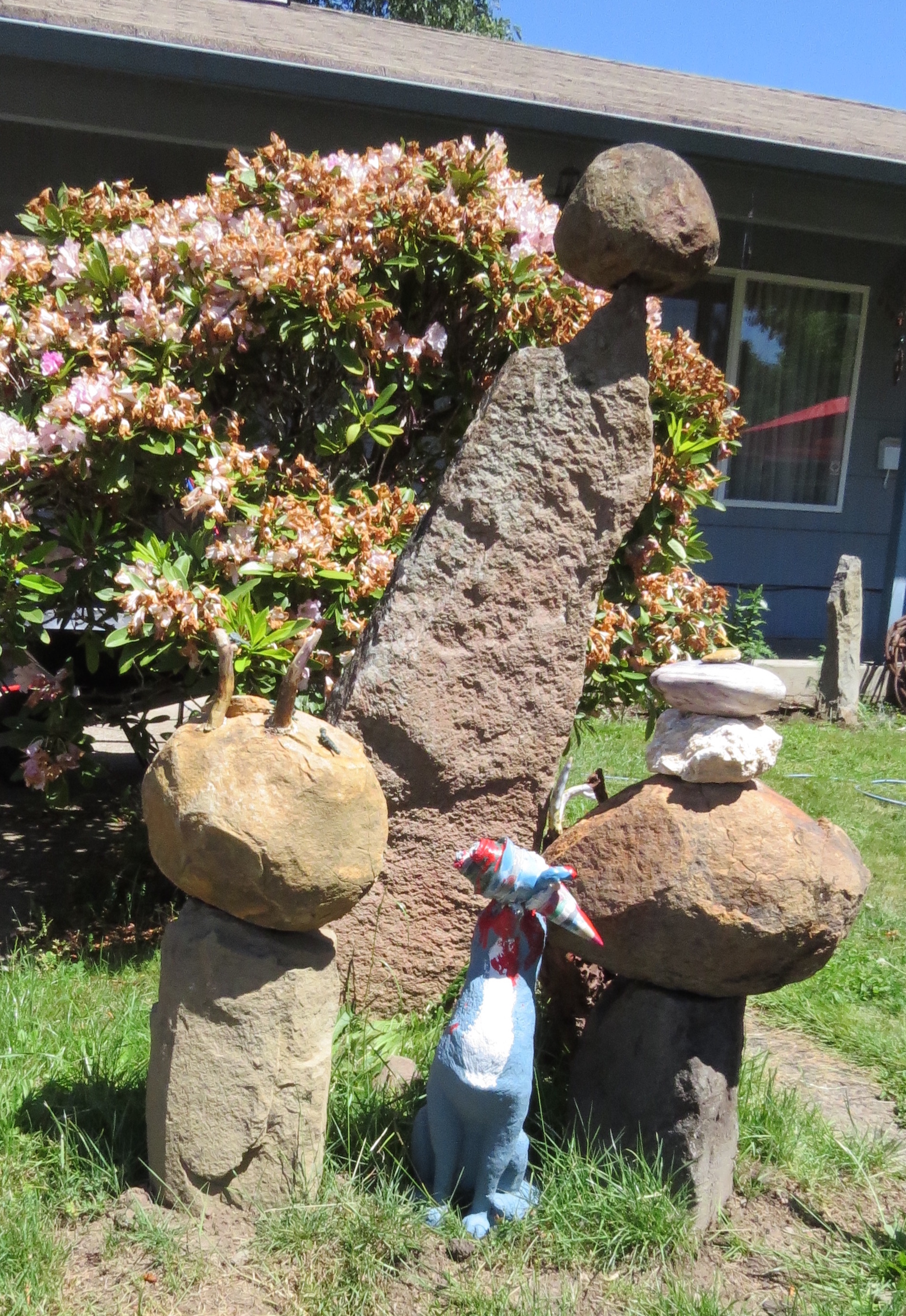
Scott pointed out another of his creations entitled “Coyote eating garden gnome,” sculpted during a wild creative evening of gin.
The blue flowers are Black Cumin. Black Cumin seeds are some of the most revered medicinal seeds in history. Photo Credit to Crow Feather Farm, Eugene, OR.
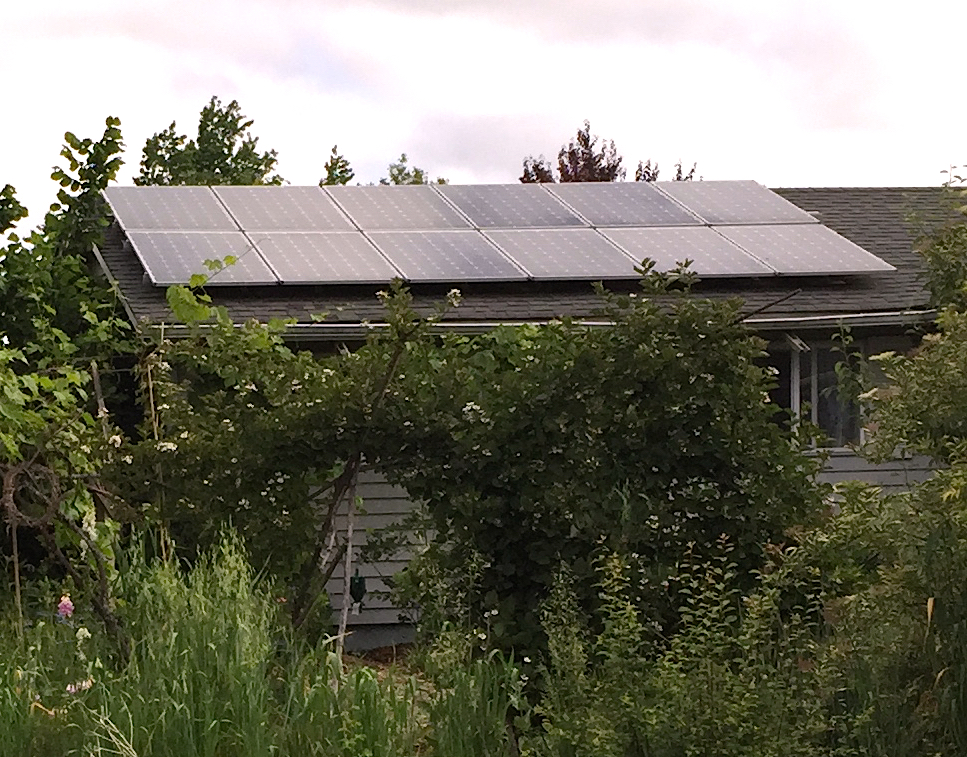
I wanted to ask the owner about the solar panels array, but I was taken by all the flowers and time was short. Photo credit to Crow Feather Farm, Eugene, OR.
I need a sign like this. Photo credit to Crow Feather Farm, Eugene, OR.
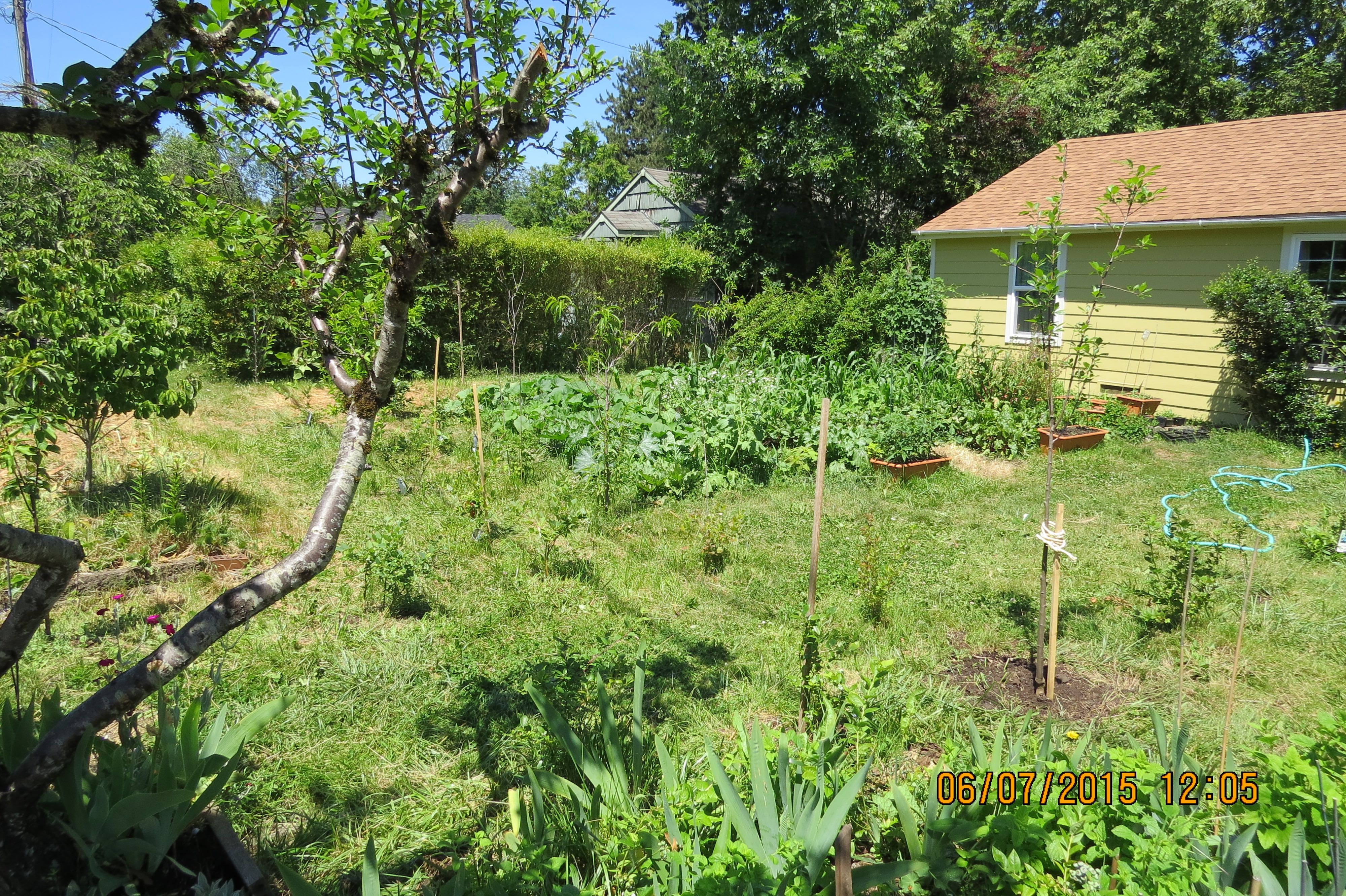
George explained while this is his garden, he shares space with the kids down the street who tend the squash.
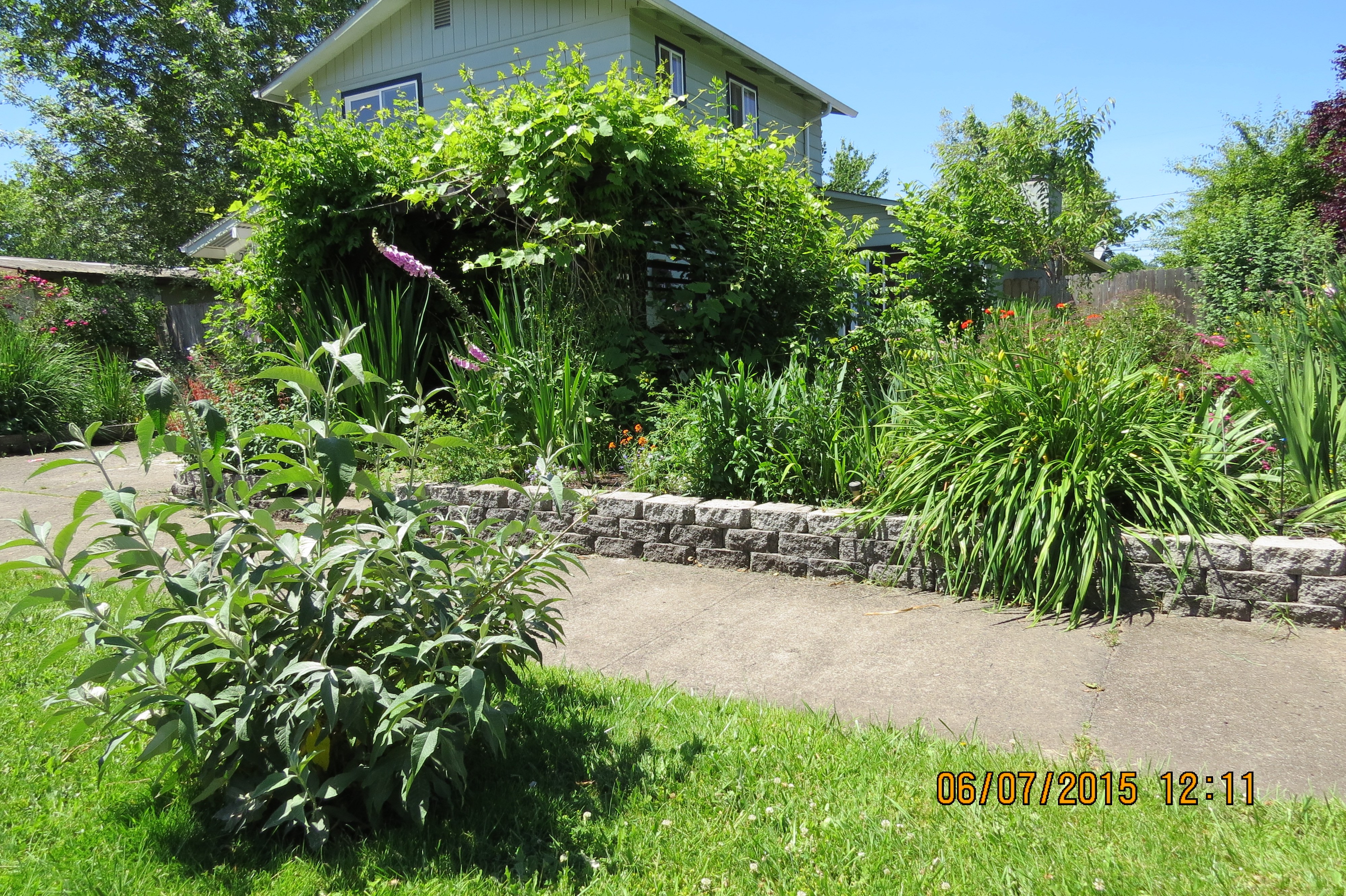
Carmella’s corner lot garden.
This one year old is intent on one thing only…getting the sweetness out of the strawberry.
This is Jim’s front yard. He apologized for the fence, but he says it keeps the deer out. I can relate.
Where does the Friendly Street go? To the Friendly Park, of course, which is how I discovered this lovely neighborhood when my daughter walked us to it.
May 31…The Bee Garden is shaping up after Sue added her brick work. We like it so much we’re going to add more on the other side. The photo shows just some of the bee-loving plants we’re growing…some from seed, some from our favorite nursery.
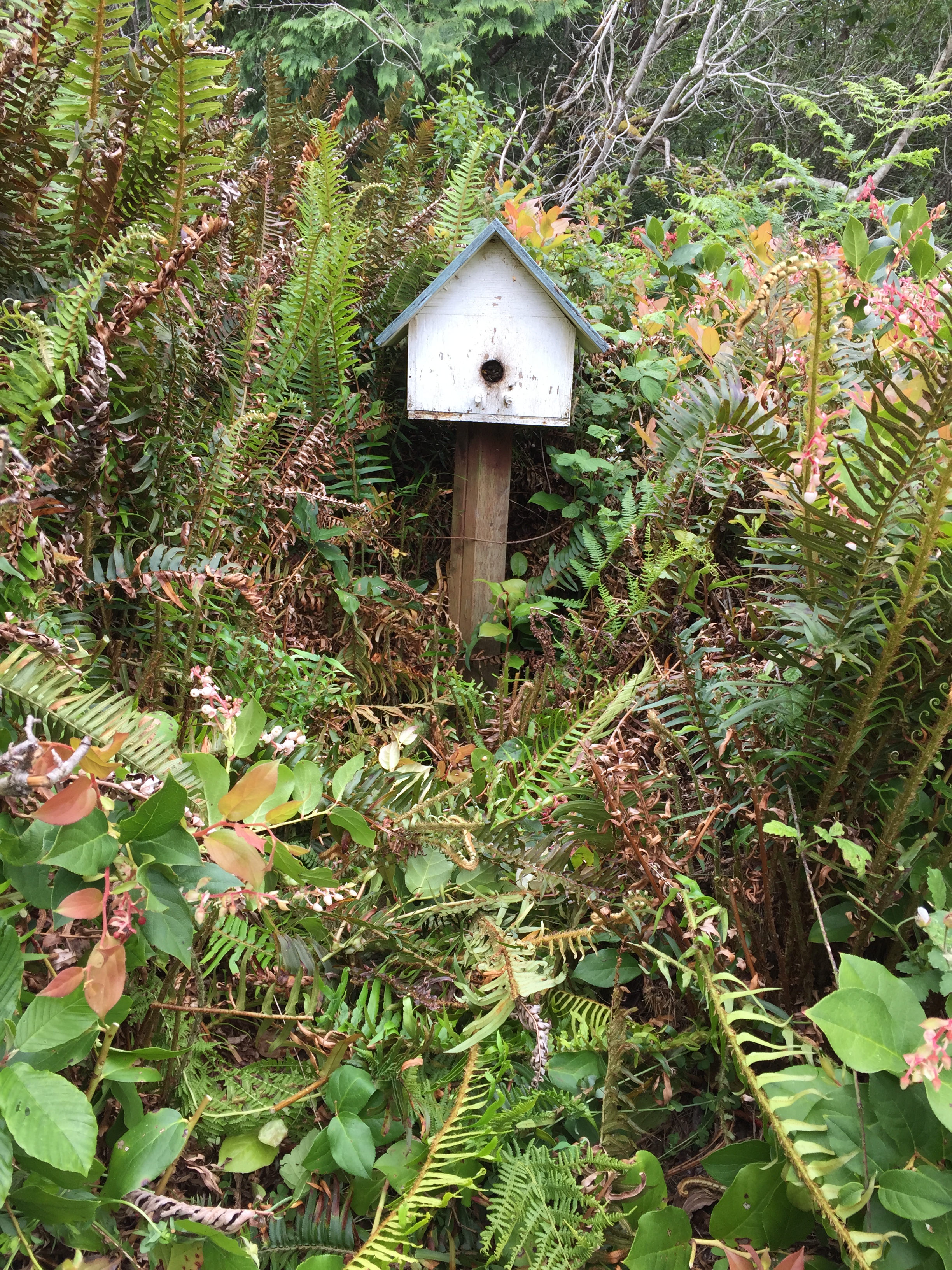
I just noticed these ferns practically overgrowing the little Birdhouse Bee hive.
I successfully trimmed the ferns without getting stung. The bees probably don’t care one way or the other, but it gives me a clear shot with the camera.
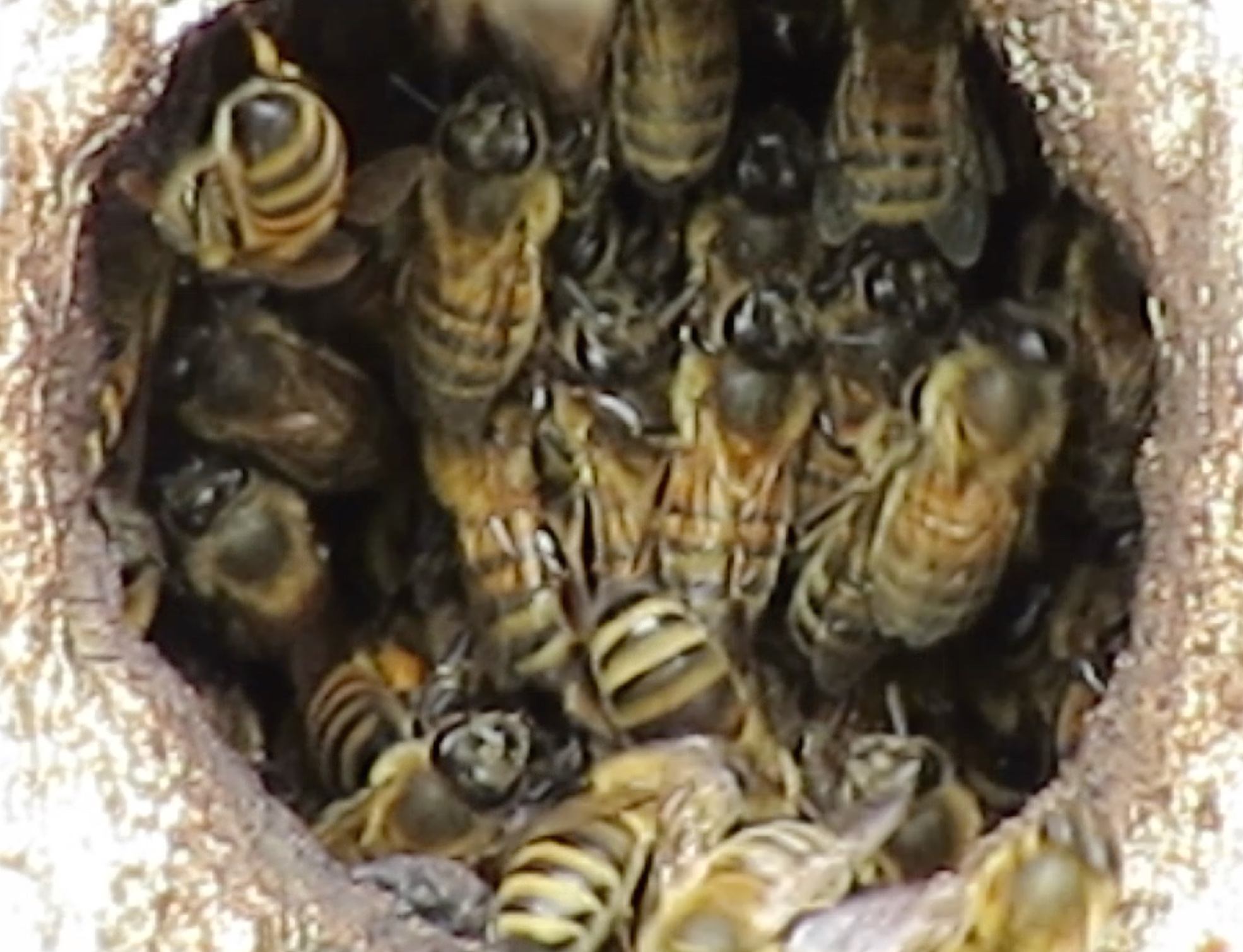
Are these drones? It almost looks like it. Drones sometimes mean swarms (before or after)…I’m hoping this is before so I can encourage them into an empty Warre hive with their name on it. 🙂
May 31…The hugelkulture bed needs a little more work for sure. This is a ‘before’ picture. I’d like to make a little path going past the hive and circling back past the sunflowers I just planted (if the slugs don’t eat them first.
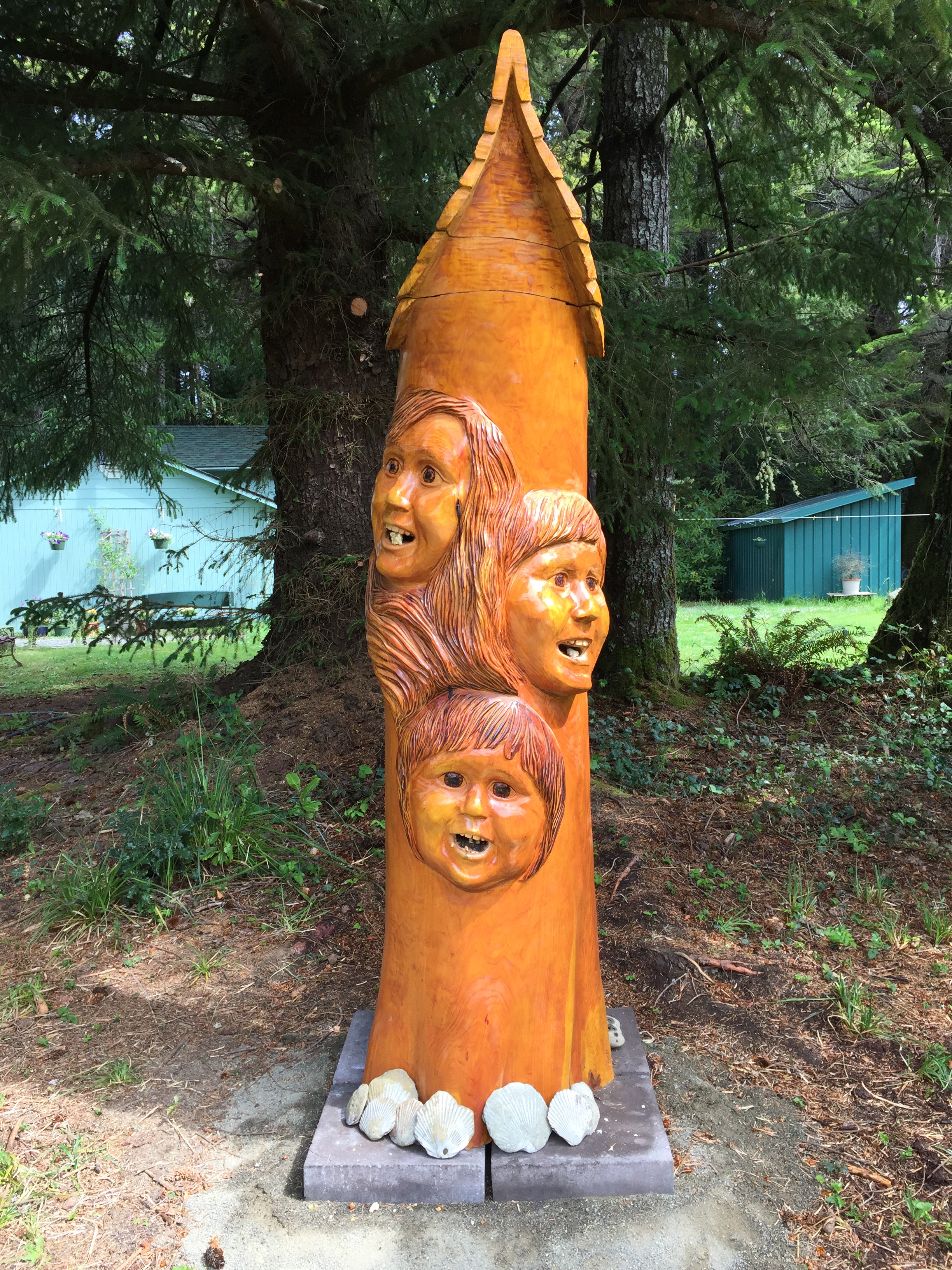
May 21, 2015…..Hal stands proudly next to his log hive #4. Bees voted his hive as their top favorite place and moved in about two weeks ago. How tall is it…? Eight feet tall (2.4 meters) Bee hive capacity is 7524 cubic inches (123 liters)
Frames are cut away to be able to see the comb being built through the observation window.
Looking inside the hive during the construction phase, you can see the screen Hal nailed in to let the mites fall through.
Bottom board holder slot
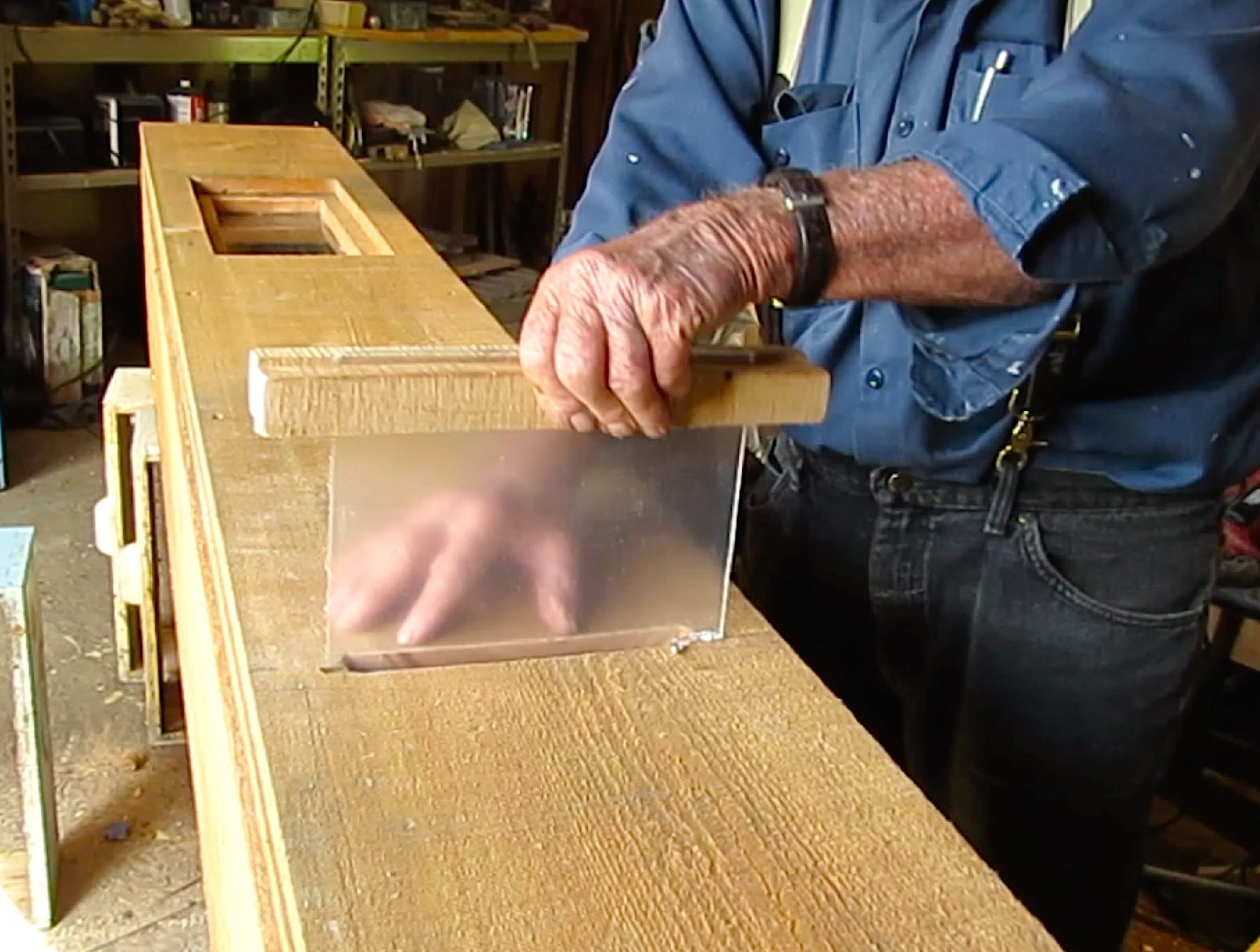
Hal explains the construction of it.
May 18…Comb length after about two weeks. Note the mid entrance hole.
May 21…Three days later, the comb is even with the mid entrance hole.
Log hive #5? Hal already has the wood for it. He will be using cedar this time. Solarbeez might have to build one too. 🙂
It’s Garden Time…and time for Patti to show it to us.
Patti, a young 80 year-old, built this fountain and did all the landscaping for the garden. The surface she’s standing on are old recycled roofing tiles.
Lobelia grows between the steps that lead to the deck.
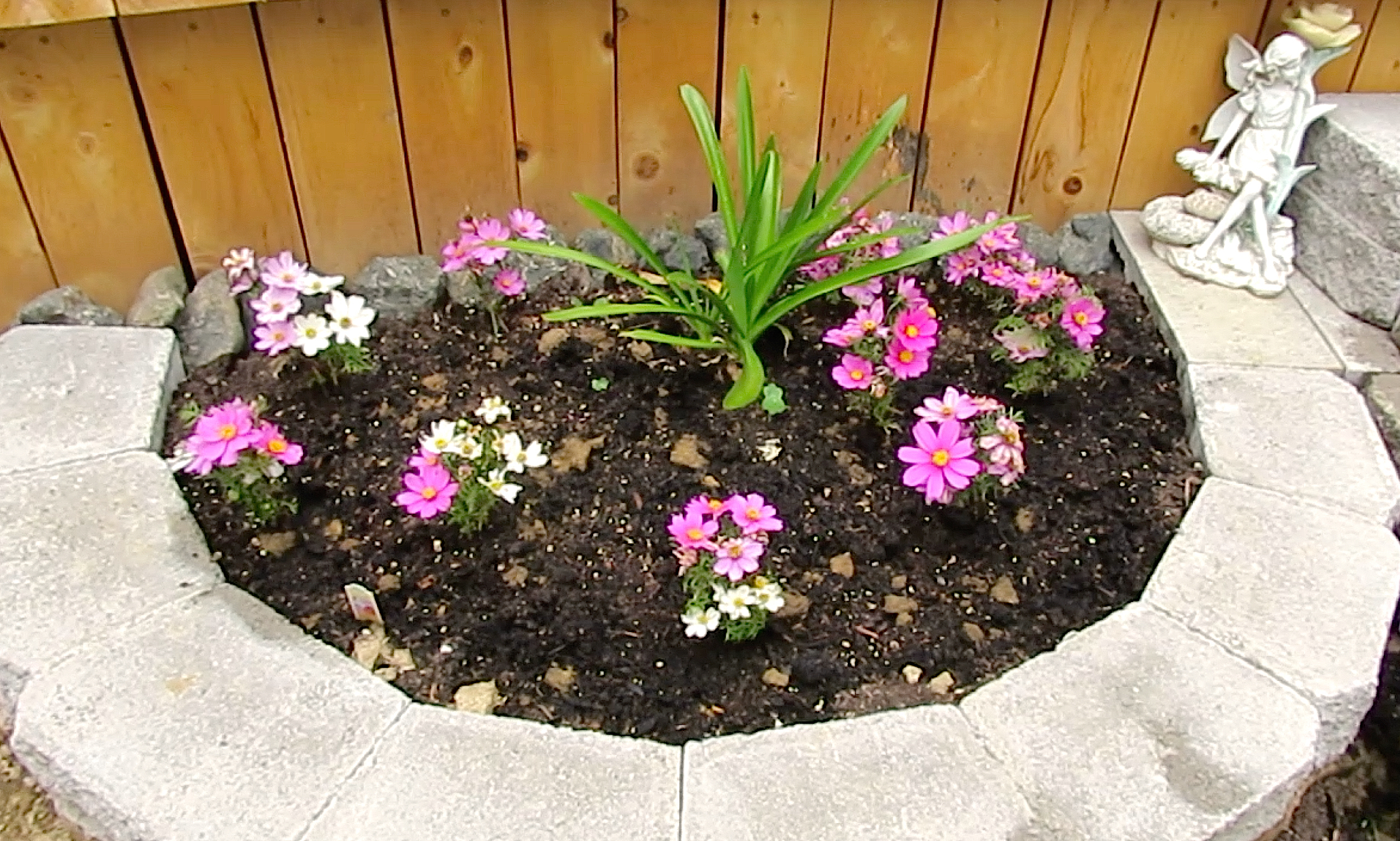
Cosmos are blooming already.
Sedum will provide much needed nectar during August and September. I’m very grateful to Hal and Patti for alerting me to this wonderful nectar source for my bees.
What do you do with a log hive that has rotted out? If you’re Hal and Patti Strain, you’ll make a pretty flower bed out of it. They’ve already had requests to make more.
I was beginning to think the swarms were not going to materialize. I thought maybe I wasn’t trying hard enough to entice a swarm to look over the log hive. I decided to step up my game plan. Kids like honeycomb and I know bees like honeycomb. I cut off a small piece for each kid (after sampling it myself first, of course).
My wife was busy working in the greenhouse. She could hear the swarm coming from over the trees. She ran into the print shop to alert me. I grabbed my camera while they were descending in the area by the log hive. I groaned…”not another little swarm” as that’s exactly what it looked like. But that was only the advance party. As they started landing on the log, more and more of them floated down, landing on the log hive, but waiting to enter. My wife wondered if the honeycomb was in the way. Ha ha, I agreed and popped it into my mouth. 🙂
5-13-15…I don’t know if it was because of the honeycomb or the spacious accommodations, but this swarm came to stay.
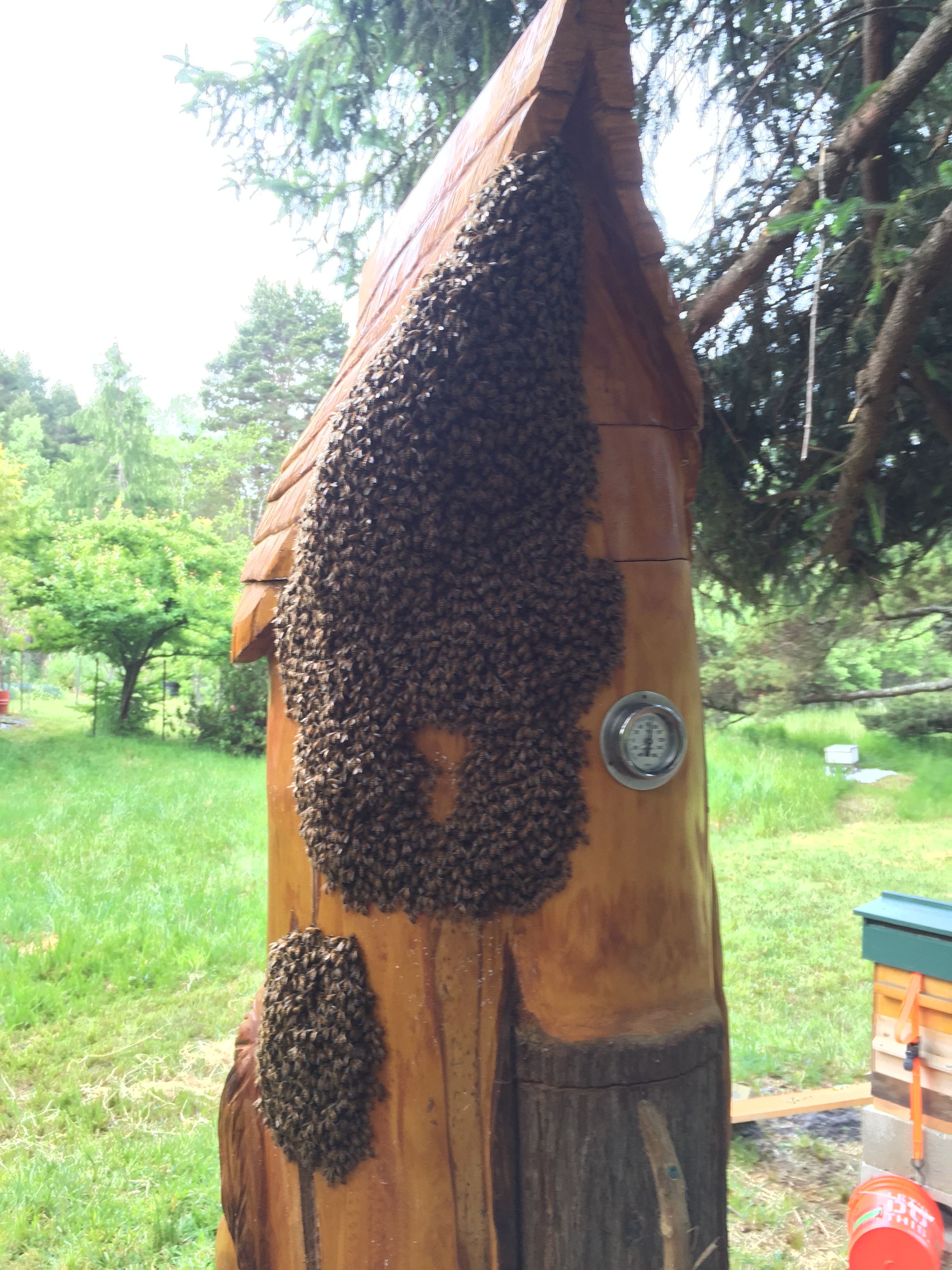
It was unclear exactly when this second swarm came along, but it wasn’t much later, probably less than half an hour. It was another big one. At first I wondered if the first one had decided to back out, but I checked the probe thermometer which showed 76F.
Internal temp at 76F at 5:20 pm. That means the original swarm is still in there.
The next day, the second swarm is still ‘hanging out.’ They hung around until about 3:15 pm when I was collecting ANOTHER big swarm, this time from Bee-atrice log hive. (When you’re hot, you’re hot!)
Temperature at 80F (26C). After the swarm left at about 3:15 pm, you can see wax flakes. (The bees were all ready to build comb in this hive, I felt bad for them)
Many thanks to Jeff Ollerton and HB for giving me the identity of this tree.
It just so happened that at the same time I was trying to identify the tree, we walked by Barbara’s house. She grows many bonsai trees. “Clearly it’s a River Birch,” she says, “compare it to my little River Birch on the left.”
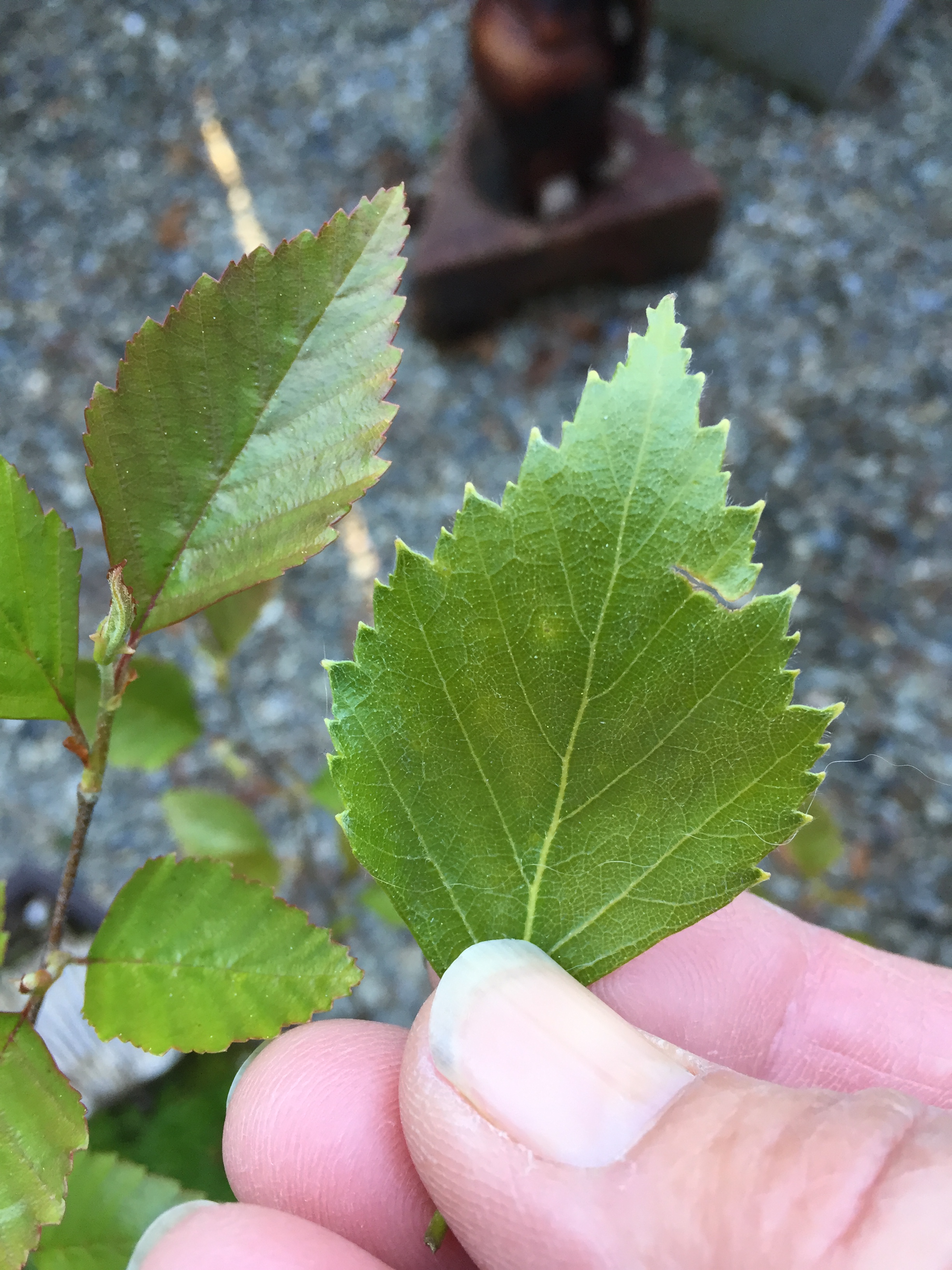
This leaf shows a wedge-shaped base typical of the River Birch.
The weird thing about the leaf is that there are two different shapes. This one shows a more squarish base. That really threw me when trying to identify the type of tree. Both leaves are from the same tree. Does the age of the leaf determine the shape?
May 13, 2015…Looking at a bunch of leaves together, we can see various wedge shaped bases…some more acute than others.
May 13, 2015…Looking upward into the umbrella, you can see the white bark limbs…
…but looking at the trunk, you’ll see cinnamon colored bark.
According to Wikipedia, “Betula nigra (black birch, river birch, water birch) is a species of birch native to the Eastern United States from New Hampshire west to southern Minnesota, and south to northern Florida and west to Texas.”
It grows in the East, not the West. I guess the jury is still out on the type of birch it is.
5-13-15…Big news today: A ginormous swarm is moving INTO my Grand Kids Log hive today! Detailed post to follow.
This is far from National Geographic video quality, but it does show the intimate relationship between the bee and the flower. The bee lands on the flower petals, spreads out the lower ones, then triggers the pollen release possibly by pushing something with it’s head…I couldn’t see that part, but when it happens, it’s sudden and strong, like an explosion.
May 3…Here’s a pretty variegated Scotch Broom (Cytisus scoparius). You can tell that a bee has been there , because the stamen have already popped up.
Pollen Alert…bee has triggered a pollen shower, stamen pop up and rub anthers on her back.
This bee has learned well how to trigger the pollen release as can be seen by the amount of pollen on herself.
I shot this video to show what our bees are doing when they leave the hive. It may surprise you. 🙂
The potatoes have been weeded and hilled up. ‘Survivor*’ garlic is on the left and Meadowfoam is in the background, fenced away from deer, but still accessible to the bees. I’ll be using 12 foot lengths of 1/2″ PVC to drip water the potato rows. The seed potatoes were planted at about 9″ distances which match up to the holes drilled into the PVC drip watering system. *Survivor garlic is garlic that made good sized bulbs even though it got the rust virus.
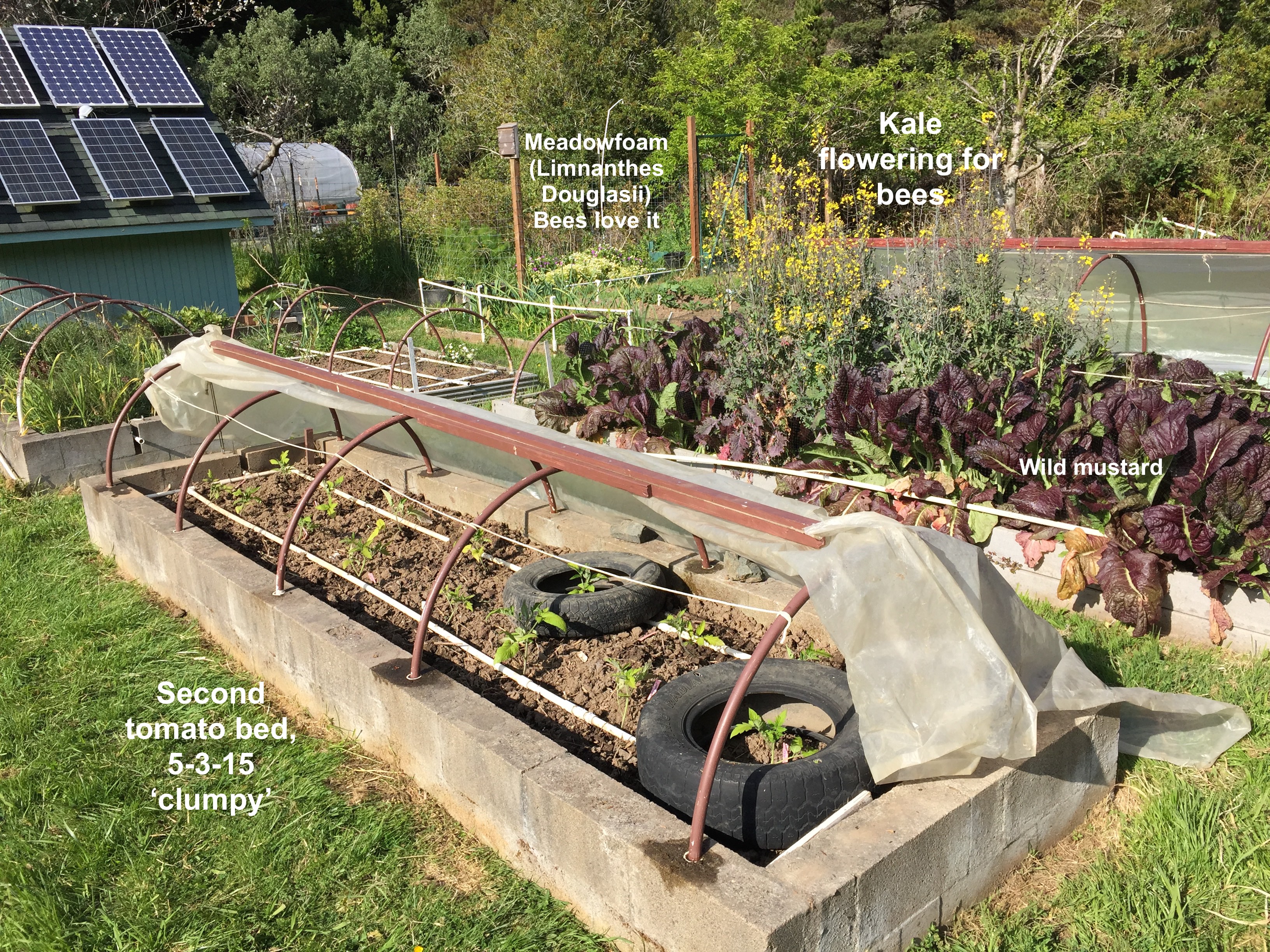
The first bed of tomatoes has been transplanted from the light stand in the house. We’ve used the tire method for 30+ years. They will dissipate heat into the evening. The night temps will get down into the mid 40’s (7C) even sometimes in the summer, so we’ve got to tent them. You might have noticed the wild mustard patch in the background…that started out as a clover patch. I wanted to grow clover to enhance the soil. I rigged up this PVC arrangement to hold the deer netting off the expected plants. I wanted to see the bees visit the clover blossoms in the spring. Then we experienced a cold snap. The clover died and the mustard plants germinated from the compost we spread out. It grows well, too well. I’ll probably have to spade it into the soil before it goes to seed.
A closer look at the tomatoes and drip watering grid. The 1/2″ PVC has been drilled so the water drips out near the plant. I’ve been using these for over ten years and it works well.
May 4th…The second tomato bed goes in. You might notice the ‘clumpy’ soil. I was soooo tempted to pull out my rototiller to break up the soil, but I resisted. We’ve been trying to prove that we can garden without the use of fossil-fuel. So the soil is a bit lumpy and we’re hoping the tomato plants don’t mind too much.
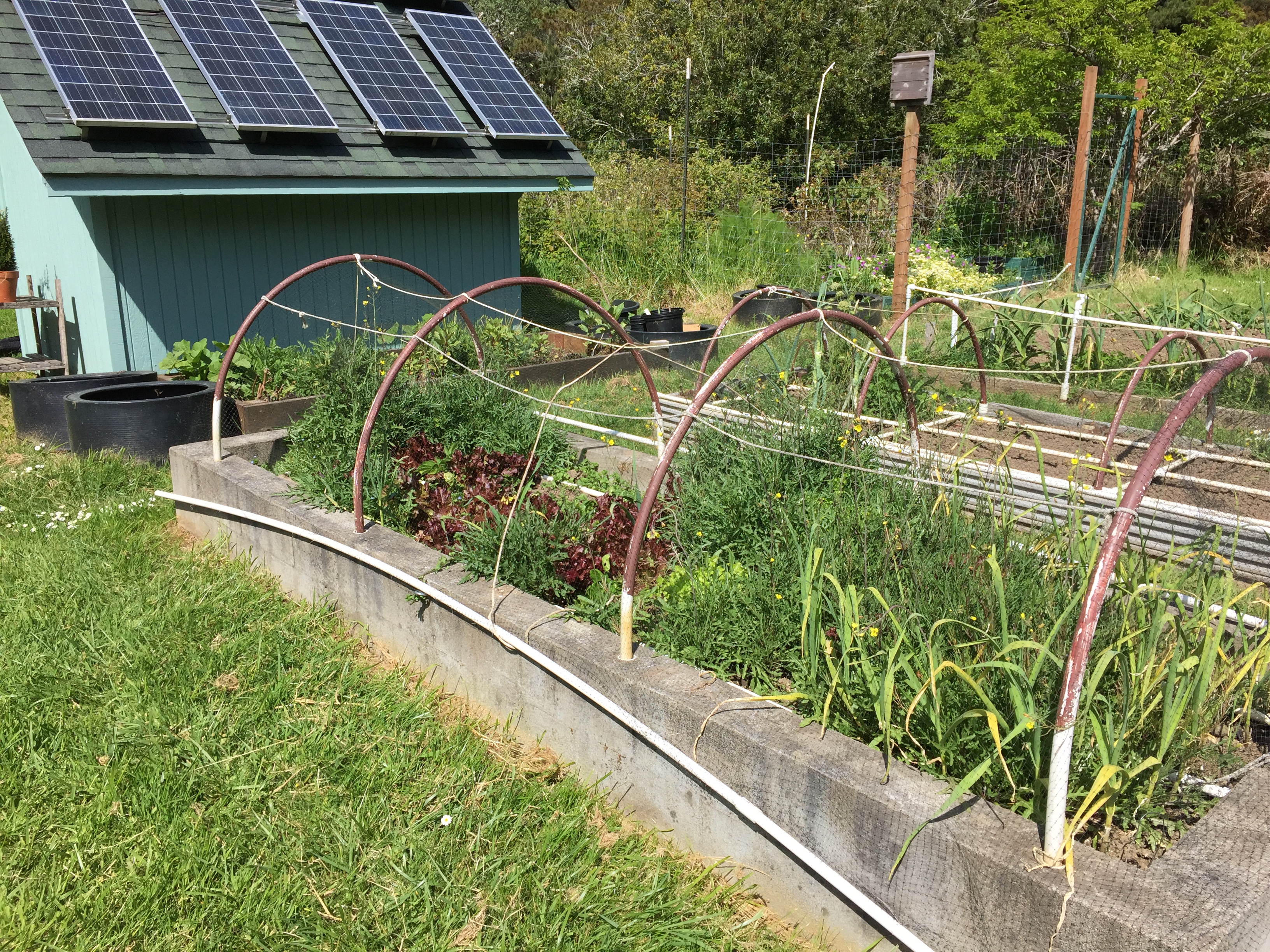
We’ve been eating lettuce and spinach from this first bed of salad greens for about three weeks. My wife likes the wild arugula, but it’s a bit hot for me.
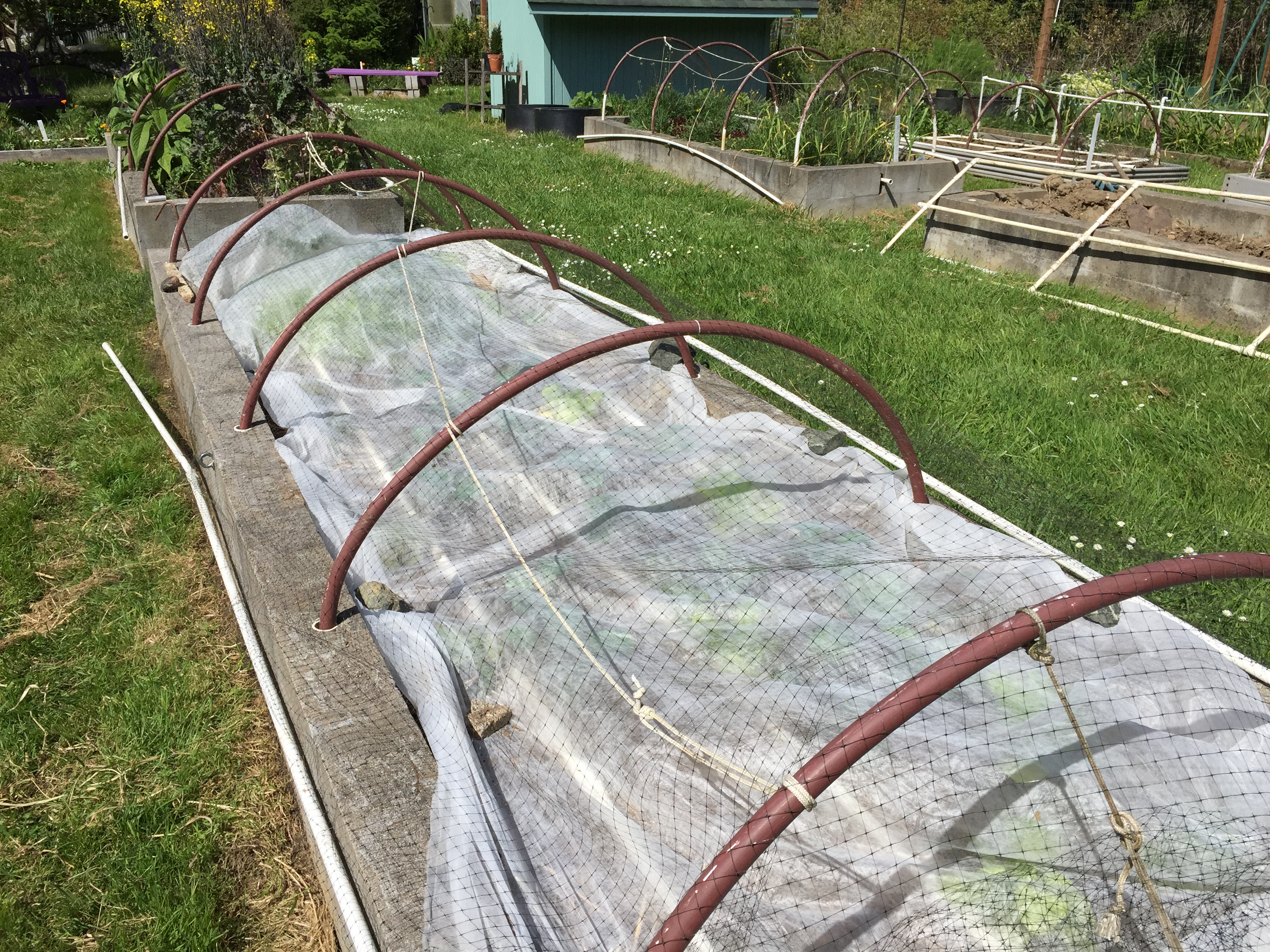
March 28…Planting the second bed of lettuce, Parel cabbages which were started in the house, purchased broccoli plants and maybe some collard greens.
We’ve got to protect them from the cabbage moth.
May 3…Peeking under the cloth to see how the lettuce is doing.
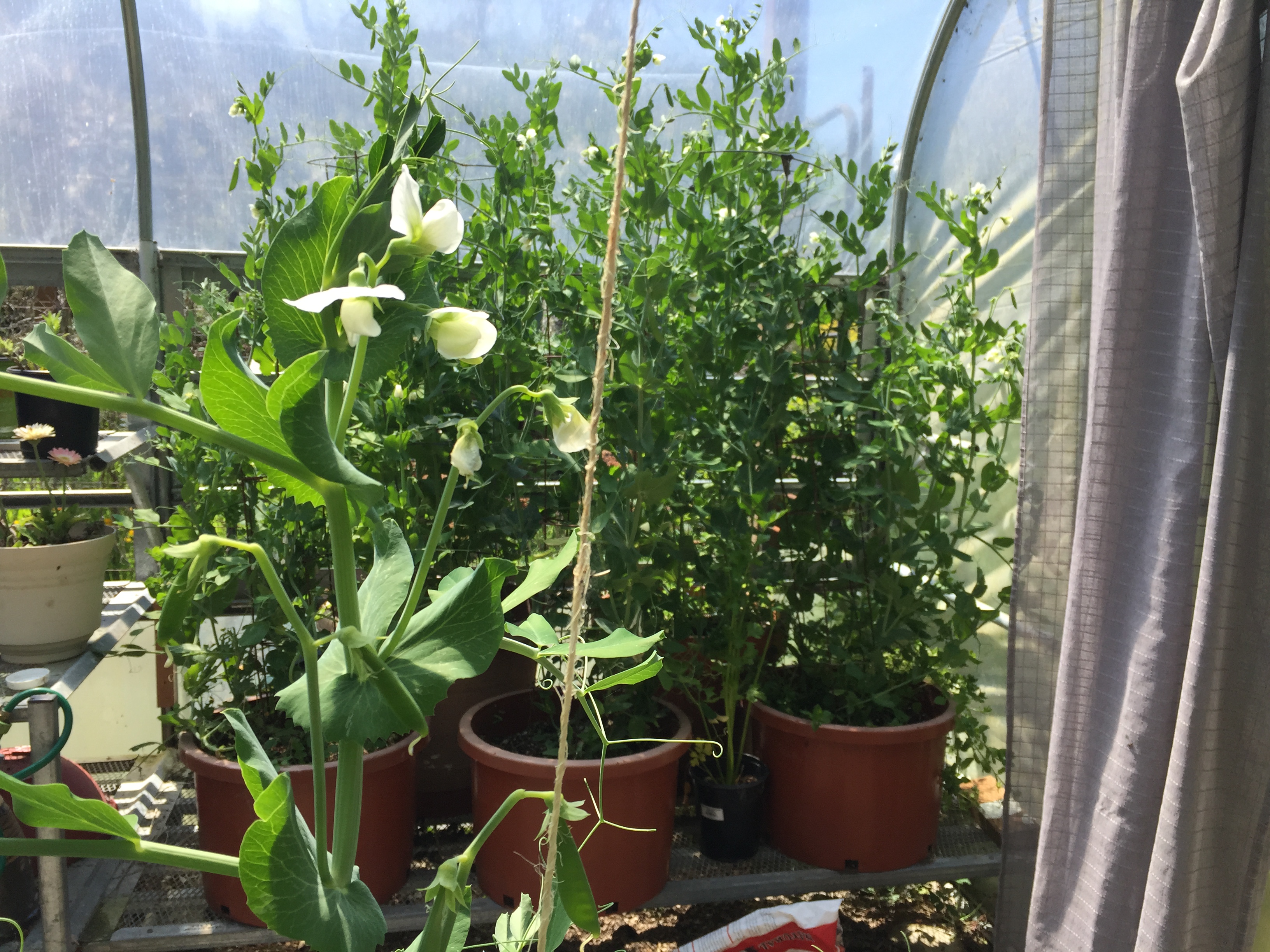
We planted the edible pod peas in the greenhouse in February.
…and have been using the pea pods in salads and soups for a good month.
April 25…Since the deer like to munch on nasturtiums, we’ve got to protect them. What better way than to clean out the weeds around an apple tree and plant them there. These are a new kind that will sport red blossoms. I hope the bees like them.
May I say something else about Limnanthes Douglasii Poached Egg Plant (Meadowfoam)? It wintered over without any kind of frost protection like a tarp or a pile of leaves. It was tough love for sure because it’s in a section of the garden that’s in the shade until noon. This was self seeded from last year’s crop which was about 1/4 the size. (What have I started?) The Vision Violet Geraniums also wintered over well. Together they have been attracting the bees in the afternoon hours.
May 3…I know, I know, I shouldn’t have to transplant borage because it grows ‘like a bad weed’ around here, but there was an empty spot in the hugelkulture bed after I weeded it and the bees love it so much. Three spade-fulls and I’ve got a three more spots to video the bees. 🙂
This Cardinal Climber is supposed to attract hummingbirds. We’ve started it under lights in the house. My wife is going to donate a couple of plants to try to get it to climb up the echium ‘tree.’ I think it’ll be fun to see if we can get some birds and bees.
May 3…”Reach for the sky,” little Cardinal Climber…
…You will have to if you want to climb this “Tower of Jewel” echium tree. It’s 12 ft tall and growing.
I just bought this African Blue Basil. Jeff, at my favorite nursery, tells me it’s a super bee magnet which will blossom all summer. He knows how to tempt me.
May 5…Because the bees were visiting the moss in the pond so much and because someone on the biobees.com forum mentioned that his grandfather used moss for a watering station, I thought I’d try it out. Who knows, the bees might be getting some kind of essential minerals or properties from it. I just dug some up, found a plastic container and try to keep it hydrated. It’s the only waterer I’ve had any success with.
Time to roll out the “Solar Roller.” Things are drying out. This ‘solar panel roller’ can be positioned to catch the early rays of the sun as well as the sunset. I can get about 10-12 hours of sunshine if I’m conscientious about moving it twice a day.
Forgive me if I’m talking about this new bee bed too often. It’s just that we wanted to add more flowers for the bees without taking away space from the veggie garden. This was the perfect solution…but after adding Walker’s Low Nepeta, artichokes, Scabiosa, and red echium, we’re already running out of space.
This started out as a garden video, but there was so much excitement today with two swarms happening and bees (from where?) checking out my new log hive. I had to include some video below.
































 Adventures in Natural Beekeeping