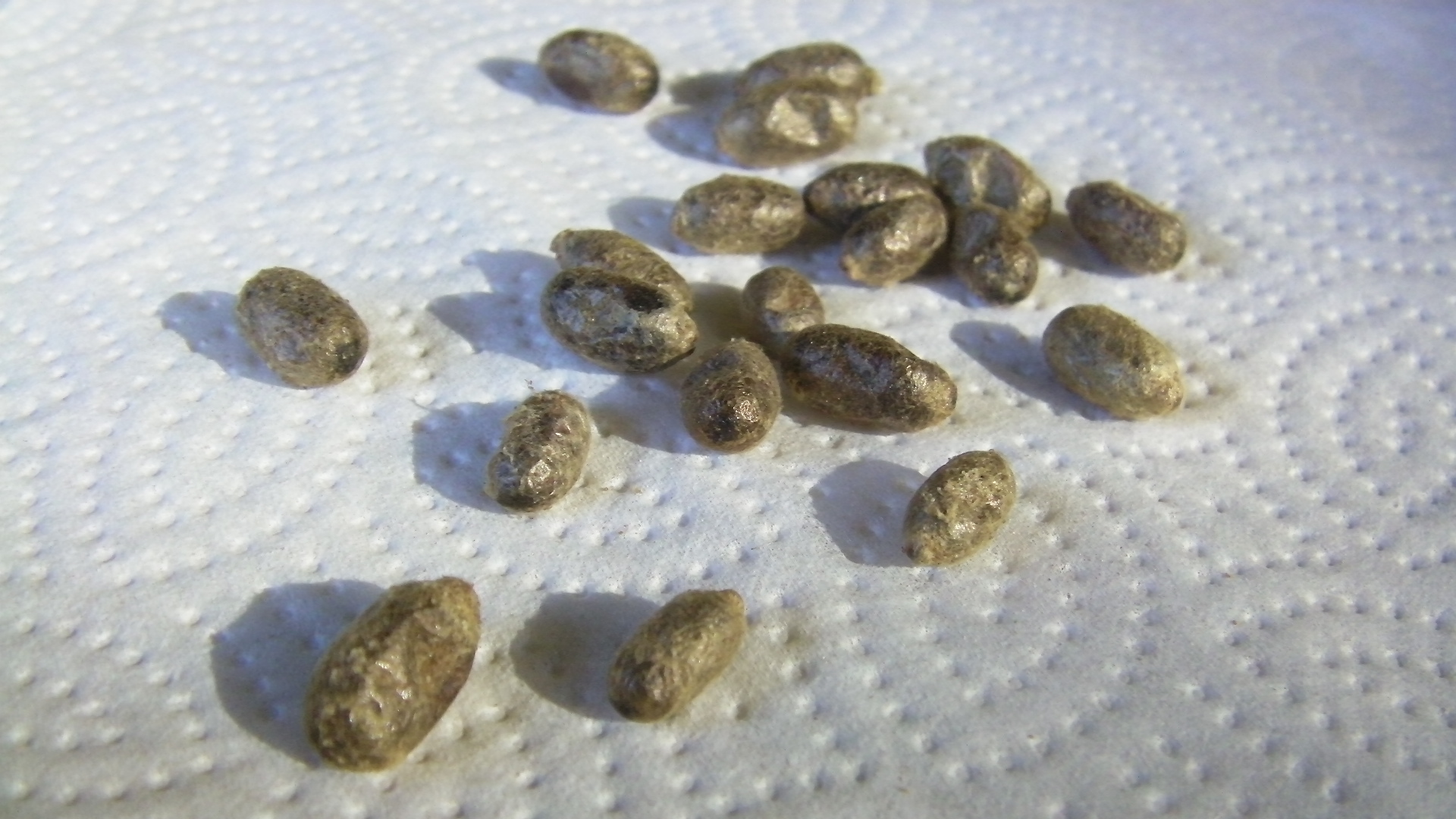
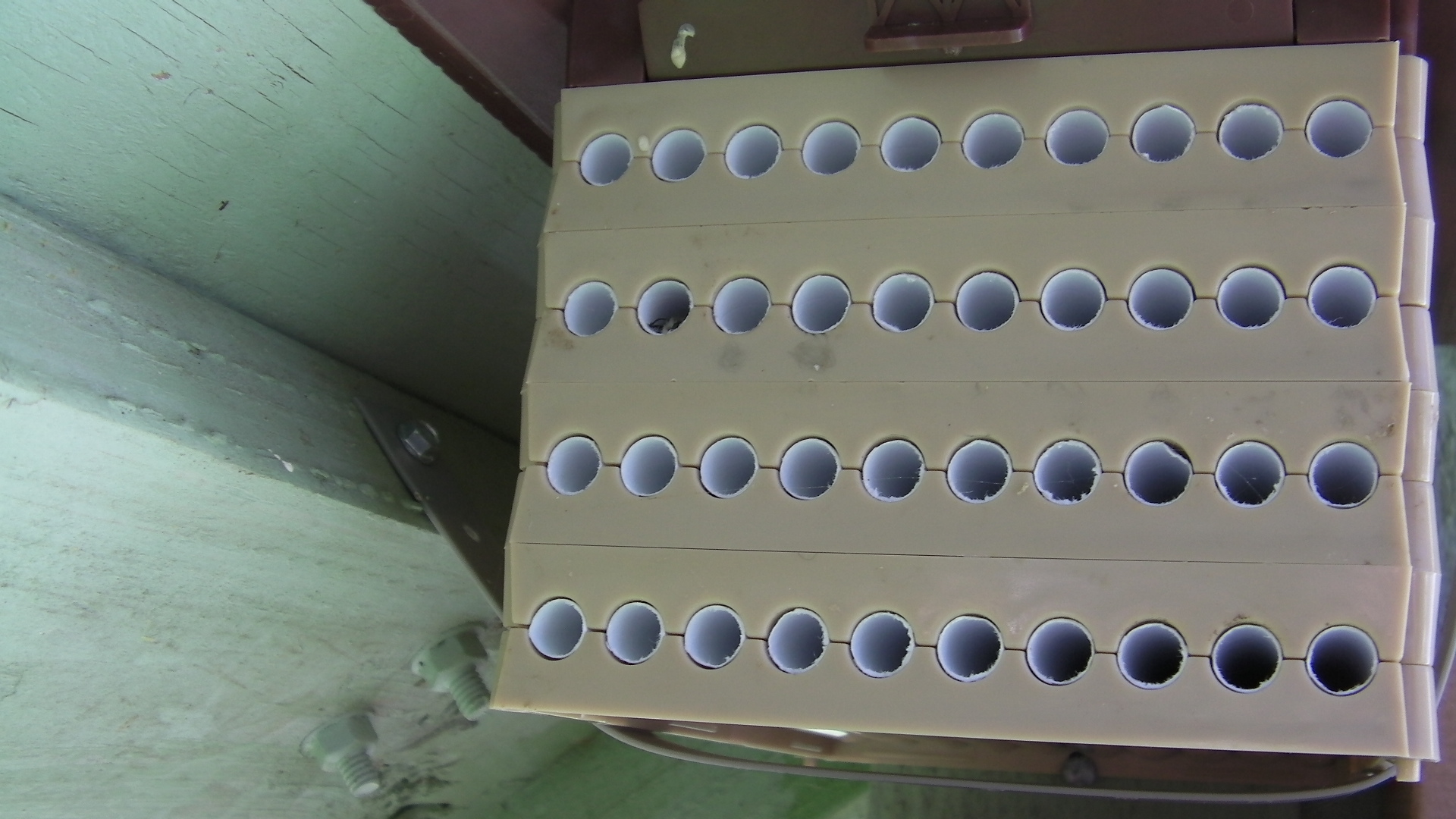
Last year my wife opened the refrigerator to discover the Mason bees were starting to hatch…this year we were determined to hang the nests before that happened. We ordered the cocoons from Knox Cellars in Western Washington. They provided this little ‘launch box.’
Ready to place cocoons into box
I saw some great plans on Dave’s Bees on how to build the nests so I got started yesterday.
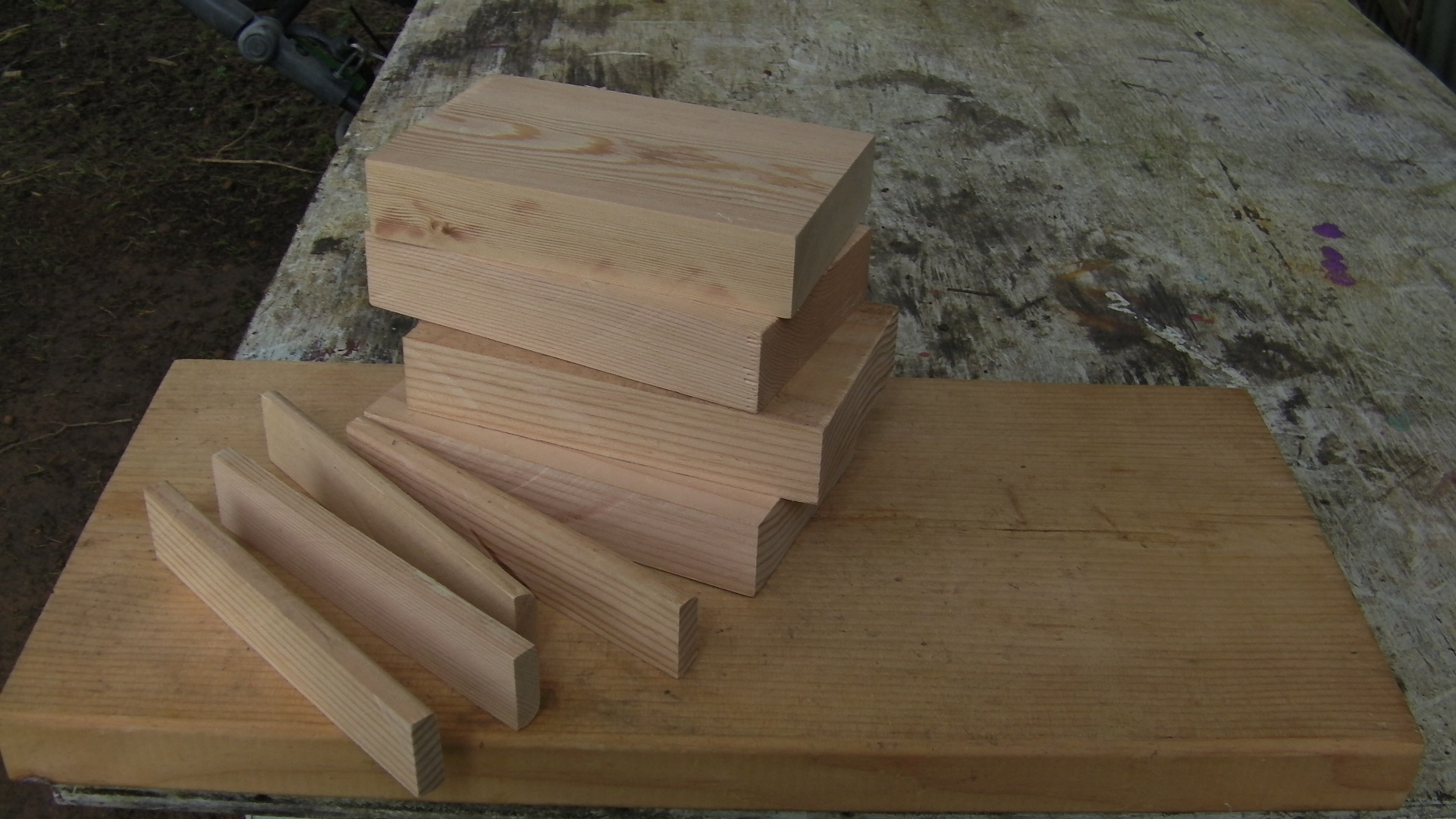
Saw off 1/2″ (1 cm) off 2x6x8″
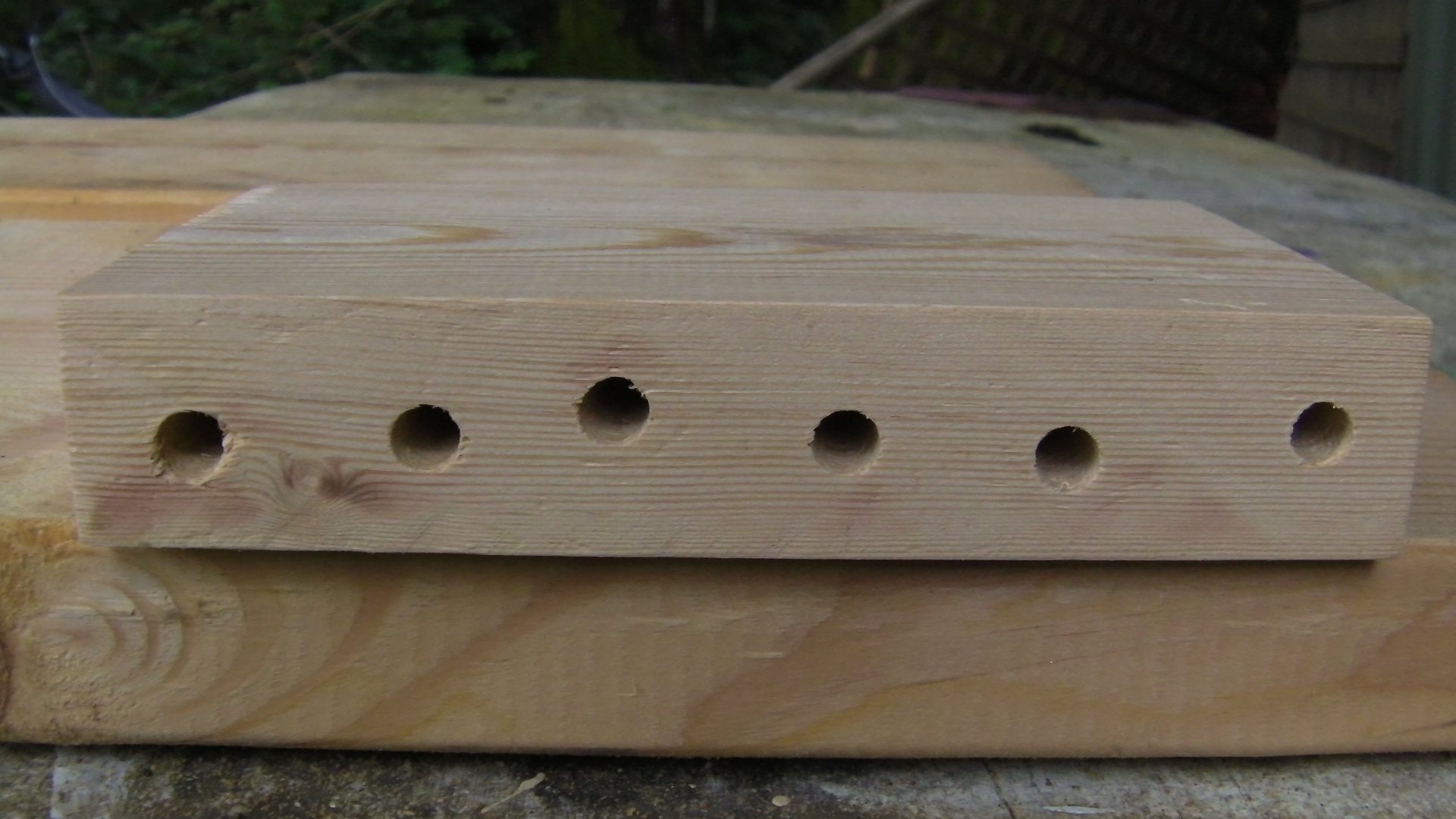
Drill 3/8″ (9.5 mm) holes more or less in a straight line about 3/4″ apart
I hope the bees don’t have a measuring tape…someone can’t drill straight!
I didn’t want to buy a longer bit, so I started with the top one and ended with the blade bit. Don’t start with the blade type…it’ll take forever to drill.
Assembly on kitchen table. My wife is knitting a bee hive hat…how appropriate.
The rolled up parchment paper liners are sticking out. They will be bent flat when the 1/2″ piece of sawed-off wood is fastened back on to seal it off. See Dave’s Bees excellent video.
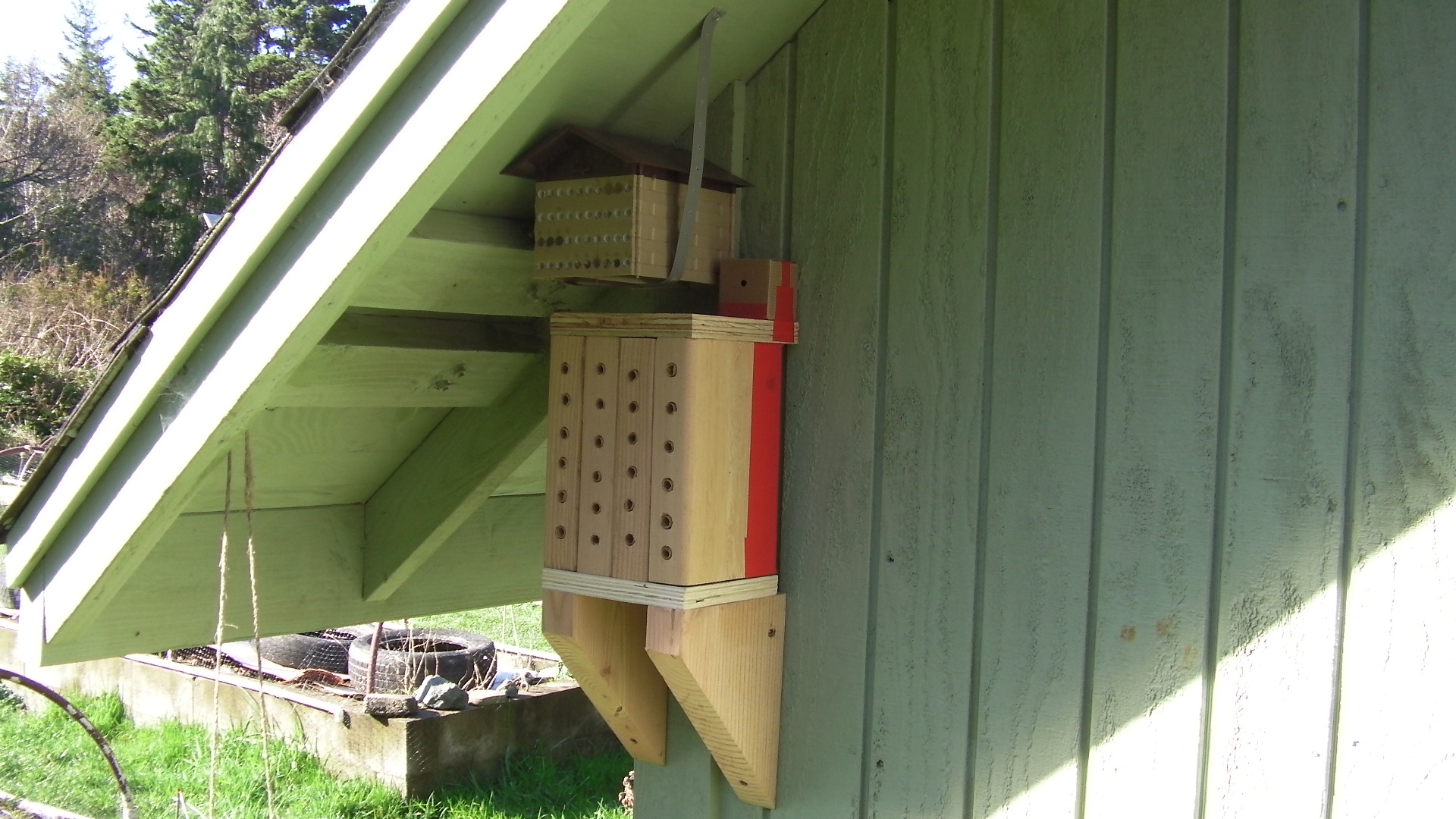
March 23…Mason Bee Nests in place with launch box taped securely
Grass trimmed under nests to make bees more visible if they fall below. The drones (males) will emerge first and wait for the females. Sometimes the females will emerge and fall to the ground.
After about a week of waiting we start to see some activity…
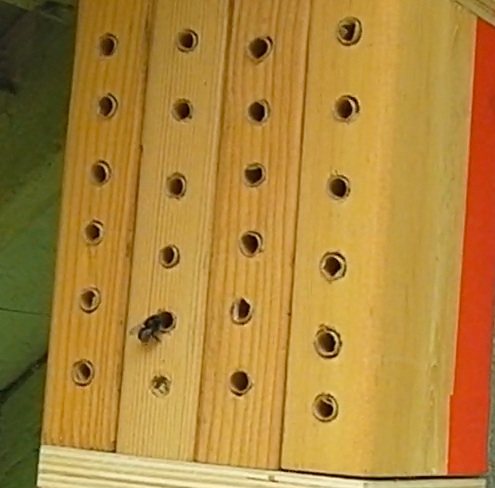
One shy bee showing in 2nd row 2nd from left
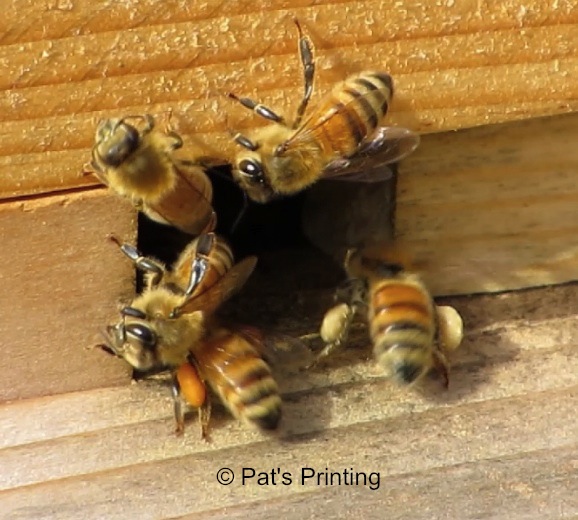
March 30…Mason bee entering straw tube in wood block
Keeping mason bees is one of the easiest method of beekeeping. Some interesting facts…200 mason bees will outpollinate 2000 honey bees. Mason bees rarely sting.
On a hot day in late March, the bees step out for some fresh air and dancing.
It’s unusably warm on the Oregon Coast today.
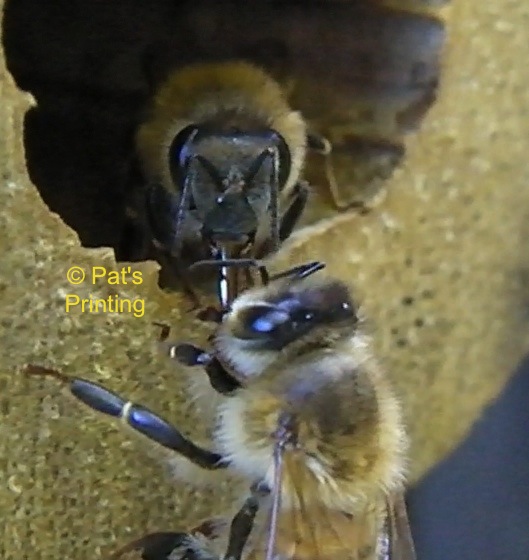
The lower bee has been fanning for awhile. While I was photographing, this other bee came out and fed her? I don’t know if that’s what it is, but from here, that’s what it looked like.
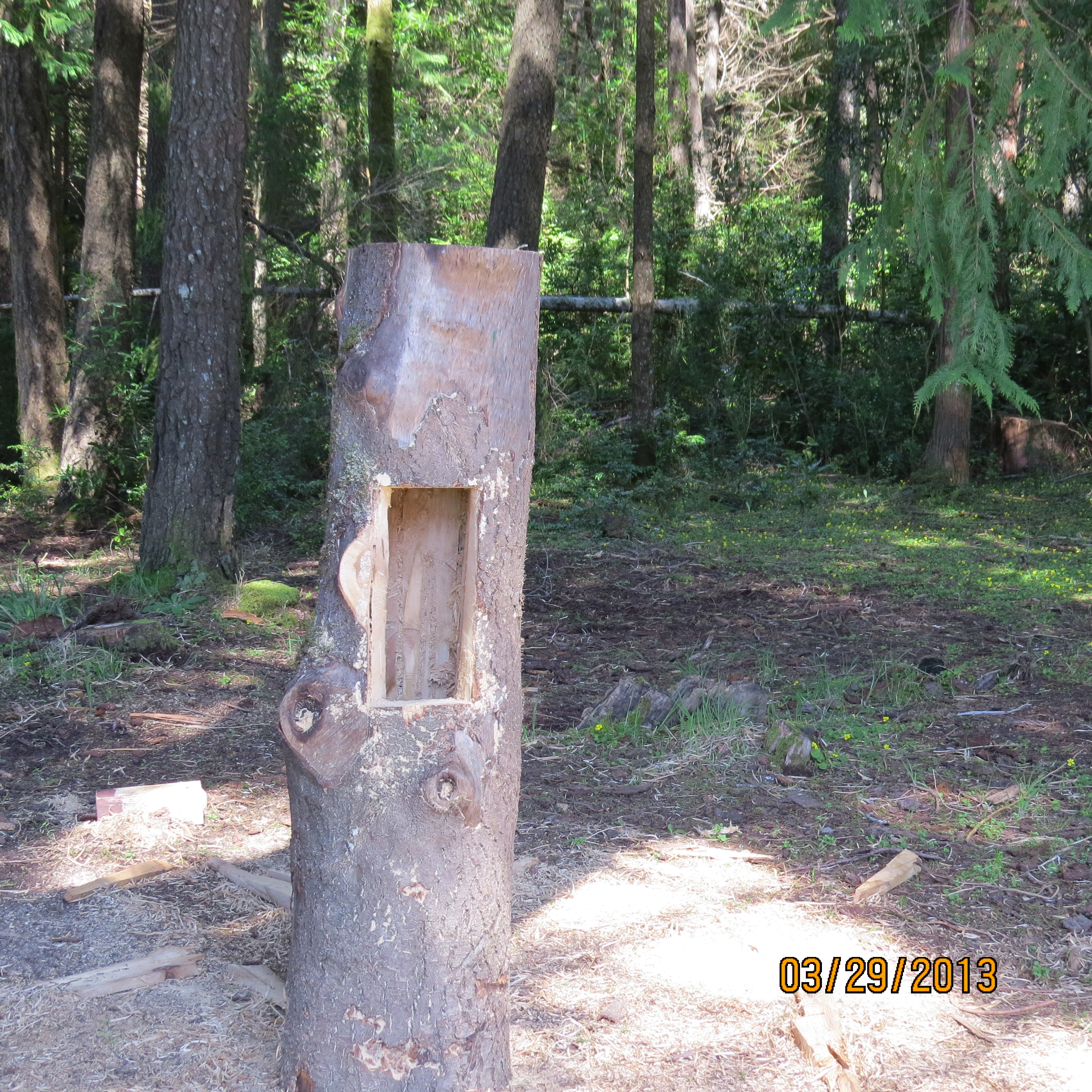
Pat’s next log hive progresses…much work still to be done before ready for bees.
Some bees are still outside the hive, at 10 pm. and 49 deg. F (9.4C)
After I added a frame of sugar on top of the single brood box, October 25, 2012, I figured that would do it for the winter. But at the bee meeting in January, we were advised to keep feeding into the spring. It was important because the bees would be flying more and using up the last of the honey stores…if the weather was bad, they wouldn’t be able to fly and could starve and all our efforts would be wasted. Just to make sure I ask the natural beekeeping forum. I was advised to super another box.
We opened the hive on a sunny February day, adding more sugar on top of the brood box, then added an empty box on top. Inside the empty box hung a bit of comb on two top bars that measured about 2 inches (5 cm) down. I figured the bees would come through the slits, eat the sugar which would give them energy to build more comb.
Feb. 15, More sugar added. Slits cut through newsprint to allow bees access to sugar from bottom box. The chunks of sugar on the right of center was all that was left of the batch we placed in October.
February 17, 2013 Bees feeding on new sugar above brood box
The bees came up through the slits no problem, ate at the sugar, but stopped there. They would overnight on the sugar…soon it was covered in bees. They didn’t have any desire to build on the comb slightly above their heads. Meanwhile the bees were crowding out the single brood box.
March 3…This box is getting very crowded…
What to do??? Okay, here’s a plan…if they like the sugar so much, let’s place the sugar frame above the empty box. They’ll sniff out the sugar, climb up the comb to the sugar, and build out their comb.
March 9…Adding more sugar to the frame and placing it above top boxes
We waited a few days before we realized the bees were NOT going up to the sugar and certainly NOT building up more comb. Meanwhile the bees were getting even more crowded in the brood box.
I go back to the beekeeping forum and notice that Bernhard has added some info about using ‘ladders,’ along with some very excellent photos taken with his expensive macro lens.
Should I try to buy foundation for the Warre…I don’t want to use plastic in my ‘natural’ hive, and I don’t want to use wax that might carry disease, but I do have a bit of comb left over from a failed hive last year which had swarmed late, not queened successfully and was finished off by the wasps. I piece it together.
Comb ‘ladders’ attached to bars. This pathetic looking comb has been in the freezer for 4 to 5 months. I don’t have much left so I hope this will encourage them to climb upstairs.
March 24…Adding the first ladder
And the second ladder…”Honey, how about trimming the grass in front of the hive?”
George Bennett wasn’t the first to visit Bandon from Ireland, but he was the one who named the town in 1891, because it reminded him of his home town of Bandon, County Cork, Ireland. His friend, Henry Hewitt Baldwin was the first. Baldwin’s ship, the “Captain Lincoln” wrecked north of the Coos Bay bar in 1852 and he hiked into this area. Baldwin persuaded his home town friend, George Bennett to settle here. Lord Bennett and two sons arrived in 1873. It is unclear how and when the title “Lord” was bestowed on him. Some members of the Bandon Historical Society Museum are in agreement that he acquired the title on the journey from Ireland to here. The former name of the town was Averill which is now the name of the Pioneer Cemetery where Lord Bennett is buried.
Averill Pioneer Cemetery, where Lord Bennett is buried.
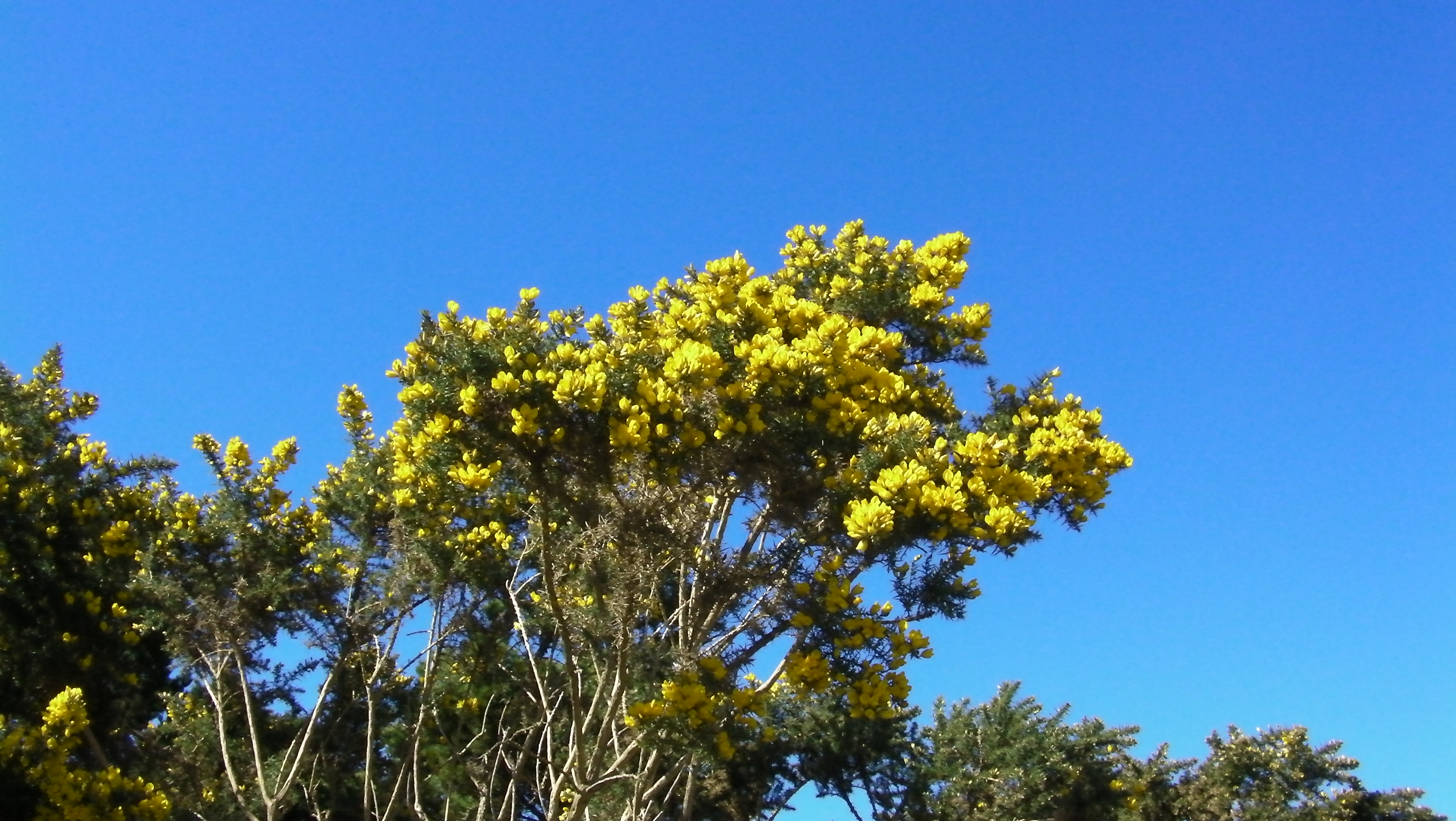
Lord Bennett is probably best known not for naming the town, but for bringing GORSE seeds to this area.
To say gorse is a nuisance plant is probably an understatement. It’s full of sharp spiny thorns, is impenetrable to walk through, and embodies an oil-type substance that makes it highly flammable.
In 1936, the Bandon Fire leveled the town, gorse being a contributing factor.
My new hobby of beekeeping has sparked an interest in gorse. When I joined the local bee club, I was advised that Bandon was not the best place for bees. “Too damp and windy.” I thought to myself maybe Bandon would have a slight advantage in the winter because of all the gorse growing here. It starts to bloom early to mid February and continues through late spring. This would be a definite advantage in giving my bees a nectar and pollen source mid winter.
Some photographs of gorse.
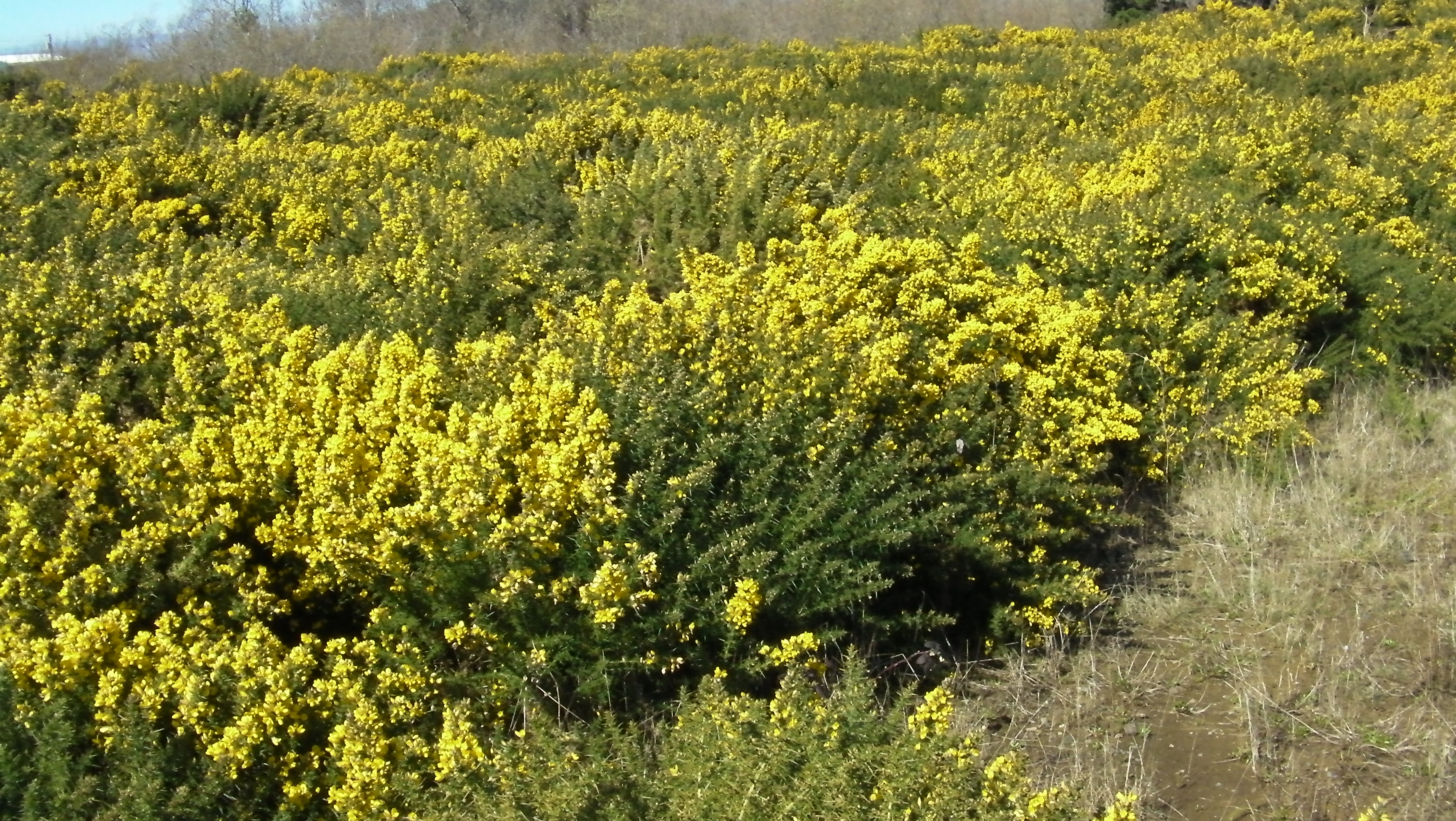
Gorse growing near town
Gorse can grow tall
Gorse pollen is orange…I had been hoping it was the yellow pollen I had seen going into the hive. February 13, 2013
Honey bee on gorse, up the road from me.
I love how the bees swagger when they are loaded with pollen…
I realize that without special techniques to properly identify pollen, I can’t say for certain that all the orange pollen is from gorse. Indeed, I could only find a small percentage of gorse with bees working it, but there is a lot of gorse that I don’t see. My bees were bringing in a gobs of orange pollen through February and early March. It’s possible this pollen could be coming from gorse. I’d like to think so.
These seeds are from last year’s Black-eyed Susan vine. Big and easy to plant.
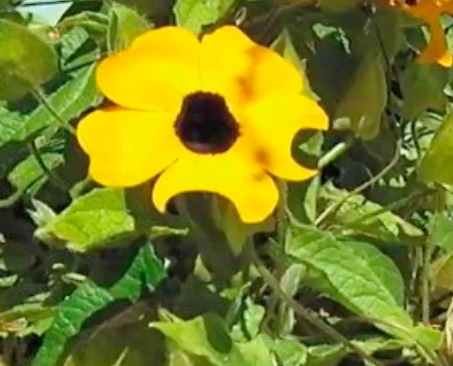
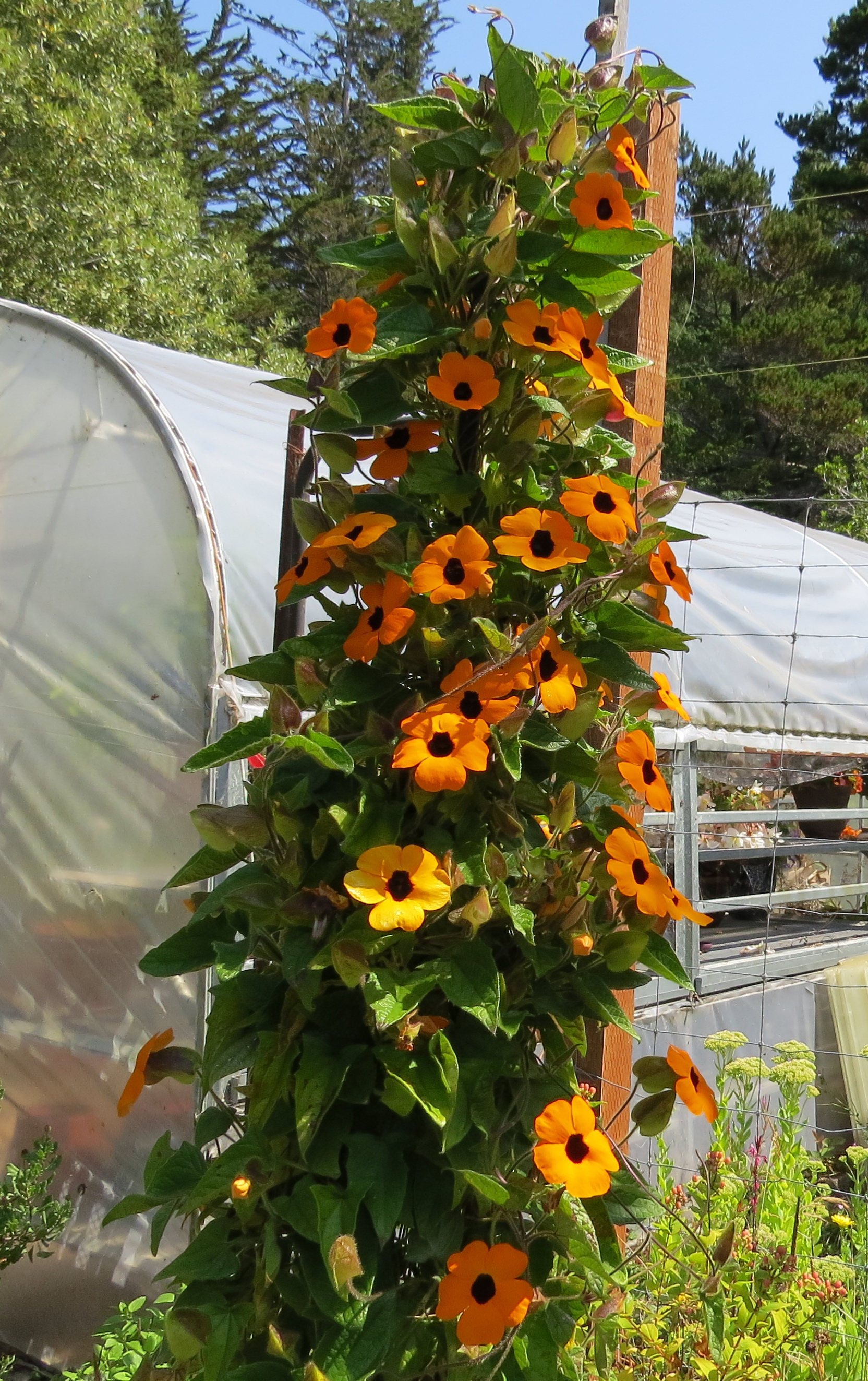
Thunbergia , also called Black-eyed Susan vines, attract leaf cutter bees.
These are not much to look at right now, but today we transplanted the Thunbergia seedlings into a hanging basket and left them under the fluorescent lights until the weather warms up. This year we’ll provide some bamboo tube housing near by.
This is what we are aiming for…last year’s vine…and where we saved seed from.
Black-Eyed Susan with leaf cutter ‘cut-outs
August 9, 2013 I haven’t seen any sign of the leaf cutter bees on this plant, but it’s not for lack of blossoms. We’re real happy with the way it turned out from our own saved seed.
August 27, 2013…This Thunbergia plant just keeps growing and growing. You can see an Echium in a pot below and the hop vine that my son-in-law said wouldn’t grow, at the top. I haven’t seen any “cut-outs” yet.
This is the video I shot last August of the Leaf Cutter Bees slicing up petals from the Thunbergia as well as a nearby Dahlia. I’m looking forward to getting more video this year. Hope they were planted early enough.
Could this be pollen from the laurel bush? It’s been blooming since Jan. 22. I know that you can’t tell by color alone, but at this time I don’t have the microscope or capability to properly identify pollen.
This is the first year I’ve had bees into winter. I was curious about all the types of pollen showing up on the bees entering the hive. I was sure some of it was gorse since we seem to have so much of it growing thanks to Lord Bennett of Ireland.
I made a 9 minute movie showing the bees on different types of flowers and Shigeo of the local bee association demonstrates how to transplant an Echium. I realize that some people can’t spare the time, so I’m offering ‘screen saves,’ as well.
Laurel blooming by Bonnie’s house
Bee on laurel, tannish-colored pollen…January 22, 2013
Bees on rosemary, at City Hall, February 8, 2013
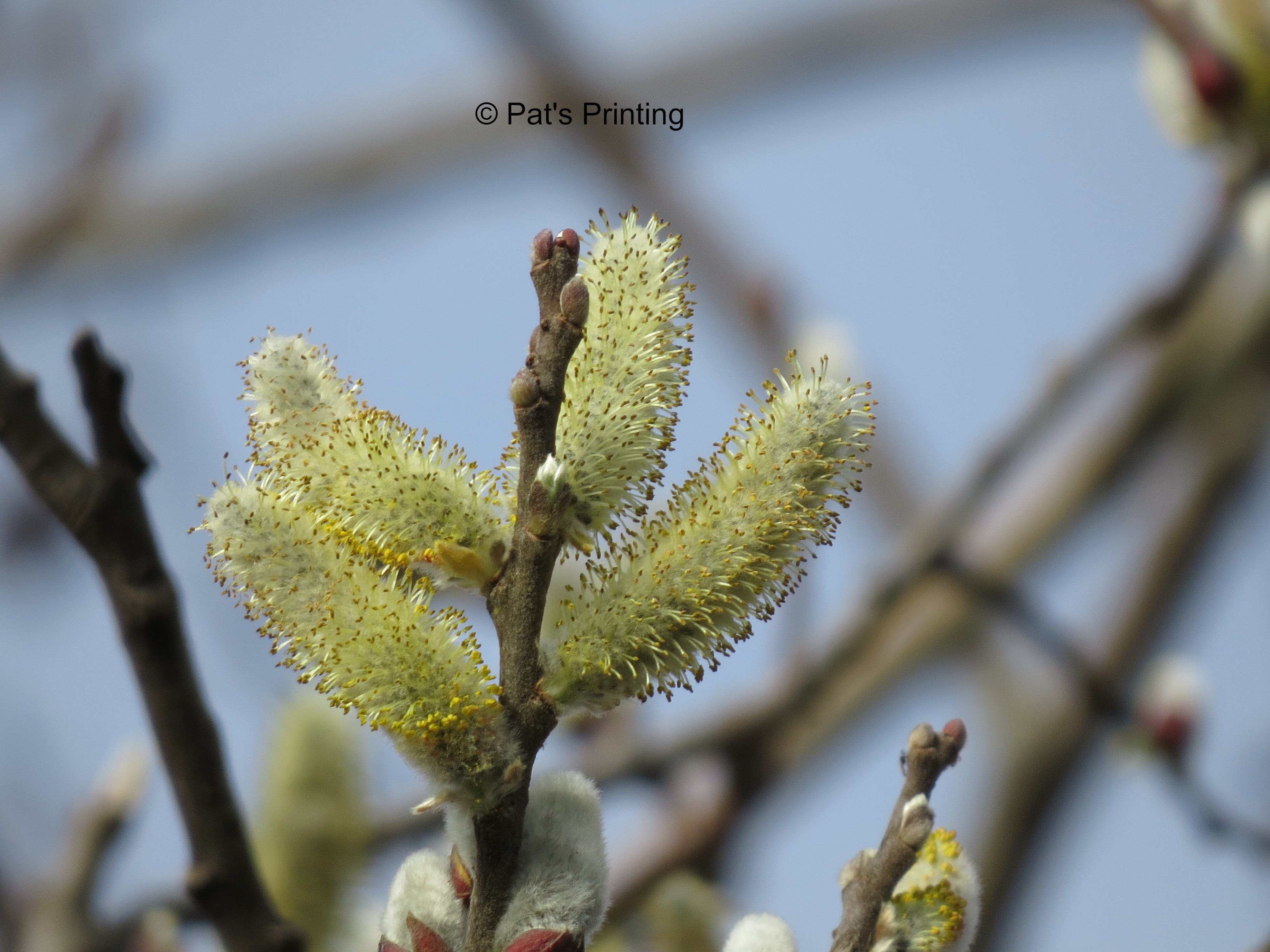
Willow catkins blooming near our hives…sun comes out…bees love it. February 8,2013
Gorse pollen is orange…I had been hoping it was the yellow pollen I had seen going into the hive. February 13, 2013
The video shows this bee in slow motion working the pollen back to it’s pollen sac. I didn’t see it at first until a more experience bee keeper showed me. February 13, 2013
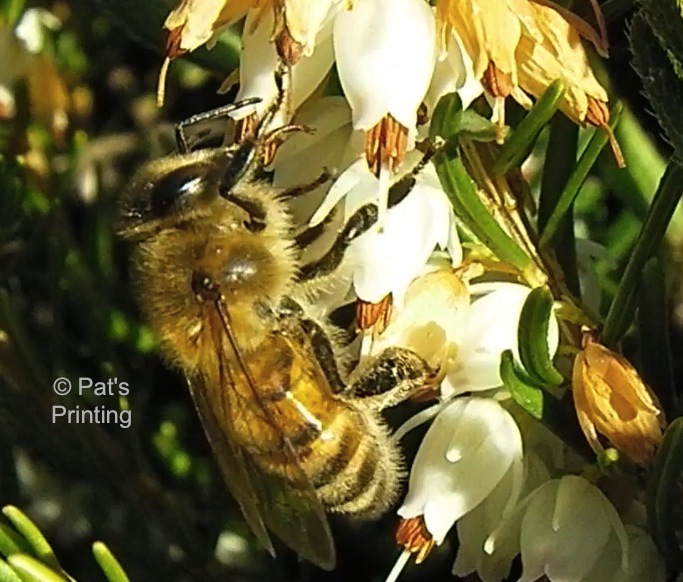
Bee on heather, 2-14-13, right up the street from Joe and Karen’s house.
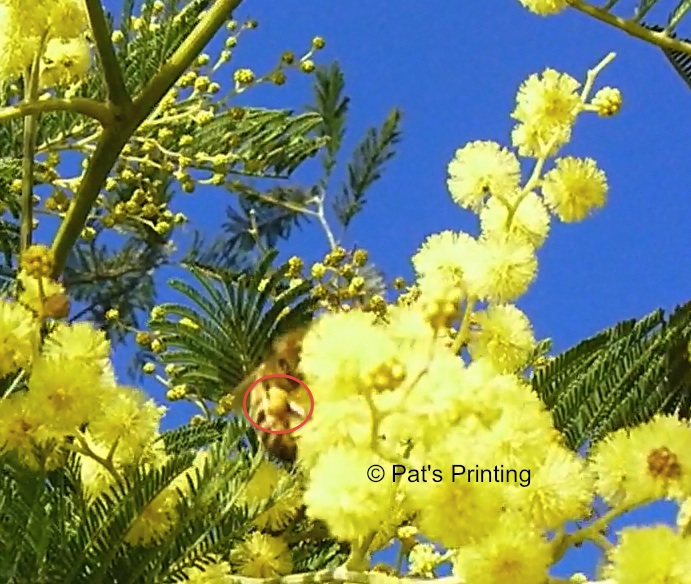
Bee on acacia, 2-15-13…Shigeo showed me this place to get some video. By the time we got to it, the bees were returning to home so I only got a short clip of it.
Shigeo shows how to transplant an Echium Tree.
Echium for 2013…I’m hoping this plant will shoot up 10 feet (3 m) starting about April or May. The tarp protects against freezing weather.
These are the plants that Shigeo demonstrated in the video, how to transplant. They are my hope for 2014
We planted this echium in late October 2011. It just stood still for several months. About April or May we noticed it had grown to about 10 feet. The bees worked it for 3 solid months.
The video shows the bees in action on the flowers. I used the Canon SX-50 (50x optical zoom) on the laurel as well as the willow catkins. My little pocket camera, a Sanyo Xacti performed admirably for the rest of the close ups…I love the ‘super macro’ feature.
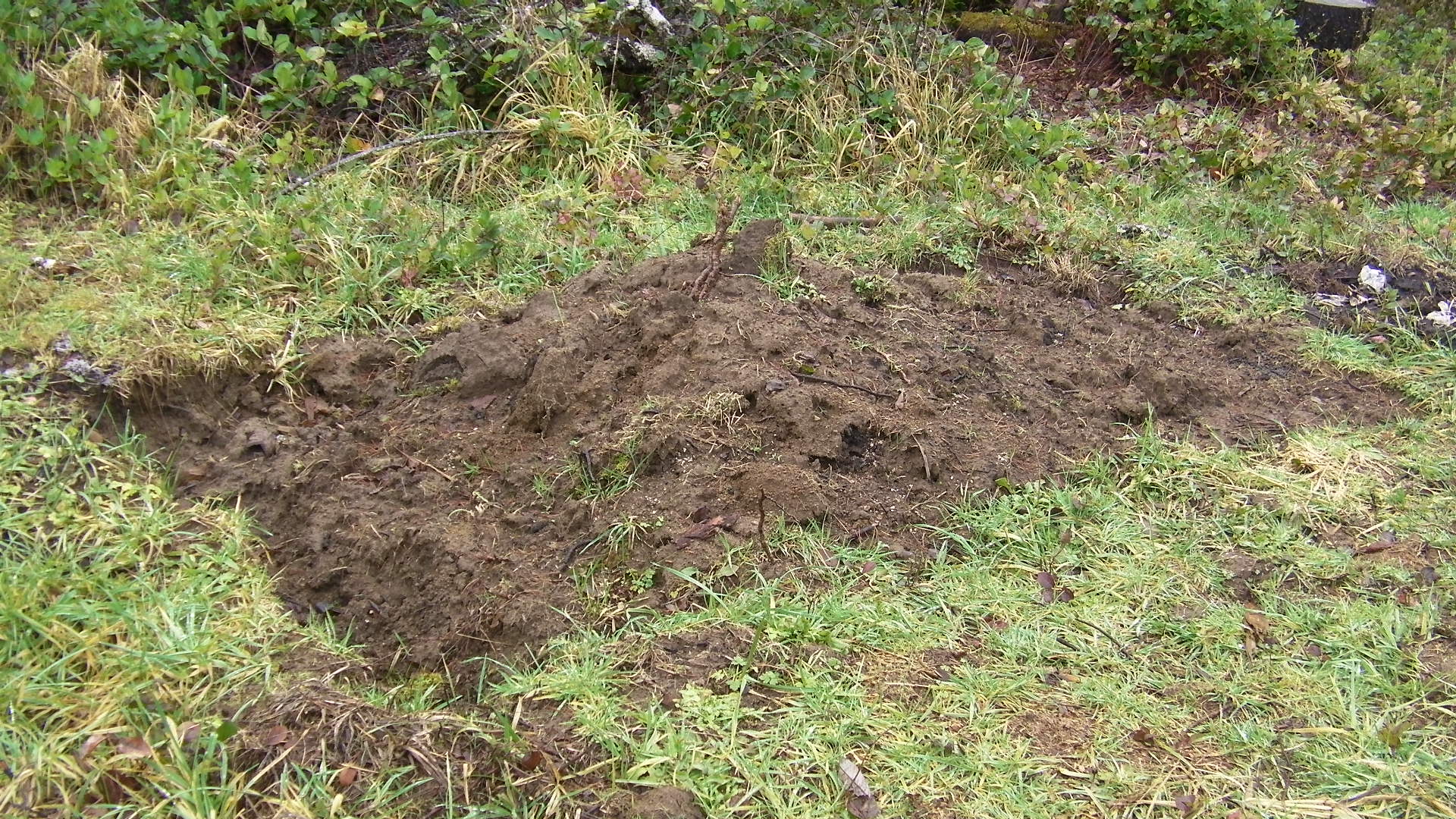
This little patch of land is going to be the hugel kulture bed
My son started looking at perma culture ideas. “Hey Dad, I was thinking about building a Hugelkulture bed. You put in logs that are loaded with mycelium and plant in them. You don’t ever need to water.” “That’s interesting,” I said, “but you don’t have any room for something like that.” “No, but YOU do.” That’s true and I’m always game for trying out a new idea. My son has helped me so much. He installed my solar projects, roofed my house and shop, and repaired a bunch of rotten siding on the house. Why NOT try this out? I’ve got lots of rotting logs too.
Pick and shovel work. I don’t think I’ll go down any deeper because I’ll hit water at this time of year.
This will be a little experiment. I’d like to plant bee-loving flowers like Nasturtiums, Wall flowers, and other flowers which the deer won’t eat so I don’t have to fence it in.
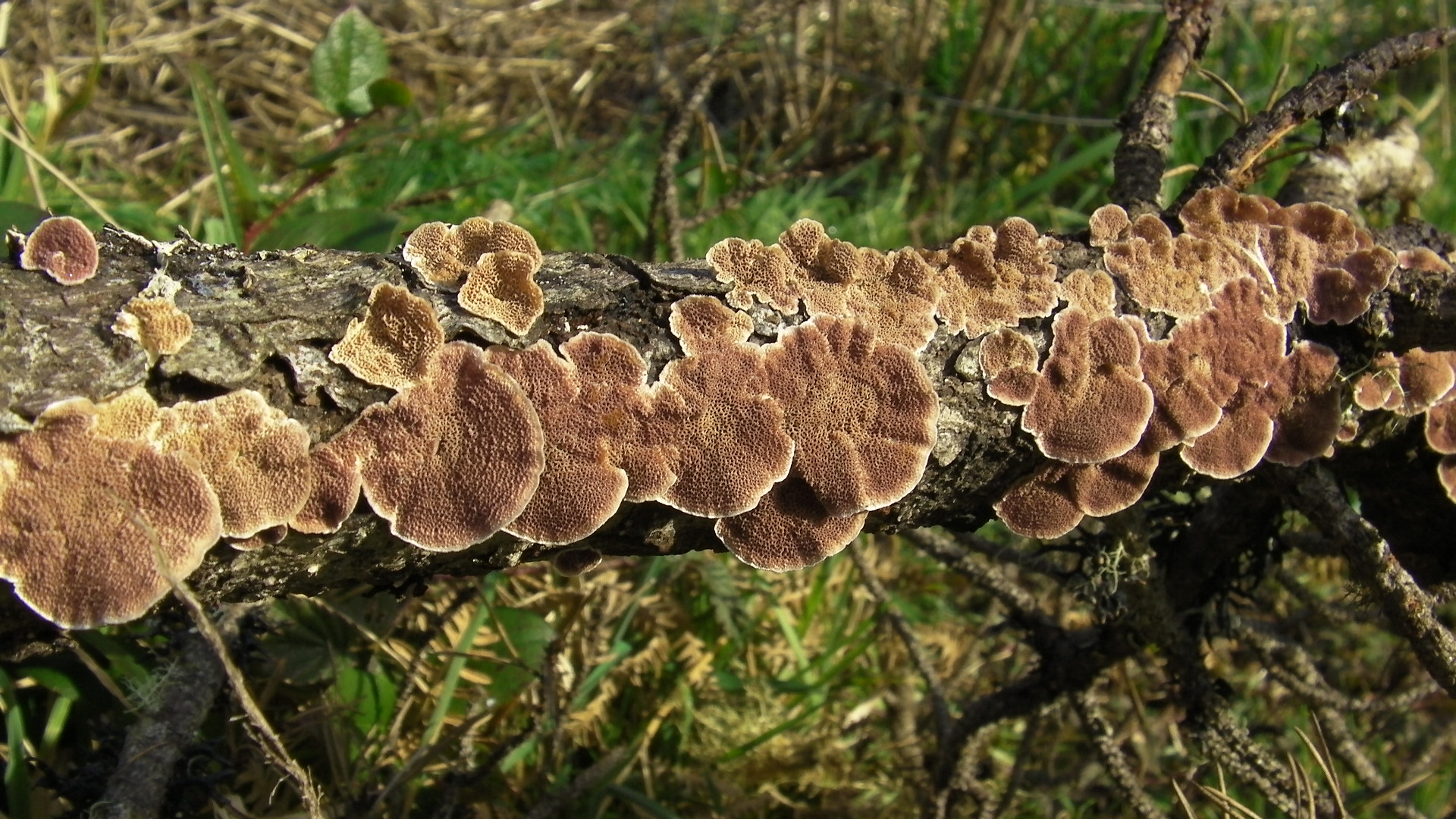
The next weekend I was working on a burn pile of accumulated storm debris. This had been piled up for a few months. We wanted to get the place cleaned up for visitors, this weekend it wasn’t raining, so it must be done NOW! Everything was so wet it, it was going to be an all day affair. As the fire got built up, I started pulling out branches to burn and starting seeing wonderful mushrooms and examples of mold. I didn’t want to destroy this beautiful living organism, so I started collecting it for my hugelkulture bed.
White tinged dusty pink mushrooms on log. It would be a shame to burn it…toss it into the bed.
Yellowish mold on branch…into the bed.
White mold on stick
Whitish pink mold on branch, save it for the bed.
This log is saturated, look at the moss growing one it. Good candidate for the bed.
I figured the mushrooms and mold grew because it was in contact with the wet branches and bamboo leaves, so I better add them to the mix.
Double split-pea soup made from scratch by my sweetie, so we could eat while I tended the fire.
Not as neat and tidy as the Hugelkulture web site, but hey, let’s face it, nature is messy.
Rotting firewood, mold all over it…into the bed
Are these drops of sap? Are they feeding the mycellium? I don’t know, but it’ll be good for the bed.
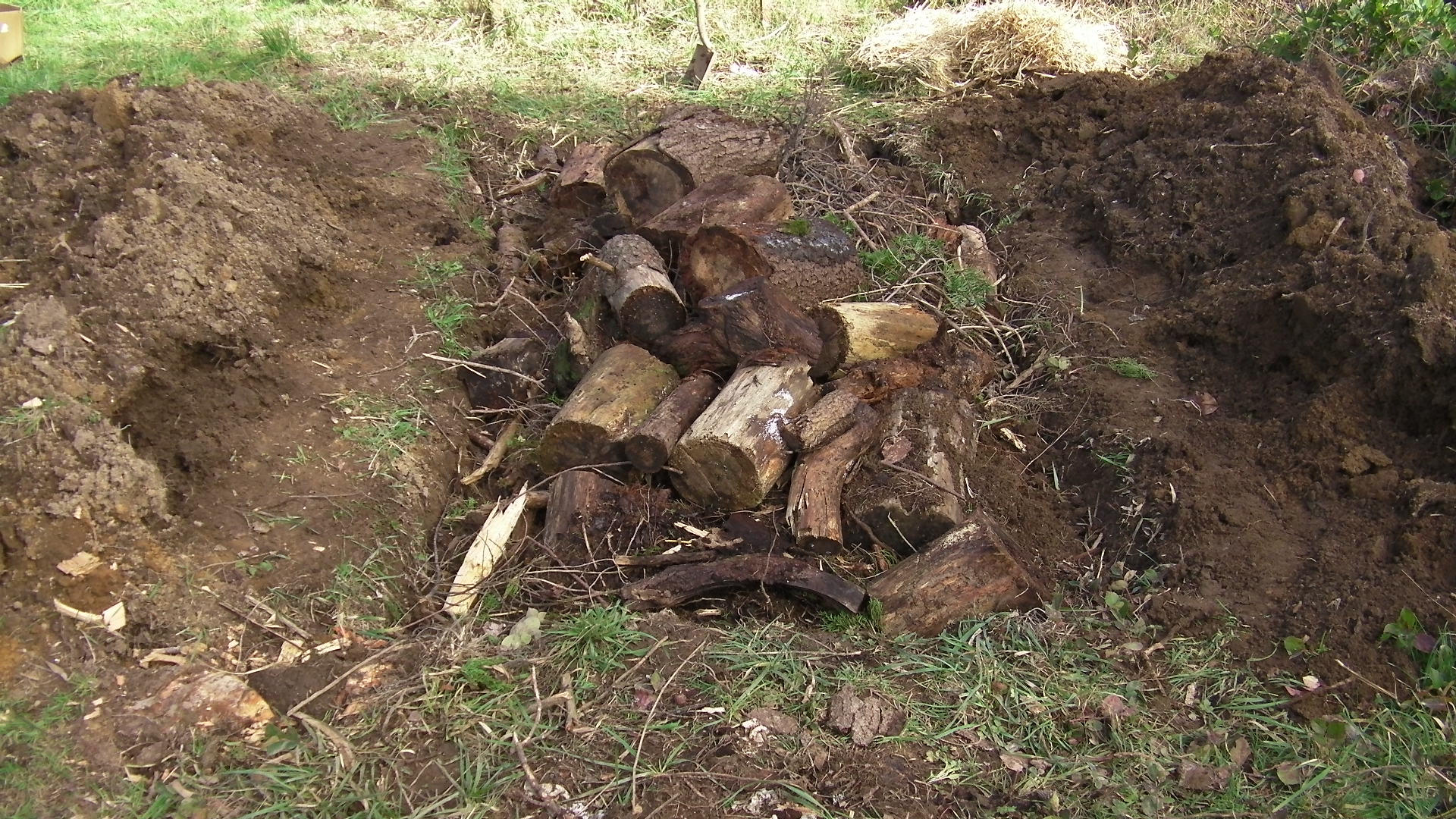
What it looks like so far
Added more rotting logs this end
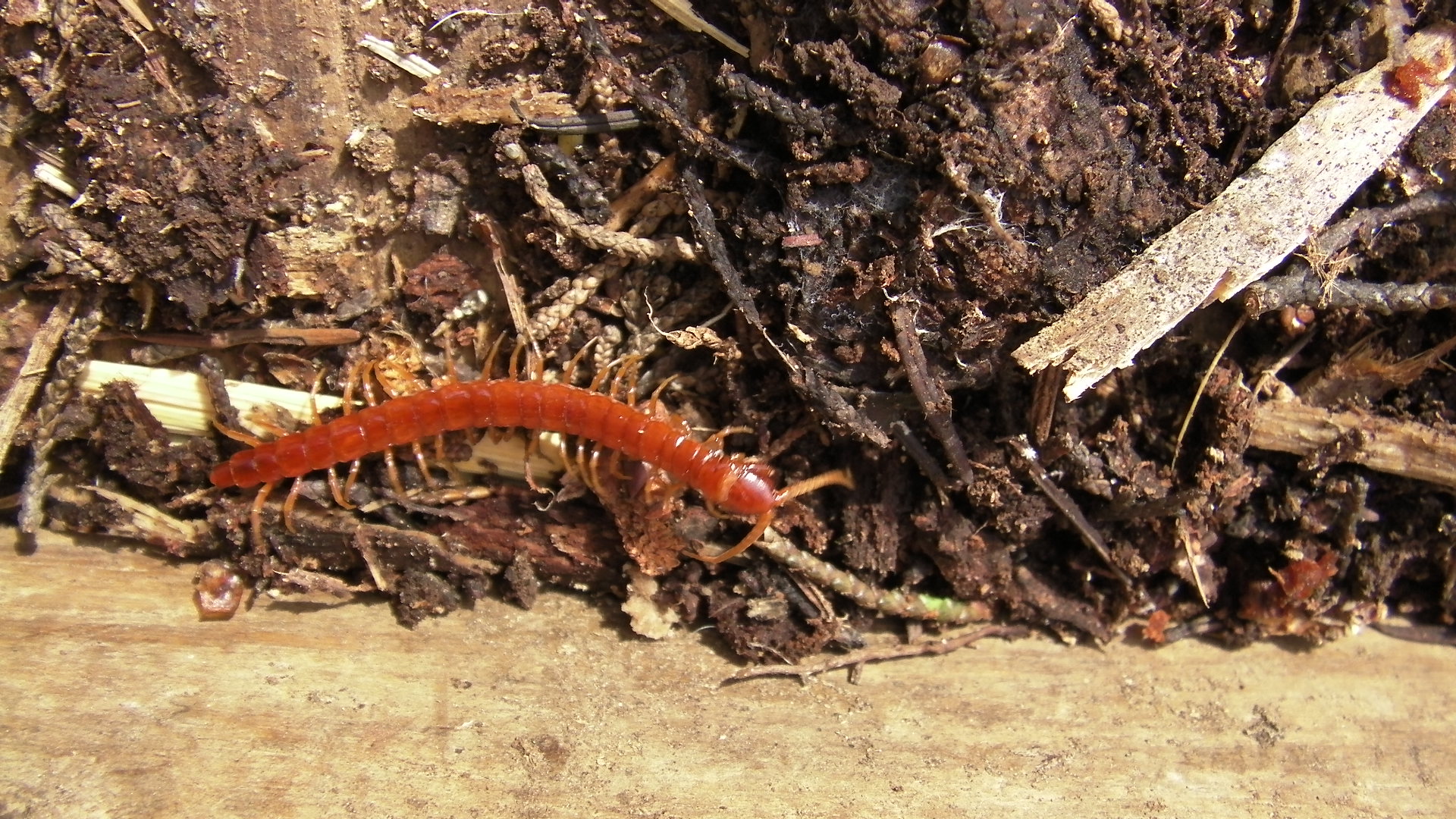
Centipede roaming around in the power wagon…into the bed!
As a newbie beekeeper I thought the bees just kept within the hive during the winter, leaving the hive infrequently. I know things are different on the coast because we rarely get snow, but we get loads of cold winds and driving rains. So it’s to my surprise that the bees are so active. They are actually bringing in pollen during January and early February. I’m hoping the yellow pollen is gorse, because everyone around here hates gorse so much (with good reason…it’s blamed for burning the town down in 1936), I’d like to know gorse is good for something, especially since it usually blooms early February.
I’m concerned about the Warre hive. The top video shows the front of the hive with the bees bringing in yellow and orange pollen and through the observation window in back. I’d like some advice from more knowledgeable beekeepers about what to do. I almost nadired another box underneath, had planned for the forecasted hottest part of the day at 55 deg.F (12 deg.C) but then the temperature turned cool. Should I add another box so they can grow into it before they swarm or should I wait for a few more weeks because the winter weather will return the latter part of February and into March? Another box means they have to heat it. I’ve got a dry sugar pad above the box as a just in case food source.
The log hive below looks very strong, lots of activity whenever the sun comes out and the temps are in the 50’s (10 C) bringing in pollen during January and February. Those bees came from a feral tree hive. I’m leaving them alone to fend for themselves. I’m hoping the hive will act as an undisturbed ecosystem…bees adapting to survive mites and other pests.
Hope to have another log hive in place before they swarm.
I’ve never been accused of being a good writer. My grades in school were mediocre at best. So when my daughter offered to set up a blog so I could write about bees, I thought “this will be interesting.” She IS a writer. When she was young our family would play little word games. Her older brother and I would be haltingly coming up with words, but when it was her turn, she contributed loads of well placed words. She couldn’t have been over 8 years at that point. Where did she learn all that? Possibly from her Mom reading to both kids every night before bed. Obviously, she didn’t get it from me. My fallback line has always been, “I’m a printer, not a writer.”
Blogging has changed everything. While I still have trouble putting thoughts into words, taking a photo first makes it much easier to write, but it still takes time. Only after the dinner dishes are done, do I get to blog…although I have been known to cheat here and there during the day. When my wife goes to deliver some print jobs I know I’m good for awhile… “I just want to finish up this thought and then I’ll get back to work.” All of a sudden I hear the car returning…”Yikes, I just blew a whole hour! I better get busy before she comes in.”
She does all the cooking, mostly from scratch, cleans the house, works in the shop and even takes time to knit in the evenings. In the summer, add the gardening to the list. What do I do? I work the presses. Thankfully, she doesn’t know how to do that or I might be out of a job. I’m also SUPPOSED to be getting the expenses in order for taxes, but when I get on the computer, I’ve got to look at my stats and comments and…the hours just fly by…sucked into the vortex. While my wife is very understanding, the Internal Revenue Service is not, so it looks like it’ll be less blogging til I catch up.





























 Adventures in Natural Beekeeping