As soon as the main nectar flow quit (blackberries), the bees started working the Phacelia. It was then that I noticed the blue pollen. I can see why they preferred blackberries…these blossoms are hard to work.
A bee works the borage in late July. A second batch of borage has reseeded itself and will hopefully bloom during autumn.
August 22, 2014…I finally visited Barbara’s Mock Orange tree. It was everything she said it was. Covered in white blossoms with bees all over it. Note: this might NOT be a Mock Orange. See below what Carol Quish of University of Connecticut had to say.
Two bees on Barbara’s Eucryphia Tree
August 29, 2014…When I think of summer, this is what I picture. SUNFLOWERS. Last year we had precious few. This year we grew a few more for the bees. It was hard to stay in the shop during the blue sky, bee-flying, sunny days.
September 1…I’m soooo glad I planted these Autumn Joy sedums a couple of years ago. The bees get nectar from it from late August through September. How many bees do you see? It’s easier to count them in the video. When we first got the notion to buy these Autumn Joy sedums, it was mid September, 2012. My wife was unloading the potted plants and the bees found them as she was carrying them out to the garden. If you have some space, plant some right away. Your bees will thank you. 🙂
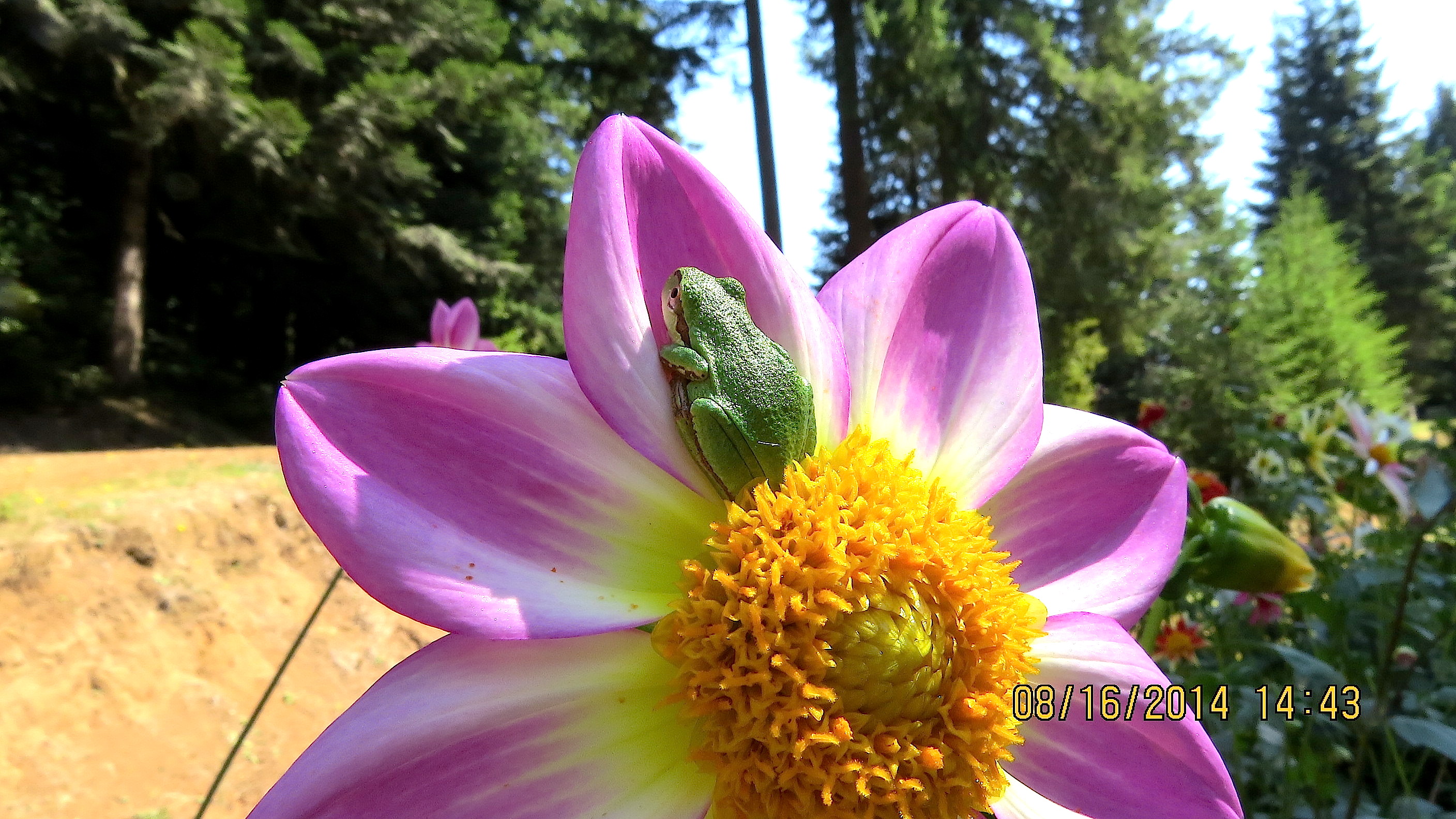
August 16, 2014…This anemone dahlia serves as a rest stop.
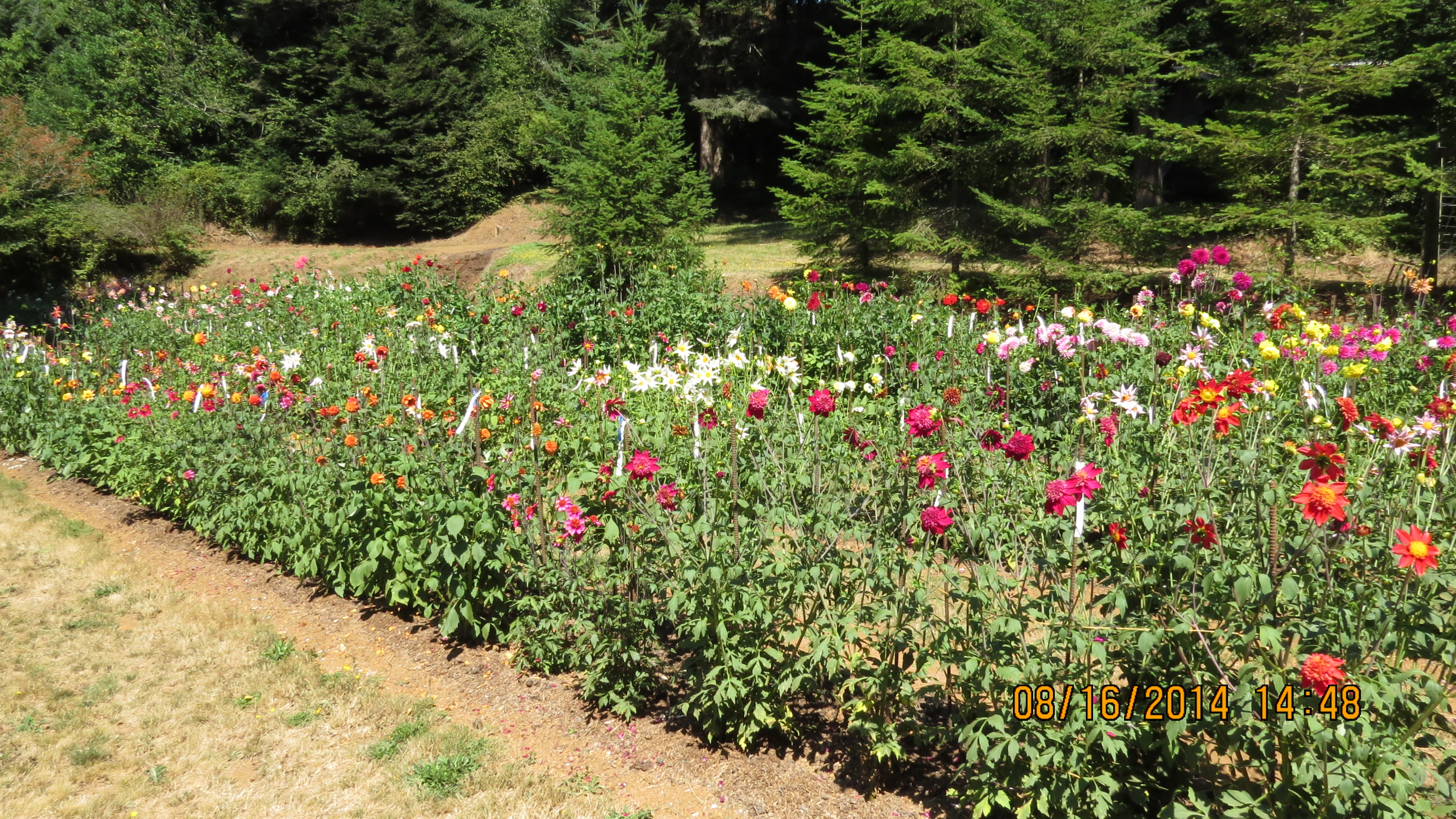
Looking over Kathy’s dahlias at some of the 2500 kinds that must be whittled down to 100.
Kathy grows dahlias…lots of them. Knowing of my interest in bees, she has explained how bees have helped her to grow different kinds of dahlias. For many years, she hand pollinated the dahlias she wanted to hybridize. About a year and a half ago, a swarm of bees chose a nearby cedar tree as their future home and started visiting her dahlias. Kathy says she gets much better results from the bees’ pollination. She collected the seeds after pollination and grew over 2500 kinds. Of the 2500, she will select only about 100 that make the grade. (I’m glad I don’t have to decide, I like them all.)
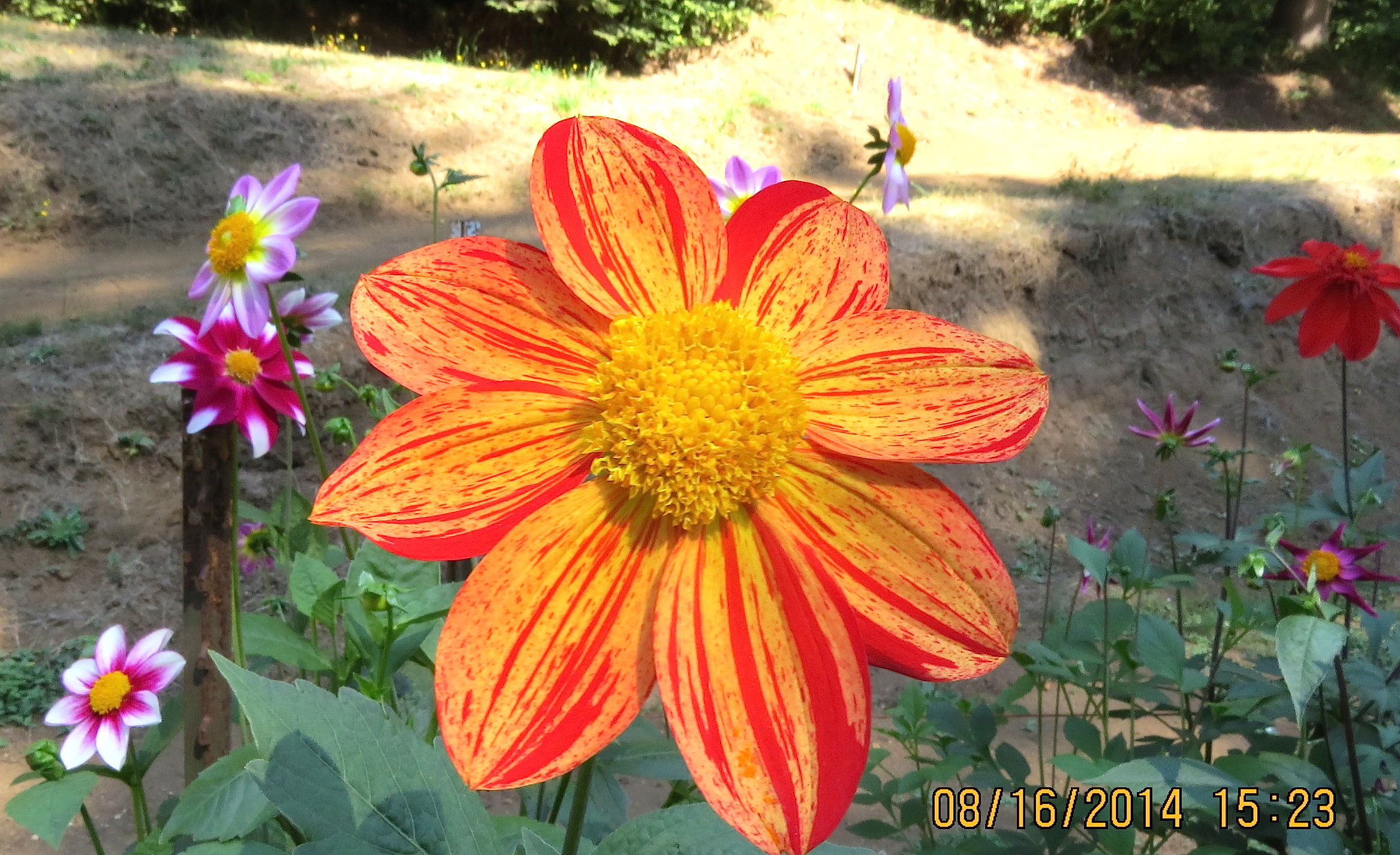
This is one of 2500 varieties that Kathy grew this year. She must whittle it down to about “100 keepers.”
This is known as a giraffe pattern dahlia. Kathy says she is indebted to the bees for their pollination services. I am intrigued by the variety of styles.
An orchid form dahlia
August 16, 2014…Since the bees adopted this high up cavity in a cedar tree, Kathy has benefited from them pollinating her dahlias. In the video you can see how high up it is with a steady stream of bees flying in and out.
Is this a keeper or will it go into the compost? Kathy hasn’t decided yet, but she does like what she sees. It started opening up yesterday and will look different tomorrow, “it’s promising,” she says.
Kathy says she is indebted to the bees for making this one which she is planning to keep.
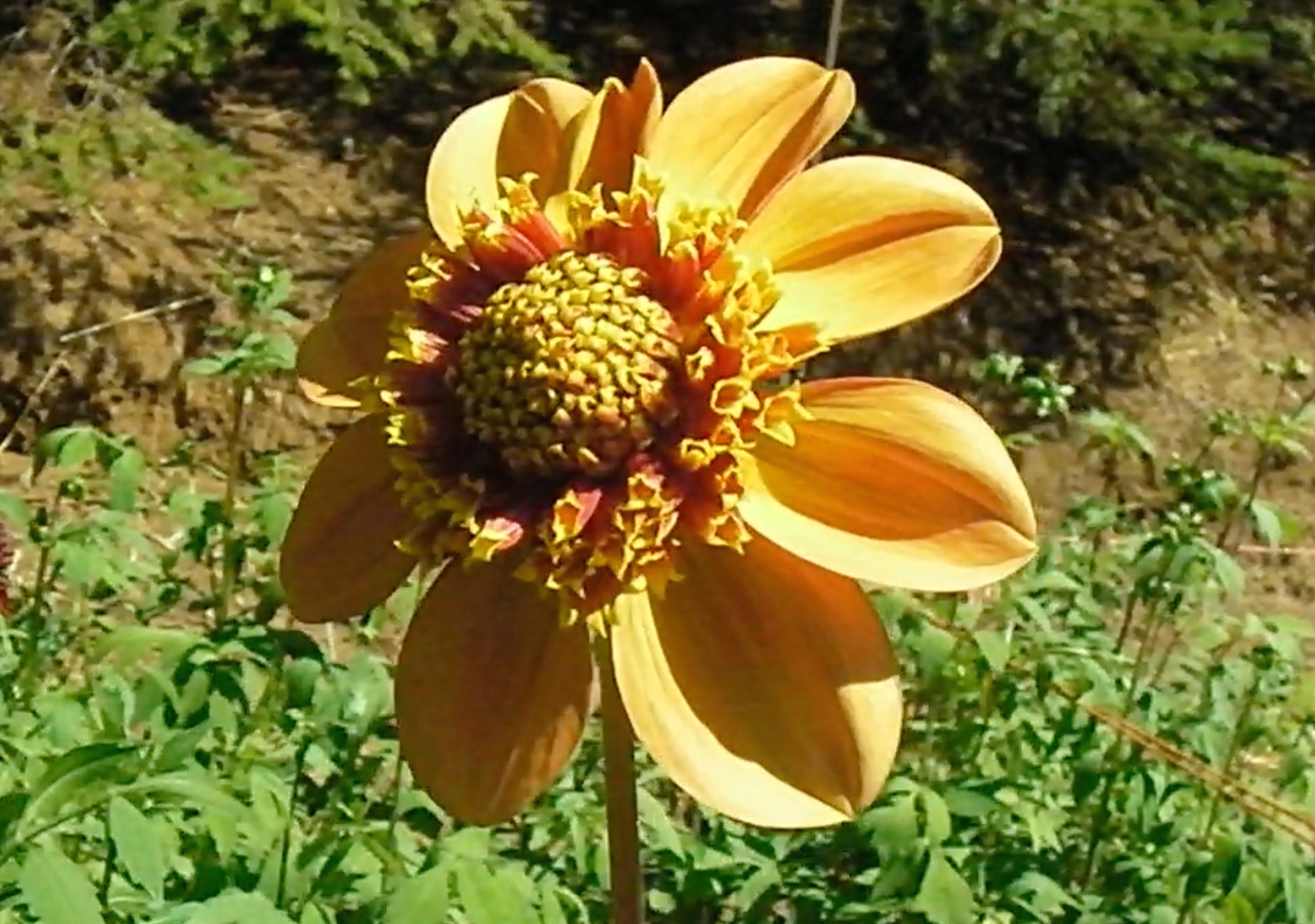
Sunspot…a mignon dahlia creation that Kathy has let us grow for our bees.
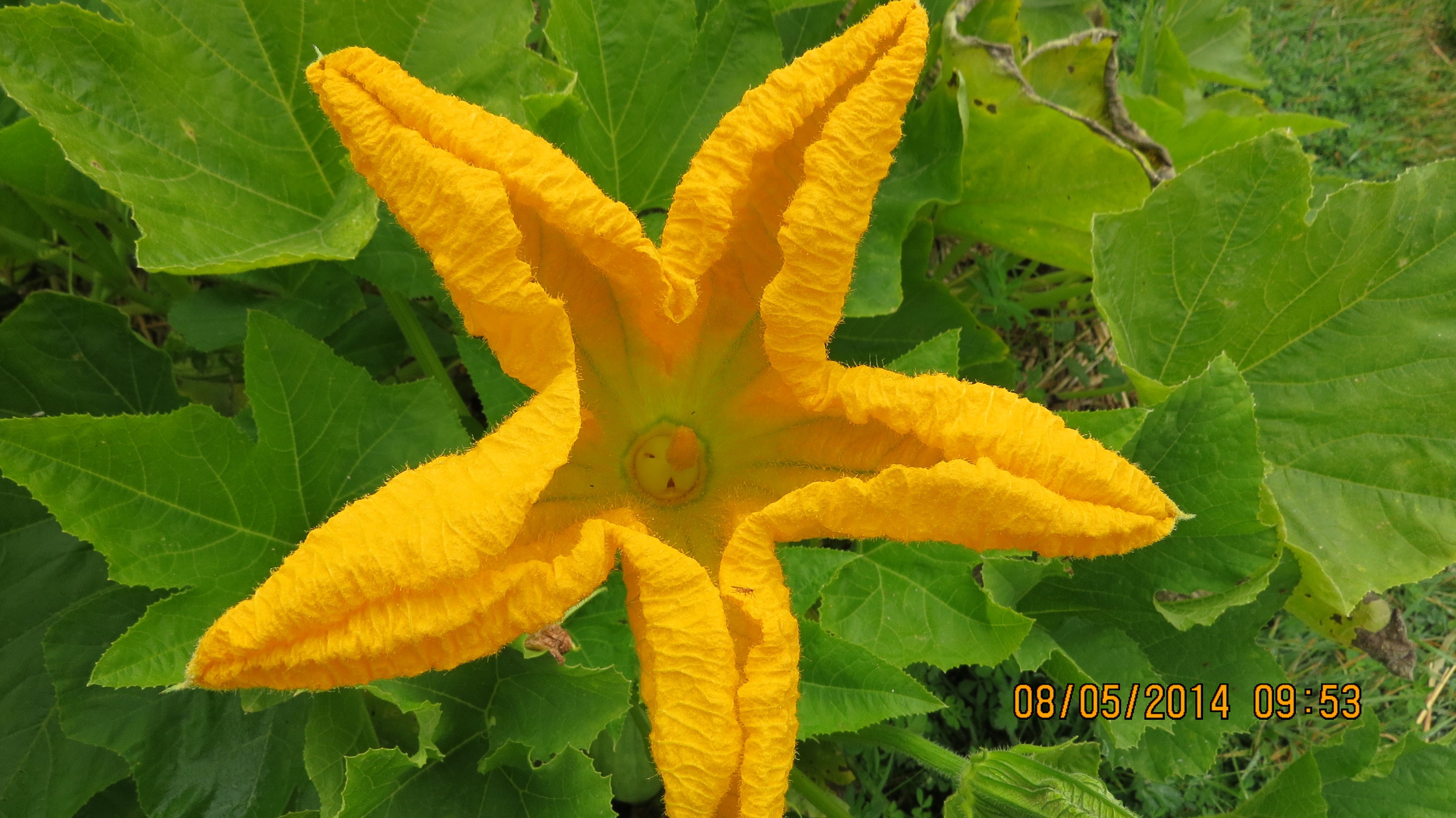
August 5, 2014…Male squash blossom (possibly an acorn squash) You can see the small sipping holes where the bees get the nectar. Male blossoms open earlier than female blossoms and stay open for days at a time.
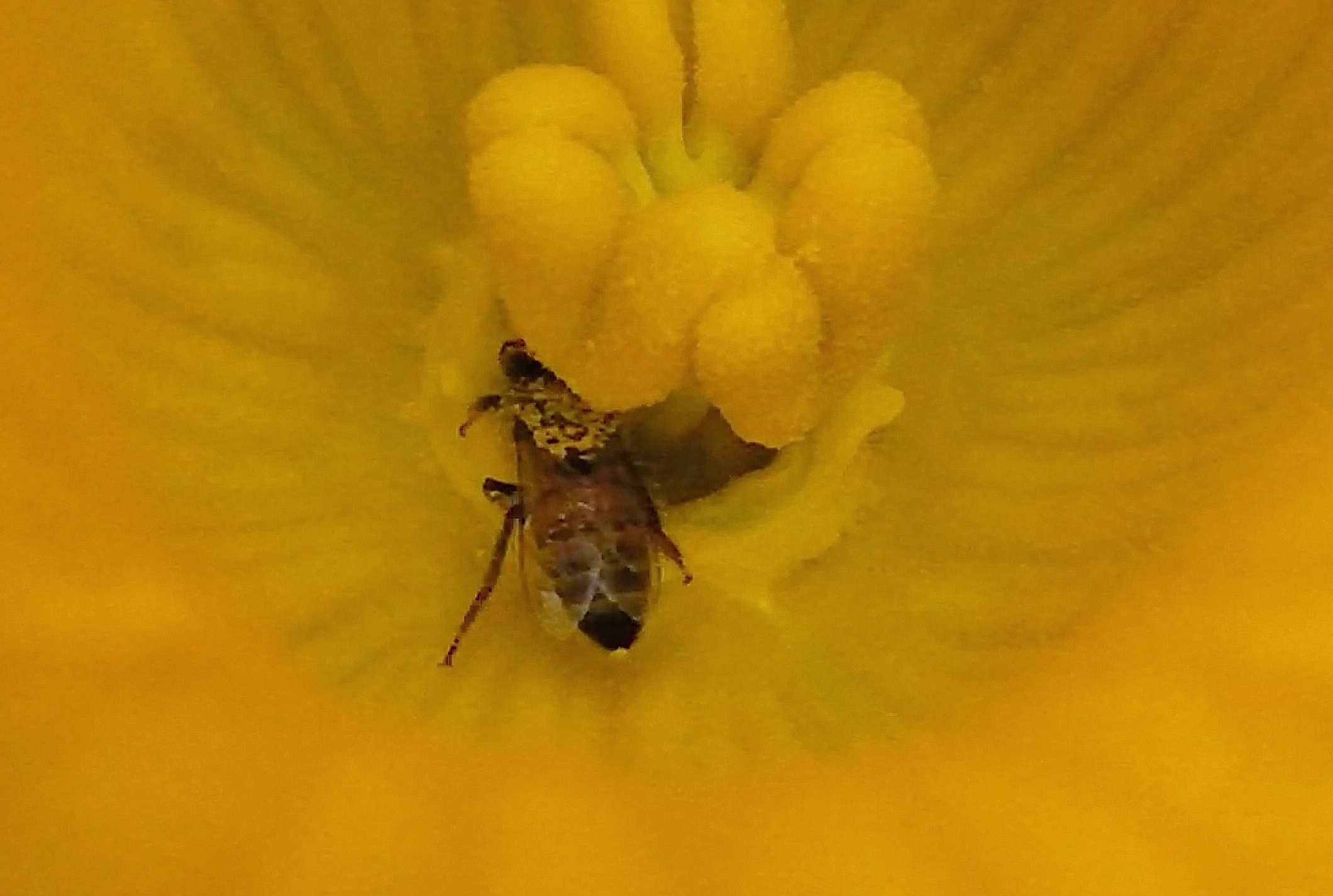
August 1, 2014…A honeybee sipping nectar from a male squash blossom. The bee picks up pollen from the anther to transfer to the female blossom.
The blossom provides nectar to attract pollinators. This honeybee is sipping from nectar fountain of the female squash blossom…rubbing pollen onto the stigma.
August 6, 2014…this female blossom just opened today. Already there is a bee in attendance.
Open at 9:29 am or before…
Closed at 7:04 pm…after being opened only one day, this female blossom closed up shop.
August 7, 2014…blossom closed yesterday and remains closed. A measurement of 1 3/16″ (30 mm) is made on the diameter of the tiny acorn squash.
July 18, 2014…Although I walk past this New Zealand Flax just about every day, I never took notice of it until it started blooming about a week ago. I became curious whether bees would be attracted to it. Yes, they were…even as early as 8:30 am..
July 17, 2014…bee going deep for nectar. I recently read a website that stated honeybees can’t get the nectar from New Zealand Flax, and yet I saw many honeybees attending these blossoms.
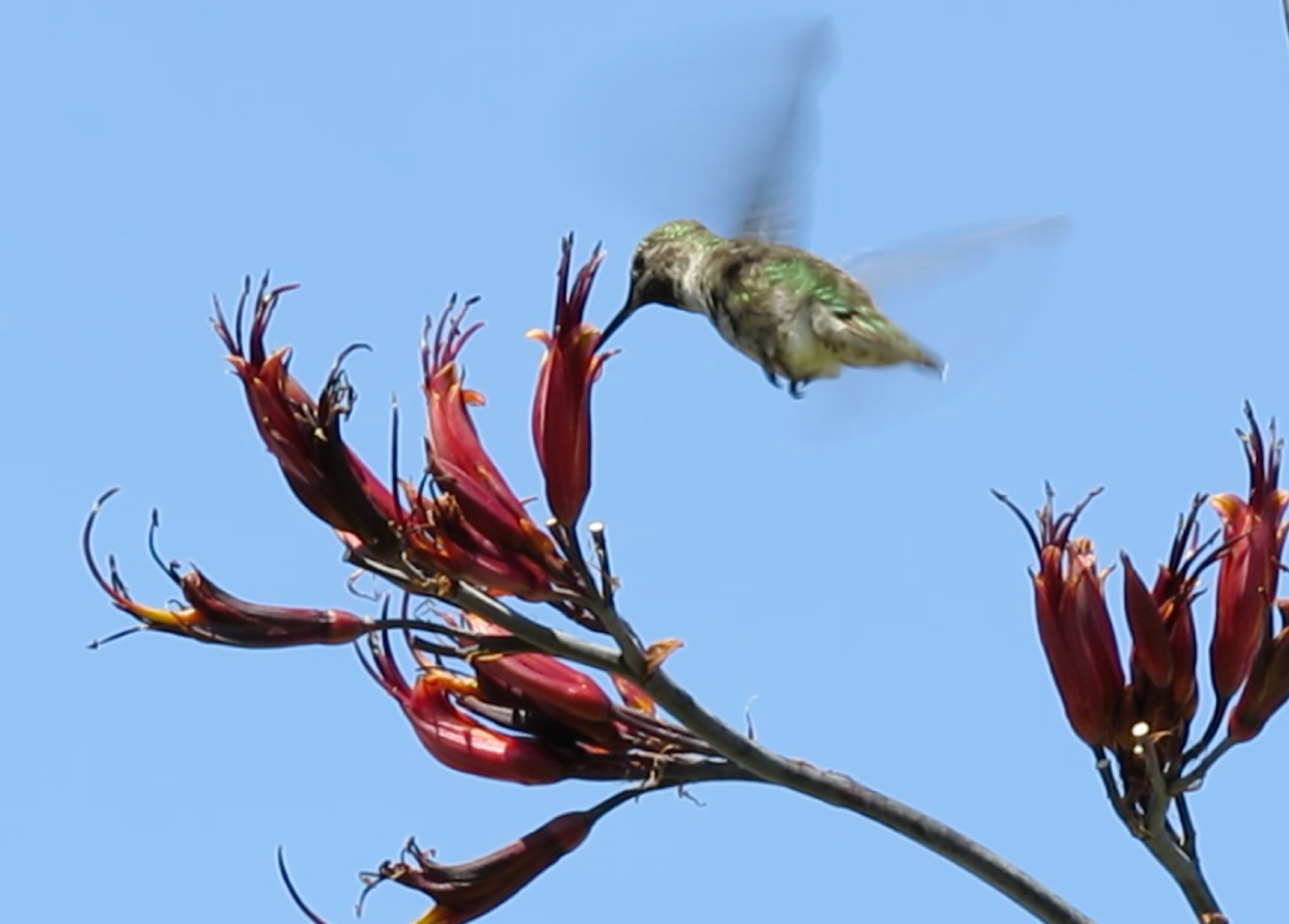
July 12, 2014…Hummingbirds also visited, but were often chased away by rivals. Why is that? There is plenty to go around. “Why can’t they cooperate for the common good,” my wife wonders? I have no idea…Why can’t humans cooperate for the common good? Looking at our blue planet from space, seeing nothing around that’s habitable for light year distances, you’d think we’d want to work together for our mutual survival. Just some random thoughts in light of the disturbing current world affairs.
July 14, 2014…When I saw reddish orange pollen coming into my Bee-atrice Log Hive, I wondered where it was coming from.
Reddish orange pollen, coming from the New Zealand Flax.
Ants like it too. When I was shooting the video I waited and waited until this ant emerged, then another came up, and another.
June 29, 2014…Honeybees and hummingbirds get nectar from these little gems. We’ve decided to grow more alliums next year because the bees love them and the deer don’t.
June 23, 2014…We started these Cosmos seeds under lights in the house, hoping they would turn out well. We’re very happy with the results and the bees love them too.
June 10, 2014…Honeybee getting nectar on this Cosmos
June 16, 2014…This little stand of California poppies planted itself on my Hugelkulture bed. In the background you can see some wallflowers (Erysimum).
A new type of poppy, called a Twister poppy. Attracts bumblebees and is a pay grade or two above the California poppy.
I started the Phacellia seeds to attract the honeybees, but rarely do I see honeybees on them. No problem, we need to help the bumblebee as well, in this case the Yellow-faced bumblebee. (bombus Vosnosenkii)
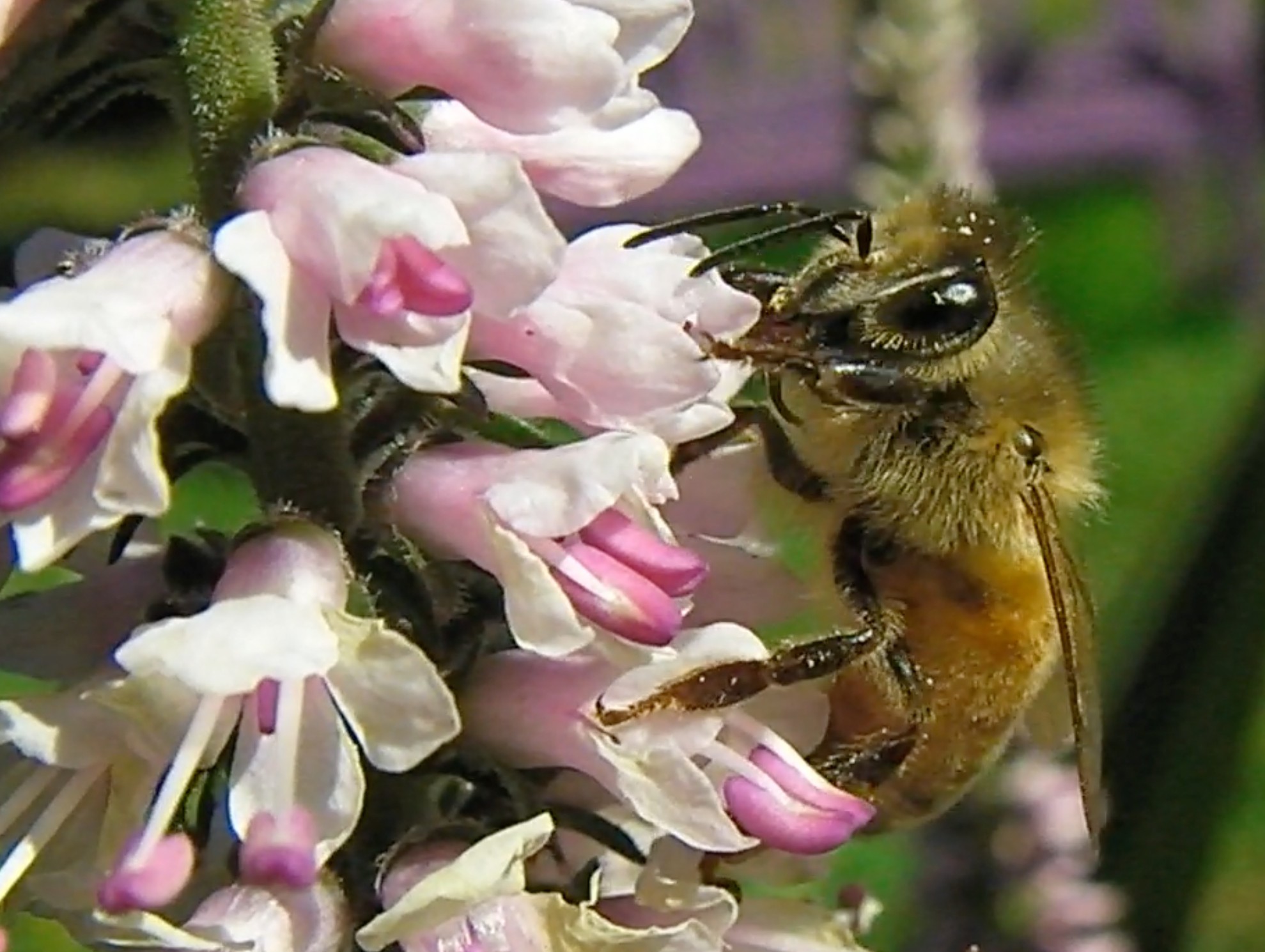
Relatively short-lived, (blossom wise) this Veronica Longifolia, ‘Pink Eveline’ served as a nectar source for a short time.
Speedwell, Veronica Spicata, ‘Royal Candles.’ The colors stand out well.
June 29, 2014…Sometimes when the bumblebee exits this blossom, it will pick up a streak of white pollen up it’s back.
May 29, 2014…My wife said there were five bees on this earlier, but when I grabbed the camera, I only caught one bee.
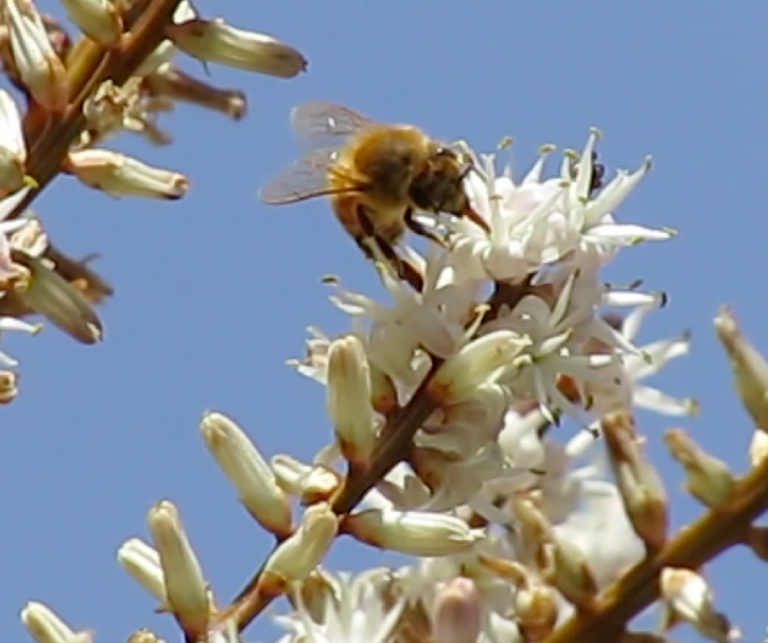
May 28, 2014…My neighbor’s New Zealand Cabbage trees are blooming. I’m glad it’s on someone else’s property because there is a strong odor associated with it. Our bees love it.
May 28, 2014…New Zealand Cabbage has been blooming awhile. Our bees are all over it, all day.
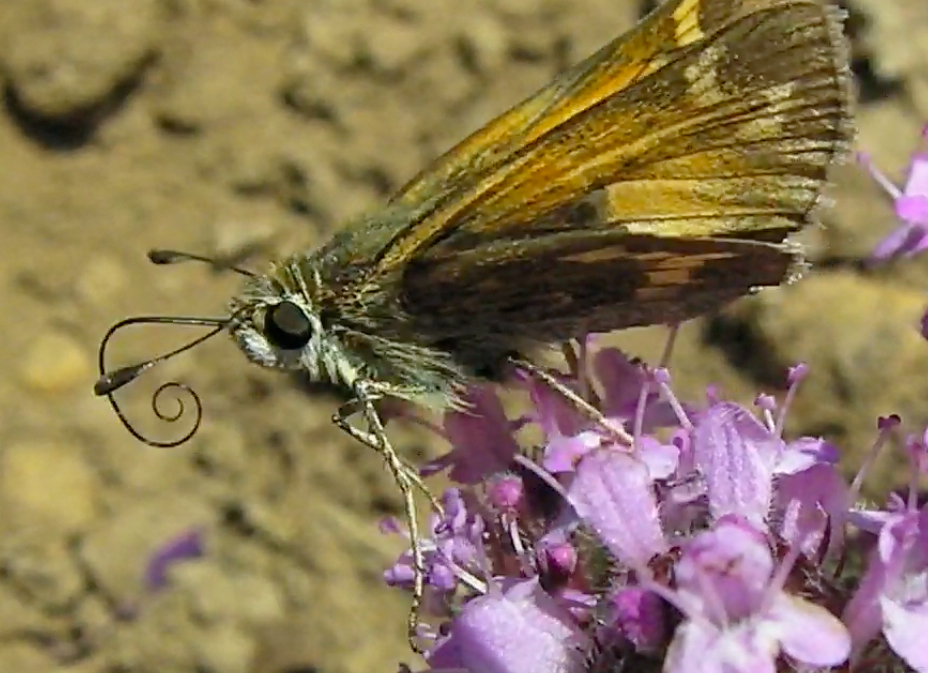
May 27, 2014…A skipper is probing the depths of this Pink Chintz Thyme for nectar. In the video, you can see it try several spots before finally succeeding. The bees love this plant as well.
May 1, 2014 mid afternoon…Photo by Mary Schamehorn. I’m glad Mary got a shot of this. When I got there, they were relatively peaceful.
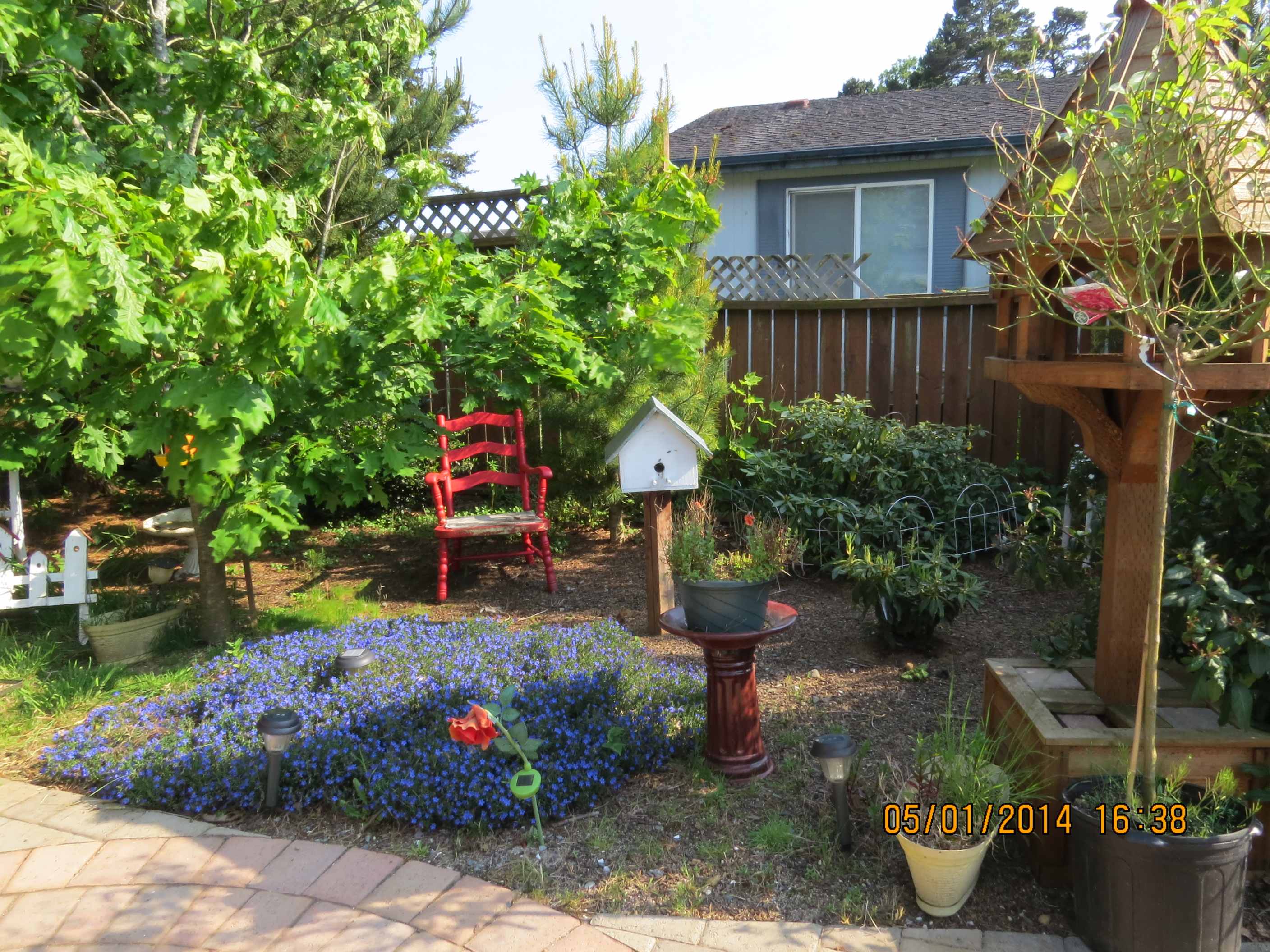
4:38 pm…By the time I got there, the bees had settled within the birdhouse. I looked at it, determined I could remove it from the post, and got my tools together. Ha ha, the screws were rusty I couldn’t get them to budge before stripping them out. I had to remove the post too.
I placed it next to the newly assembled and baited Warre hive in my bee garden. I was hoping the bees would recognize a 4 star lodging with ample room to grow…they didn’t. I gave them plenty of time to reconsider, but they weren’t having it. I couldn’t leave them there, like that. I didn’t want to grind the brackets off or pry the birdhouse floor off because it would have been too stressful. “Dramatic and traumatic” are words I like to avoid in beekeeping.
Okay, I’ve got to move the birdhouse out of the bee garden because, well, we’ve got to be able to weed and water without the bees buzzing us. After two days, I pre-dug a post hole, waited til night and ‘posted’ the birdhouse among the ferns about 20 feet away. (Something most beekeepers would tell you NOT to do because the bees might not be able to find their way back to the hive.) I stuffed tissue paper into the entrance hole so the bees would notice something was different. They would have to make orientation flights all over again. I’m thinking that maybe the Warre was too close to the birdhouse…if I move it away, maybe they will want it more. My wife said I was crazy to think that. I says, ‘maybe,’ but we’ve got to get it out of the way.
Next day, the birdhouse/hive is in it’s new location. The bees are aware something is different because of the tissue paper stuffed in the entrance hole.
As my wife bicycled to town, I noticed a bunch of activity between the birdhouse and the Warre hive. I got my camera to document my findings…I was going to have it on camera so I could show her I knew what I was doing. They are fanning from the nasonov gland to indicate the queen is within. Wow, that didn’t take long. My wife is going to have to admit I was right, but I’ll be humble and admit it’s just a stroke of luck. But it was too good to be true. By the time she returned the crowd at the entrance was thinning and the bees rejected this hive once again.
Here is where they will stay. It’s the house they chose and while the location has changed a few times, the house is the same. I just wish I could have fastened it to a taller post.
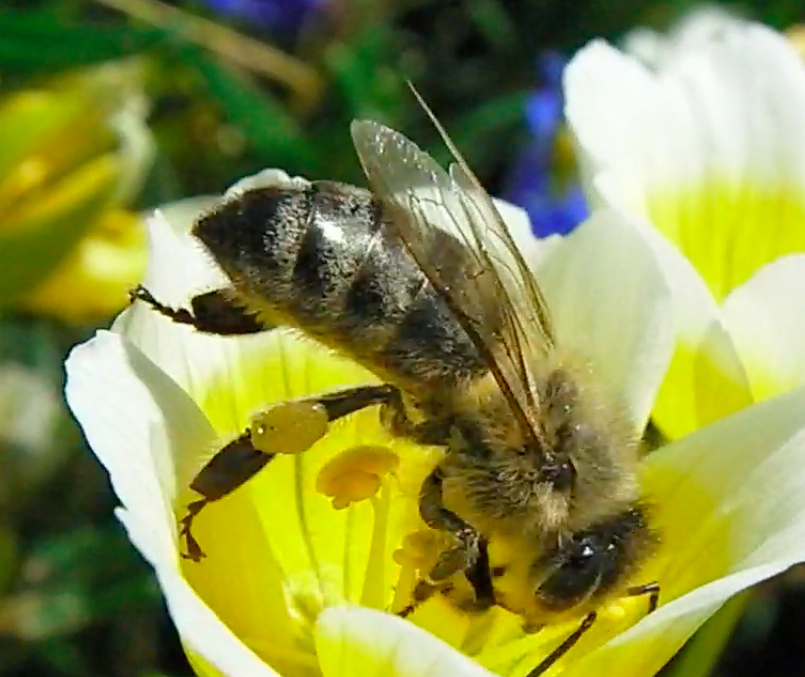
Mary’s bees have settled in now. They have discovered the Poached egg meadowfoam.
Mary’s bee cleaning off her antennae. How do I know they are Mary’s bees? The abdomen colors are different. I’m happy to get new genetics in my bee yard.
May 10, 2014…as I was driving to Eugene, Oregon, we spotted fields of this beautiful plant. I asked about it and was referred to Heiko Koester, a garden consultant who specializes in edible, medicinal, and native plants.
Heiko Koester says, “The plant you saw was either Camassia leichtlinii or Camassia quamash. If it was knee-high or taller it was probably the former, if shorter probably the latter. Ethnobotanically speaking they are both fairly interchangeable.”
May 10, 2014…a honeybee can be seen looking for the perfect pollen source. In the video you can see the bee using her mandibles to pull the pollen off.
May 10, 2014…bee in flight over Camas. The flower-bee relationship can be seen when the flower opens a petal so the bee can get to the pollen. I missed it the first few times, so I marked it in the video.























 Adventures in Natural Beekeeping