December 27…Bees in Bee Beard Log Hive have found a pollen source late in the year. Natural comb can be seen in the rear. In the video, the bees can be seen entering the hive and moving downward in front of the comb.
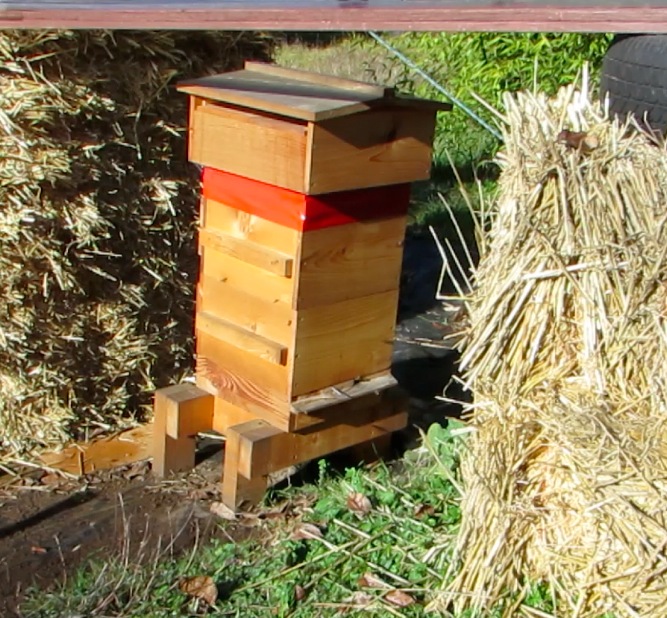
December 27…Warre Hive is being fed with a dry sugar mix consisting of green tea, chamomile tea, nettle leaf extract oil, cane sugar, and a few other little gems. The sugar was placed on a 2″ x 2″ frame and positioned between the brood box and the quilt box, then sealed with red tape. I’m not real excited about feeding sugar to the bees. It’s possible that I won’t do that next year, but that’s what I said last year too. It’s the only hive that is being fed this year.
December 27…Even this little hive was flying today. The pink insulation is meant to cut the cold wind, but it still lets the hive breathe through the quilt box on top.
A hack saw works real well on the bamboo. Cut near the node, so one end is sealed naturally.
Cram the tubes into some protective covering. In this case the down spout of a gutter, works well. Different sizes offer choices. I thought the large diameter tubes would too big so I was pleasantly surprised to see them sealed up.
July 27, 2013…Bamboo nesting tubes, NOW OPEN!
July 27, 2013…Last year’s tubes (on top) have two tubes filled, chewed up leaves are evident. These must be leaf cutter bees.
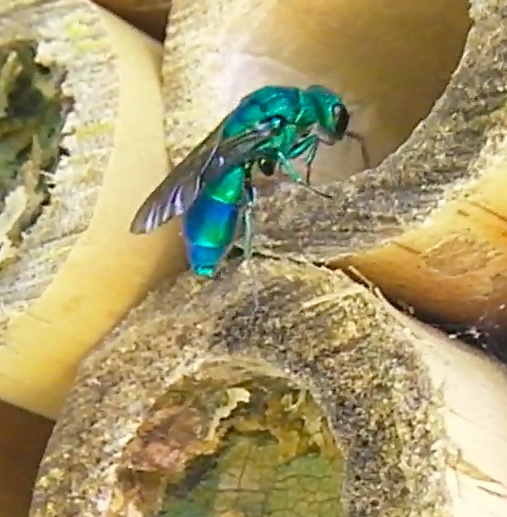
Sept. 1, 2013…Two more tubes filled. They are sealed with mud. Maybe these are mason bee tubes. A blue-green visitor decides to investigate.
Sept. 1, 2013…While I was waiting for a solitary bee to fly in, this curious little insect strolled up. it’s either a cuckoo wasp or a Blue-green sweat bee or Osmia aglaia.
I asked a couple of knowledgeable people if they could give me a solid “Bug ID” on this insect.
Marco at My Biodiversity Garden …says “one of my acquantances told me it could well be Osmia aglaia but she was not 100% sure as it looked more like a wasp to her – to be continued :-).”
“The other person gave the following ID “looks like a green sweat bee to me”. Some cuckoo bees look very similar but of course they won’t have any device to carry pollen (compared to the female bees) as they don’t collect pollen to feed their young but simply deposit their eggs in the nest of a normal bee.”
Celeste says, “I think it is a Cuckoo Wasp–good heavens, it’s beautiful!”
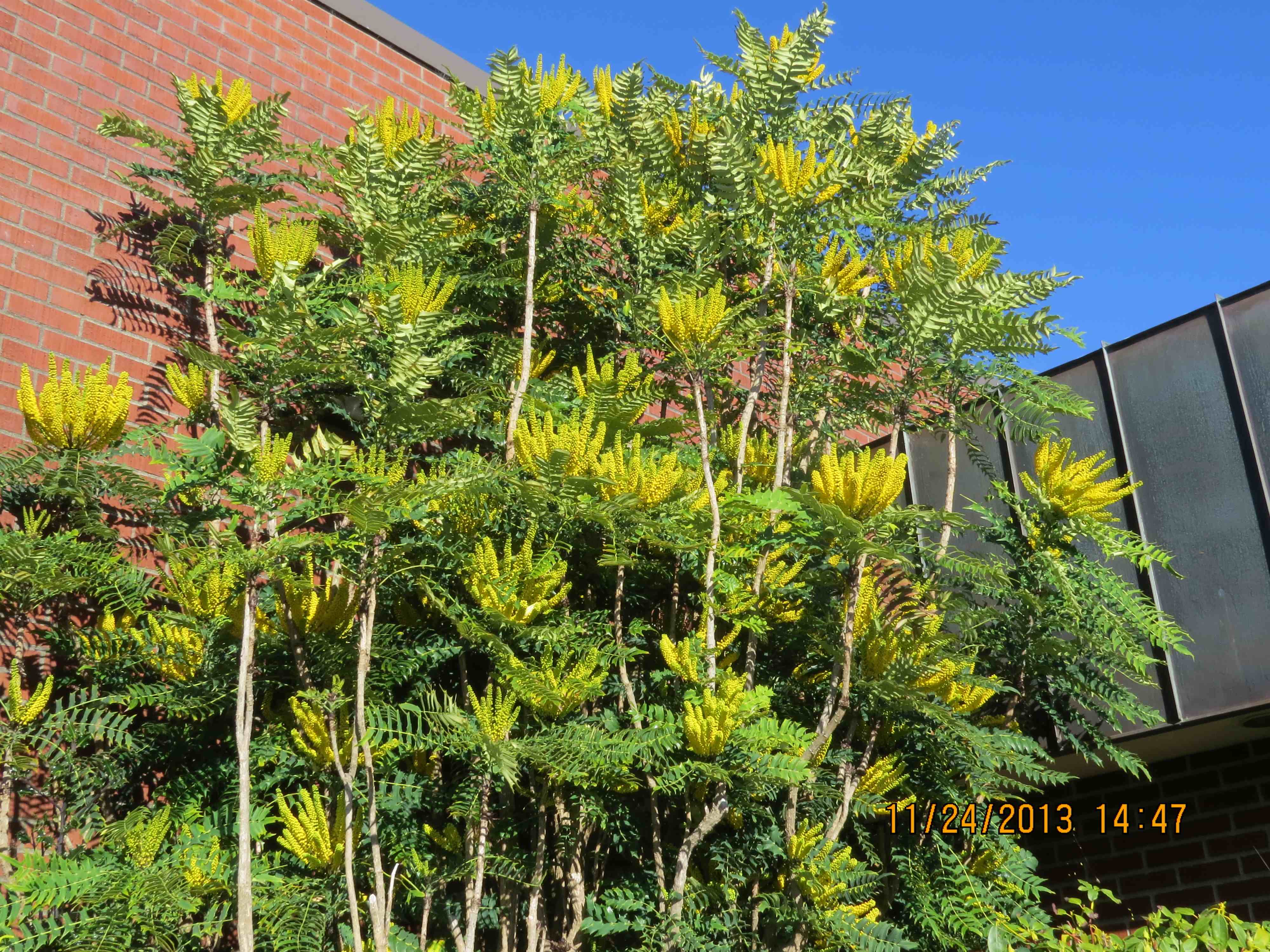
Most visitors to the post office go to get their mail. These visitors go to get nectar. The Oregon Grape Holly is in full bloom, offering nectar and nectar is what they got. Honeybees, bumblebees, even a couple of green hummingbirds partake in the feast.
What is the importance of nectar? My Biodiversity Garden states “Nectar is the fuel for our pollinators such as solitary bees, bumblebees, honeybees, butterflies, moths and bats. It is the only source of energy and without it, the pollinators cannot fly. Nectar is secreted by nectaries within the flower.”
According to Dave’s Gardens Mahonia Aquifolium blooms in mid spring. This is late November! The plant is growing against a brick wall, facing south, during an unseasonably dry autumn. In any case, the wild pollinators love it.
November 24th…This honeybee is getting nectar from an early blooming Oregon Grape Holly (Mahonia Aquifolium)
Sweet Thunder provides the delightful musical background for this video of hummingbirds, bees, and butterflies at work in my garden on the Oregon Coast.
Mid October…the bees are bringing in baskets loaded with orange pollen.
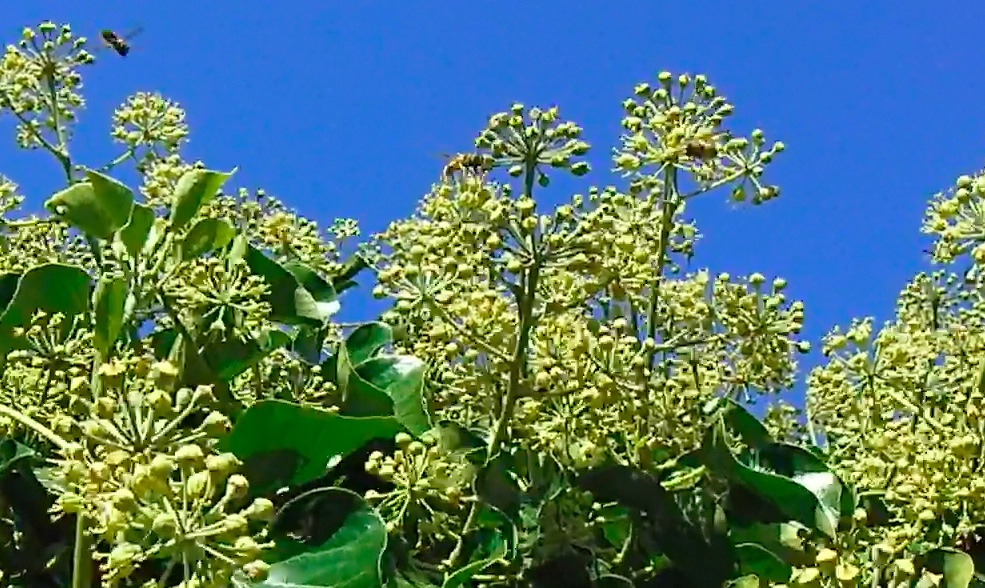
When I saw how much pollen was coming into Bee Beard log hive, I wanted to find out where it was coming from. I knew it had to be ivy because that’s the only thing in bloom this late. I set out to prove my theory.
I went to my known ivy patches, which just happened to be in the sun…perfect.
Mid October…An American Painted Lady (I think)
I didn’t see any bees at this first place, but this butterfly posed for me long enough to get a short video. She is sipping nectar through her long proboscis which acts like a flexible straw.
This looks like a bee, but the eyes are different. It’s a fly who is grooming herself in the sun. The video shows her rubbing her front legs and using them to scrape the pollen off the top of her body.
I see Barbara out walking her dogs. She knows I’m obsessive about bees and mentions an ivy covered wall that was buzzing with bees. I head over.
This ivy wall was buzzing with bees…I’m going to get lots of opportunities to shoot bee videos.
I knew something was weird with this when her proboscis touched the top anther and rubbed it. It’s another fly that resembles a bee.
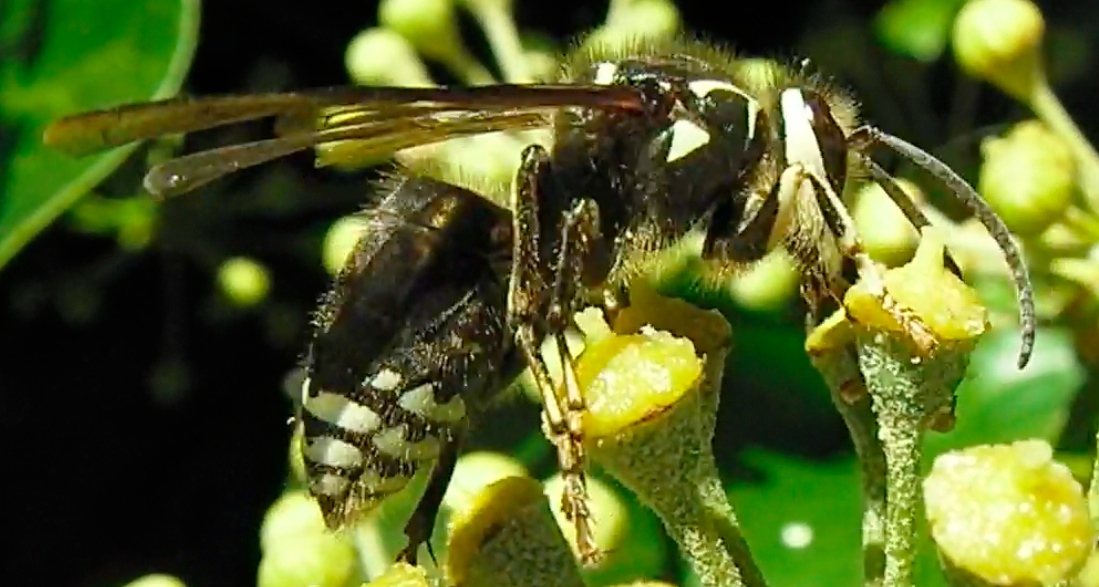
This looks like a white-trimmed black wasp, but it’s the wrong habitat for it. Can anyone ID it for sure? It’s another ‘buzzing insect’ working the ivy.
Celeste replied to my request to for an identification of this wasp… Pat, I am pretty sure that what you have are some lovely shots of the White-faced Hornet (Vespula maculata, also known as Dolichovespula maculata, not sure which name is the most current). The markings are quite distinctive, especially around the eyes and thorax, and this is the only West Coast wasp species that is white and black–all the others are yellow and black. These dudes are apparently aggressive little stingers, and the adults are predatory on small invertebrates, so I don’t think they’d be more than incidental pollinators. They make above-ground nests out of chewed wood pulp, but a colony only lasts for one year–they die off over the winter, except for females that mate at the end of summer and start new colonies the following spring. These are nice photos! Thanks, Celeste.
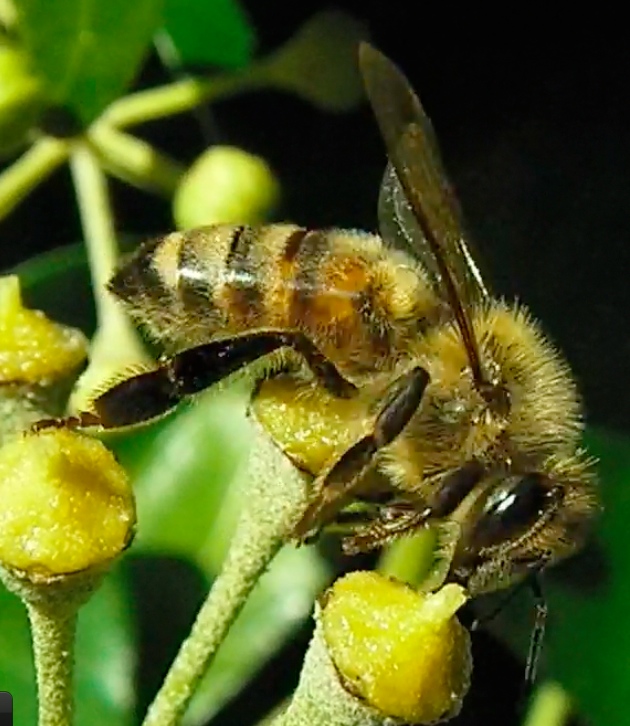
Finally I see an actual honeybee who is sipping nectar, but no pollen is evident.
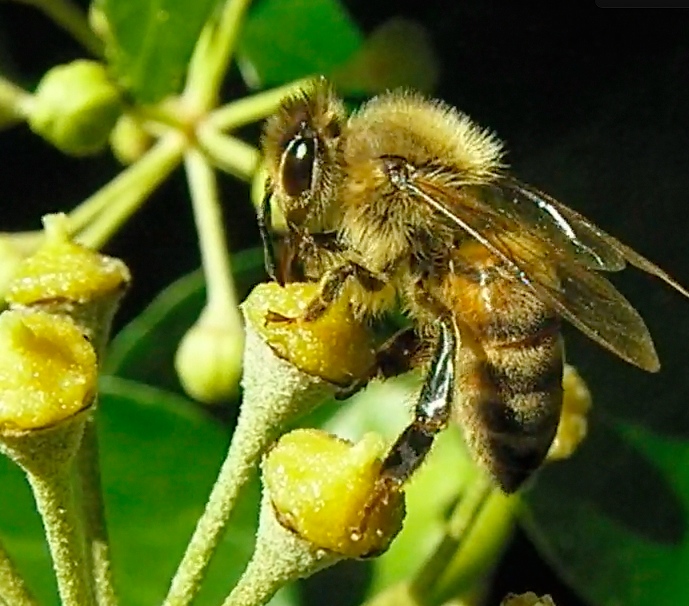
Another look, but no pollen is visible.
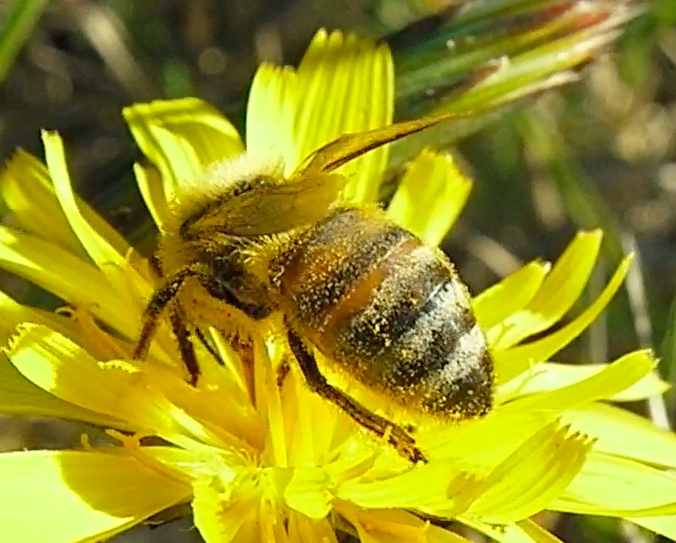
I spot a bee on a dandelion, pollen sprinkled on her abdomen. A close look revealed none in her pollen baskets.
I can see I was mistaken about the pollen going into my hives. It can’t be ivy just yet…not sure what it is, but I’ll keep looking.
I asked Kiera O’hara, the composer and pianist of the background music, “Song for Earth Day.”
“I’ve got the melody replaying itself over and over again in my head. Since you wrote it can you describe the background of it? I’m always curious how a person comes up with music, probably because I’m so NOT musical.
There’s that little voice towards the end (at 3:10) that says to me, “But why can’t I?” or “but what about this?” It’s definitely a question. That’s how it sounds to me. :-)”
Her reply…
You’ve got it, exactly! That ending was meant to sound tentative–the vulnerability of the earth asking for help, and the question lingering for us humans, will we help?
In July I noticed honeybees were pollinating these bushes in the cemetery. I took photos so I could show them to knowledgeable people to ID them. I asked quite a few people who had no idea what those bushes were. Jim, the volunteer at the cemetery, said at first he thought they were planted, but later he realized the birds must have dropped seeds where the mower couldn’t reach and they just grew without being cut.
July 1, 2013 Bees love this bush. Circle shows the color of pollen.
October 26, 2013…we suddenly realize this is a cotoneaster bush. It’s just so obvious with the red berries. Thanks to the bees the birds will benefit.
When Dan discovered a tree full of bees on his property, he wanted to save the bees and the tree so he asked Del for help.
Del built a platform to hold the hive, a 5 frame nuc, above the screened ‘trap-out.’
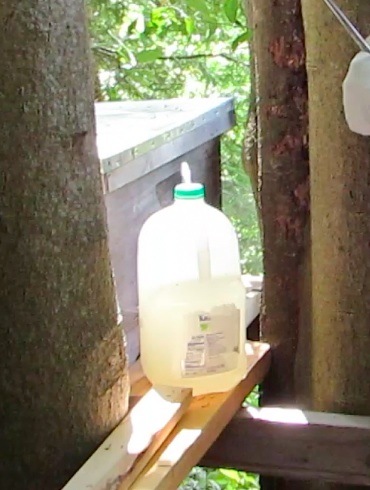
This bottle of sugar water is accessible from outside the hive so Del can add more water without disturbing the bees.
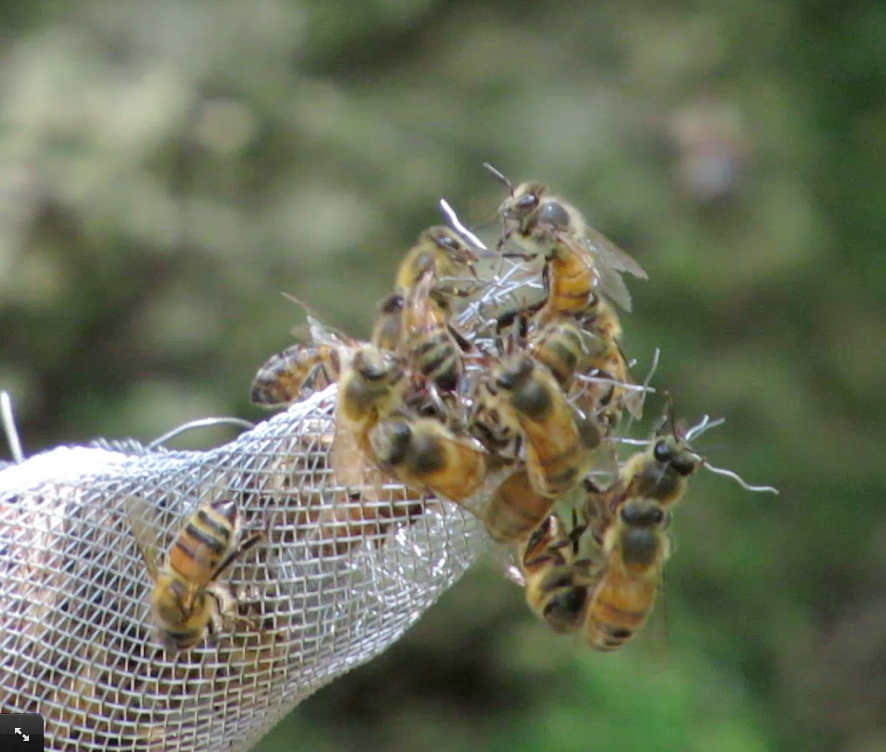
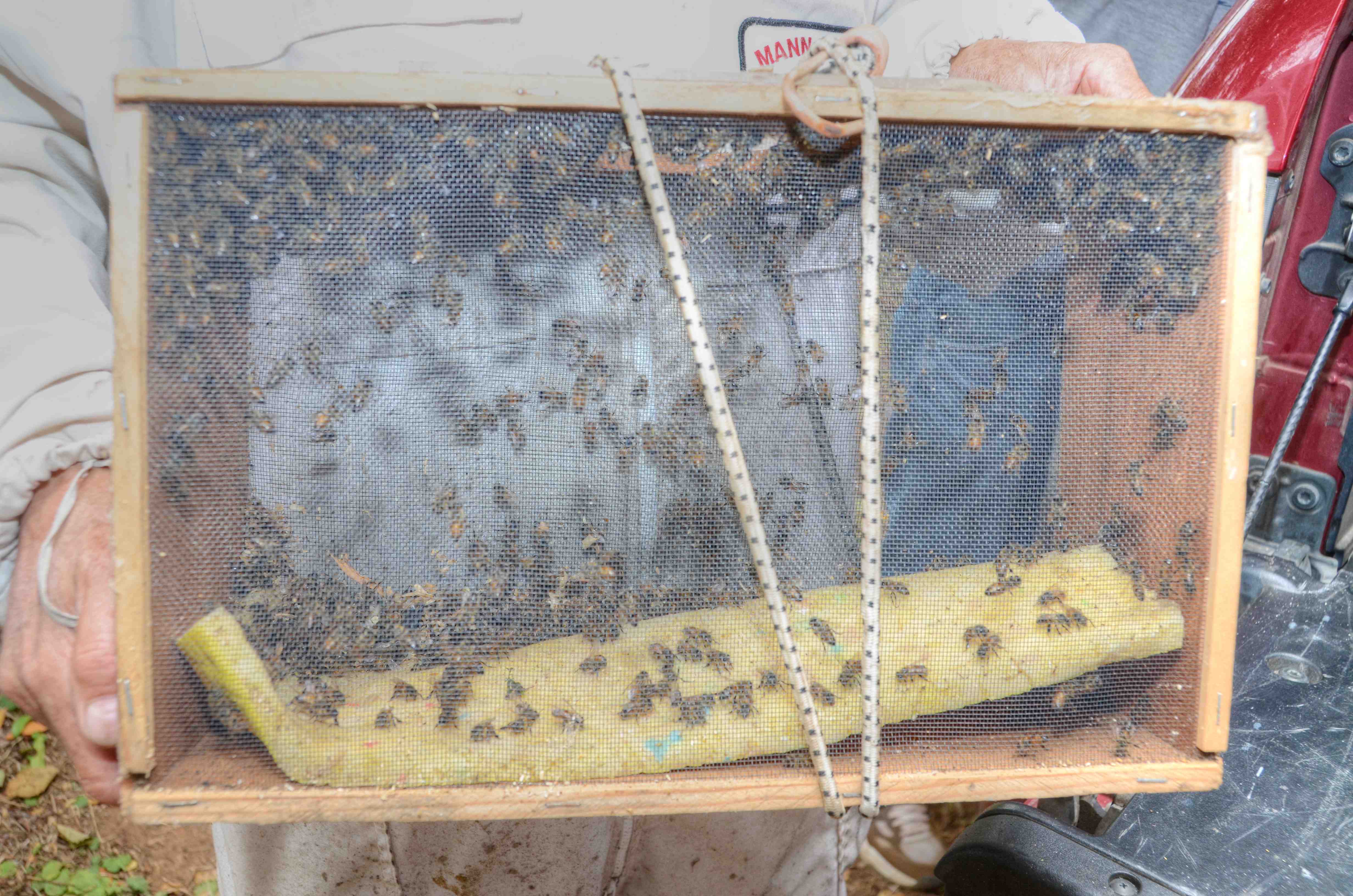
The screen is fastened to the tree so the bees have only one exit and that is through the narrow hole in the end. The hole has wires sticking outward so bees can only travel one direction…out. The idea is the bees will come back to the screen, discover they can’t go back in and use the hive box above. If all bees smell the same, they will be able to enter the hive box unchallenged. When Del sprays peppermint water on the bees, it not only calms them, but makes them smell the same as the bees in the hive.
Bees are leaving through the one-way exit
The internal temperature on the fourth day is 92 deg F. (33 C). As more and more bees move out the temperature will drop.
Dan, the property owner checks on the progress
Del and Jim, on level ground after checking on status of hive. Jim collaborated with Del to come up with a plan on how best to remove the bees with the least number of casulties, monitored the internal temperature of hive on an almost daily schedule and kept the screen exit open when the drones tended to plug it up.
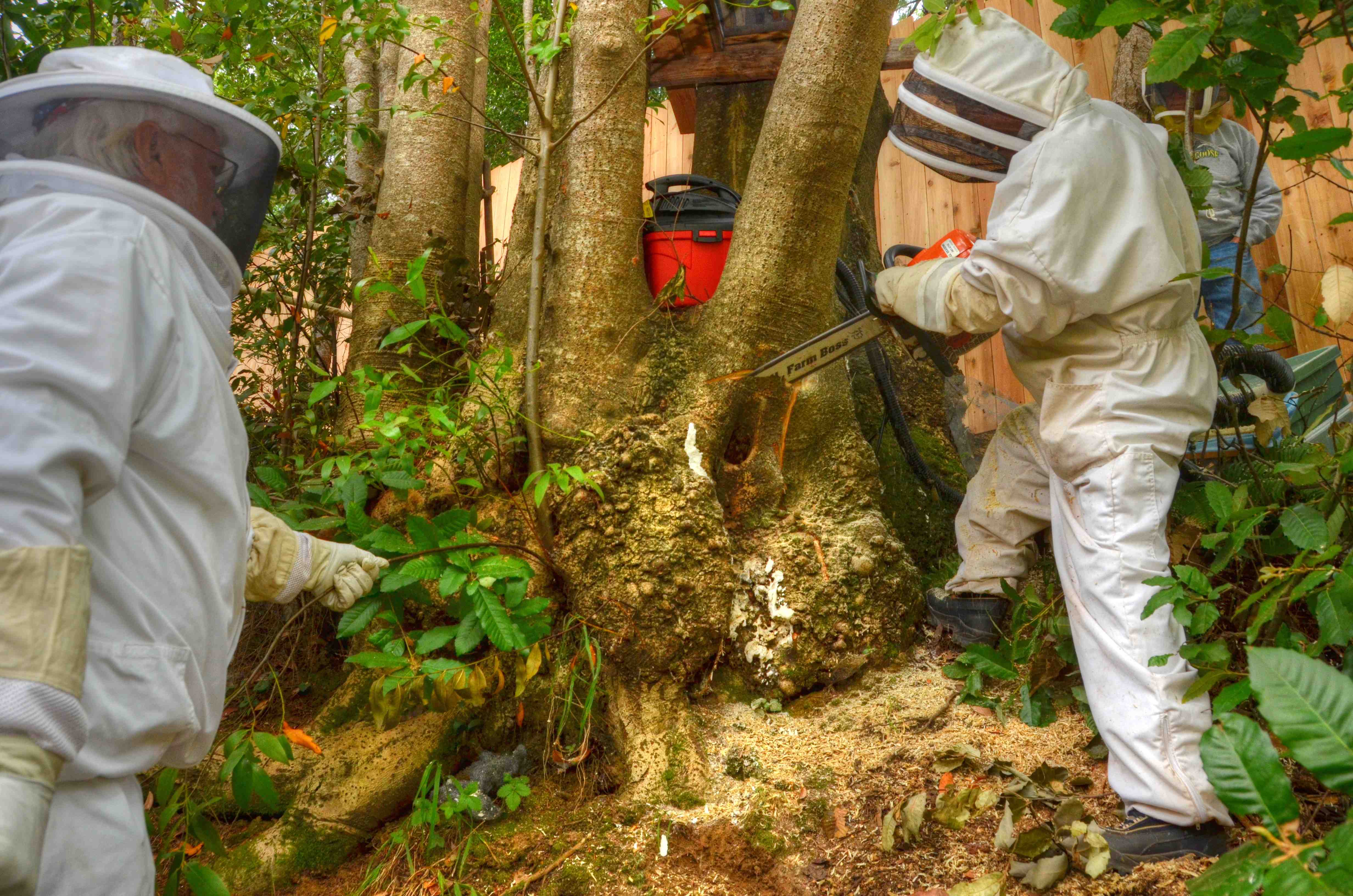
As the internal temperature of the tree dropped, the hive above grew. Five frames grew to 10 frames, and soon they added another 10 frame deep. After about 6 weeks, when the thermometer had plummeted to 78 deg. F (25 deg C.) it’s time to move to the next phase. The screen is removed and Shigeo opens up the tree with his chainsaw.
Shigeo cuts a wider hole to get at hive in tree
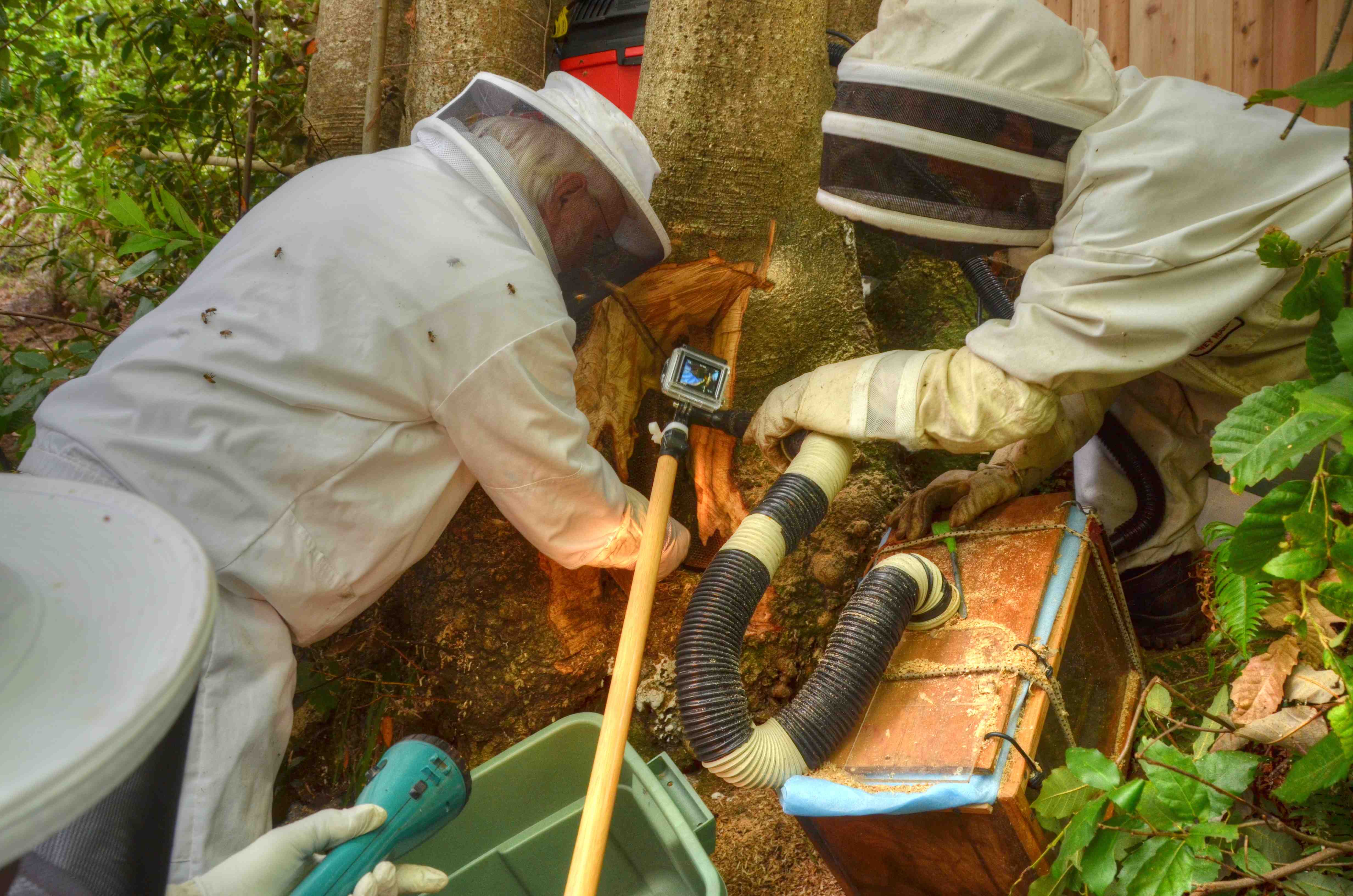
Removing bees with Shigeo’s bee vacuum.
Pulling bees off combs
Bee-vacuumed bees
Tree is completely free of bees.
Del shows all the comb that came out of tree
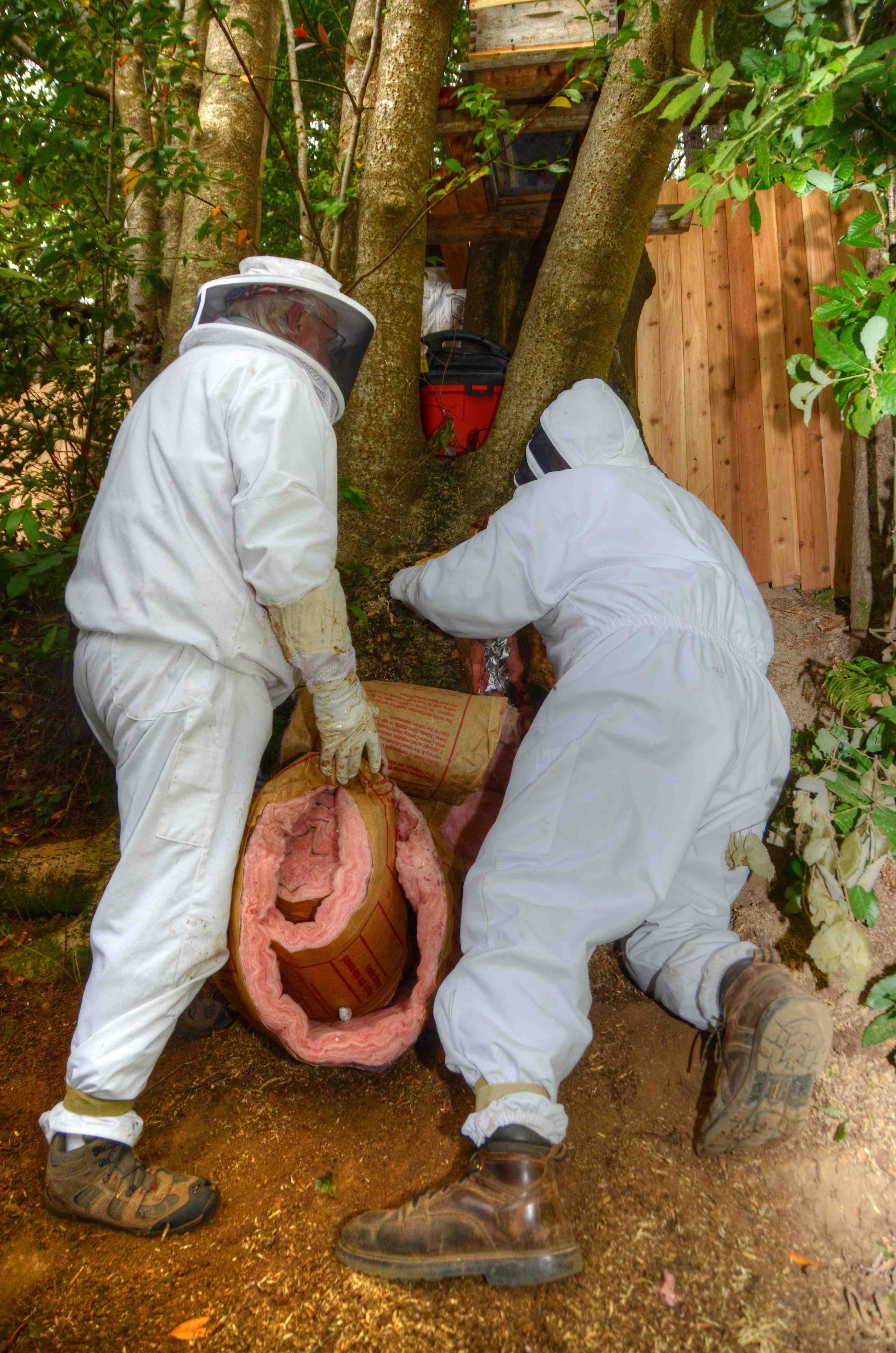
Stuffing insulation into the tree cavity
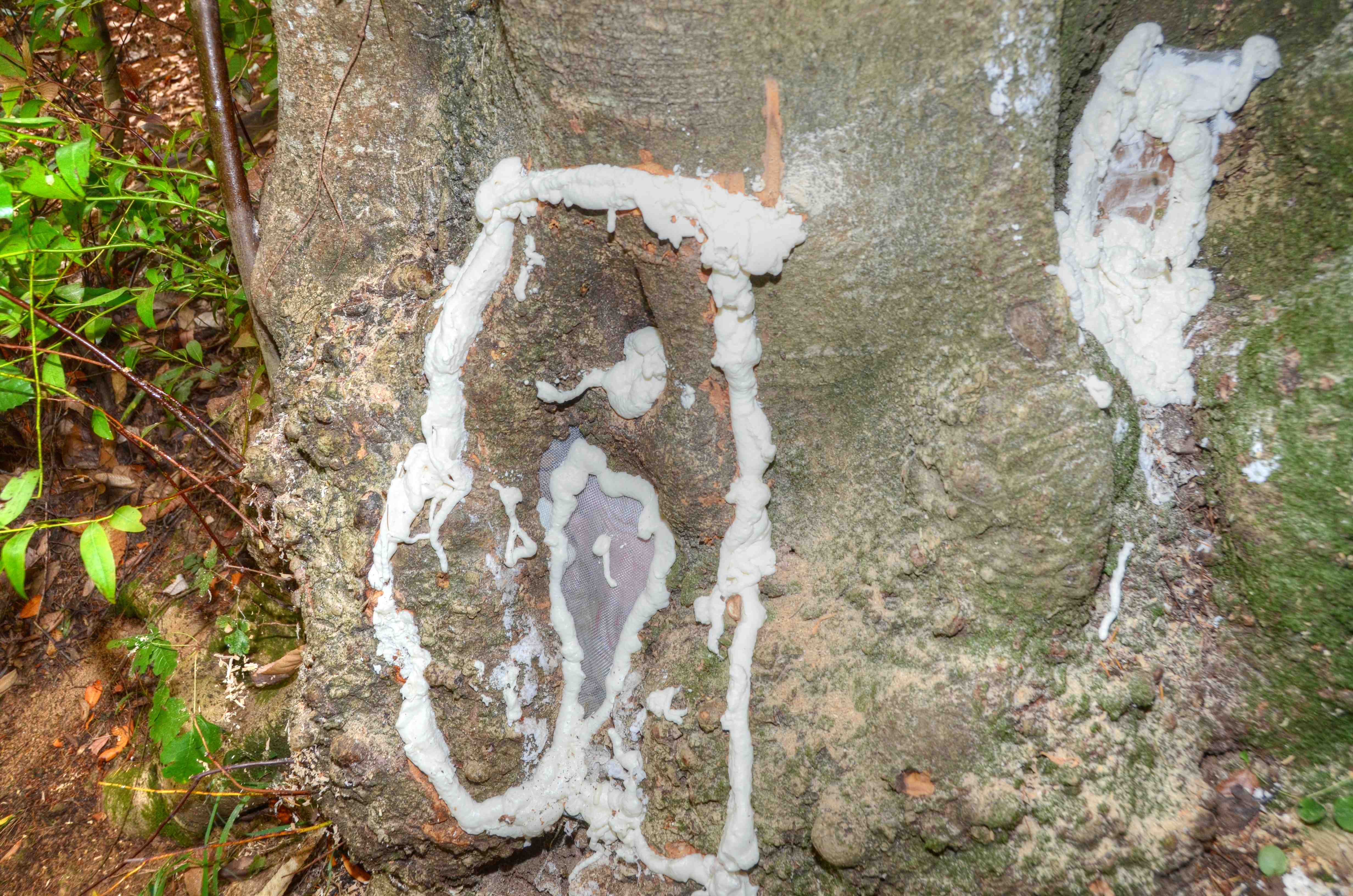
This tree is ‘insulated’ against the possibility of another batch of bees entering it.
…and sealed up
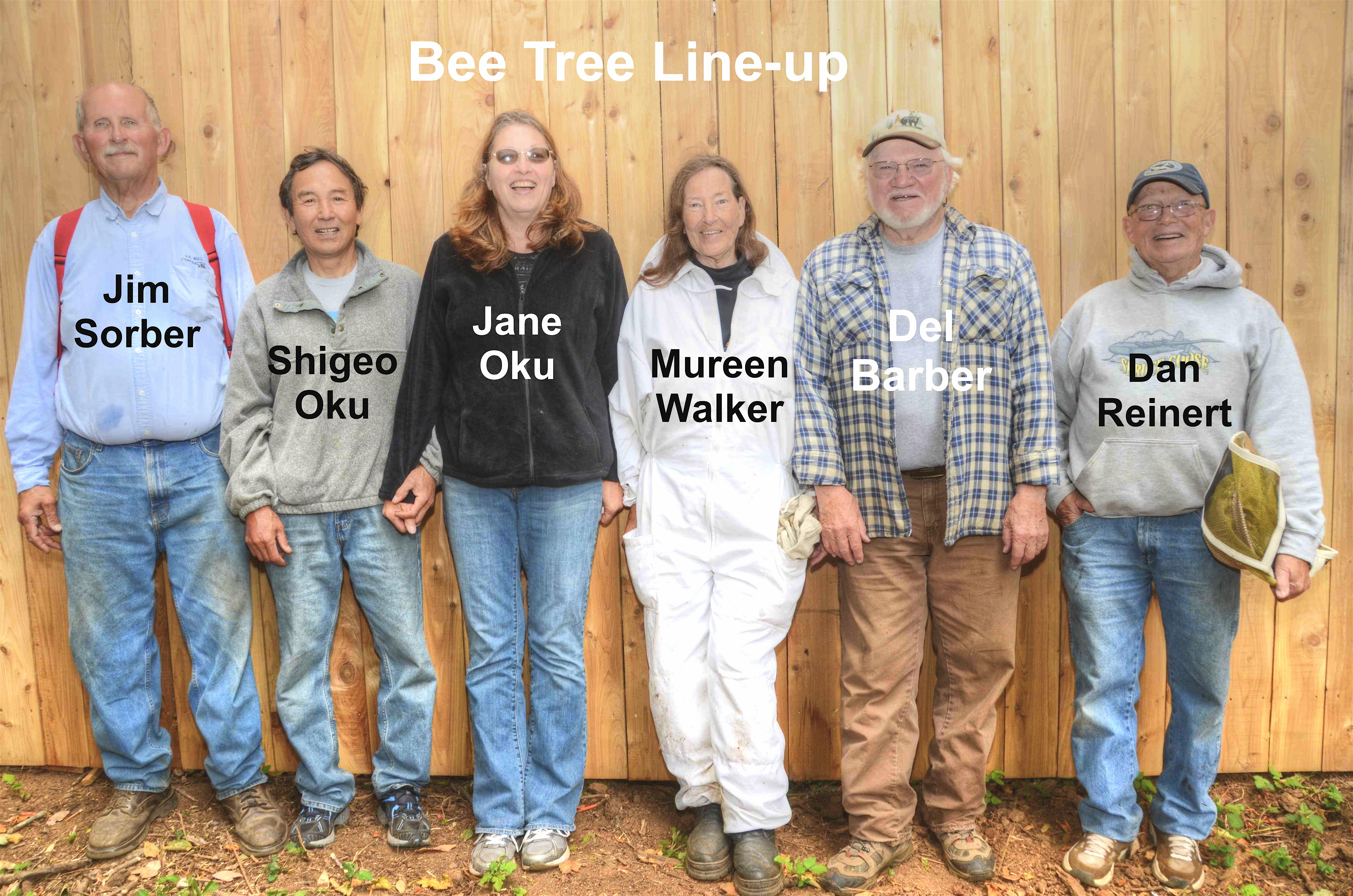
This has been a joint effort with many ‘players.’ On the left, Shigeo Oku, vice president of Coos County Beekeepers Association, brought his bee vacuum and expertise. On the right, Del Barber, president of Oregon South Coast Beekeepers Association was project leader.
Jim Sorber helped from the very beginning, monitoring temps and checking the screen. Shigeo and Jane brought all their equipment to help in the final stages. Mureen Walker shot the video and photos when the tree was opened up and last bees were removed. Del Barber was project leader, making everything happen. He built the trap-out, set up the hive box in the tree, and successfully moved bees from tree to a hive box. Dan Reinert owns the property where the bee tree was located. Thanks to everyone, both bees and tree were saved.
This video shows the steps taken to successfully move the bees out of the tree and into a box hive, and how to prevent future bees from relocating in the tree.
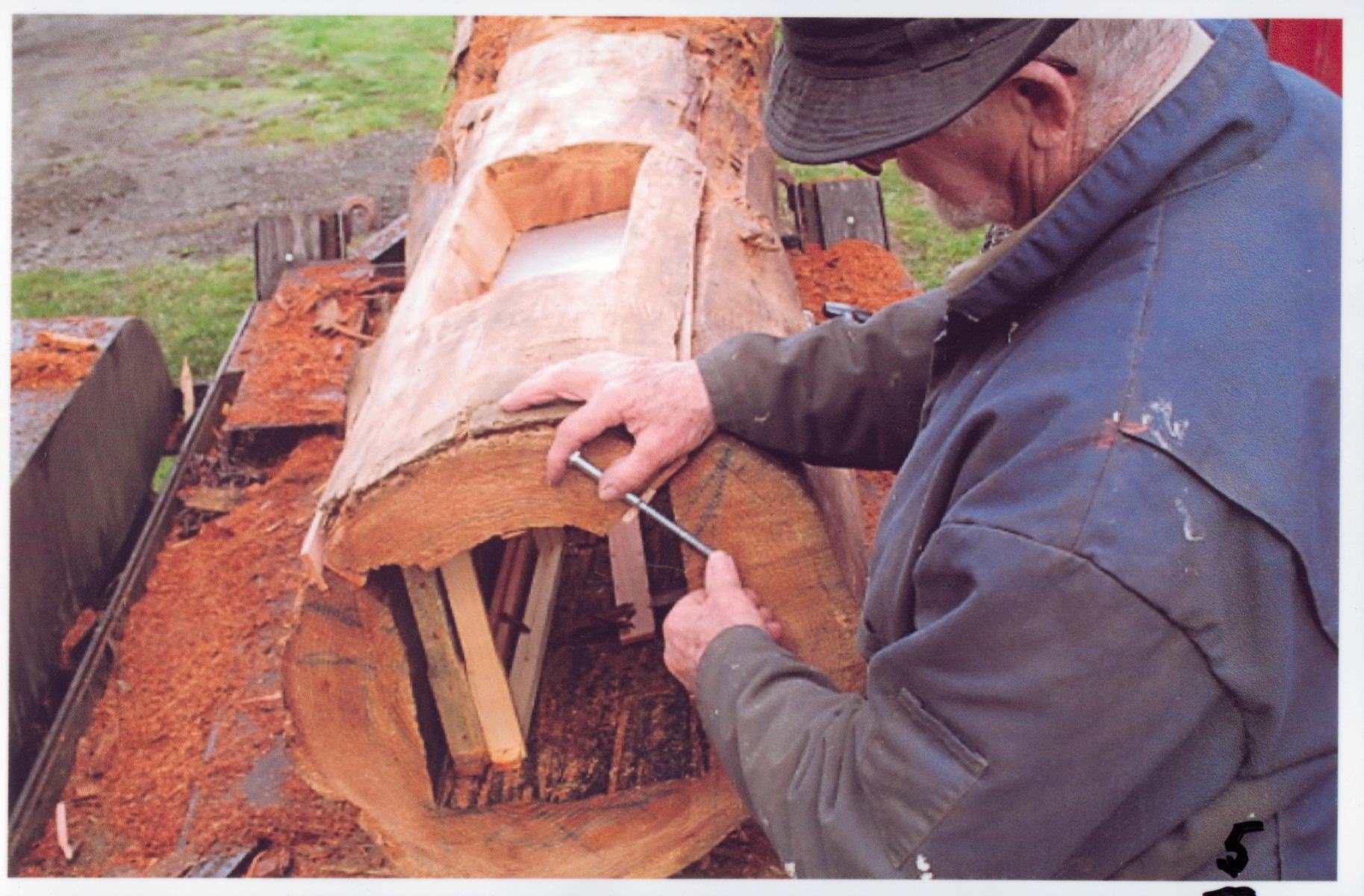
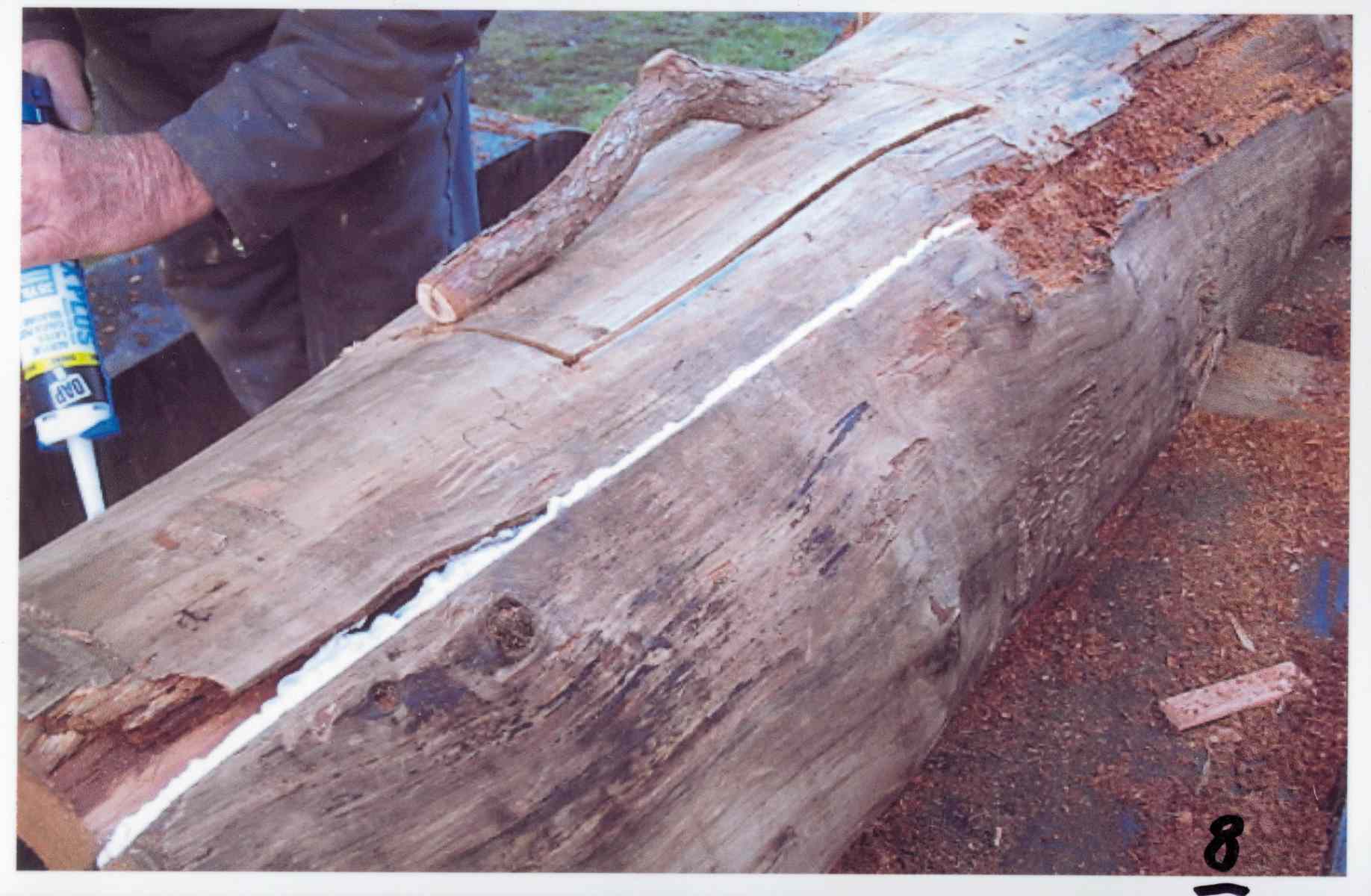
Early 2012…The foundation is in place, now Hal will fit the window panel on.
Measuring the bolts
Fitting the window plug.
Sealing up the cracks.
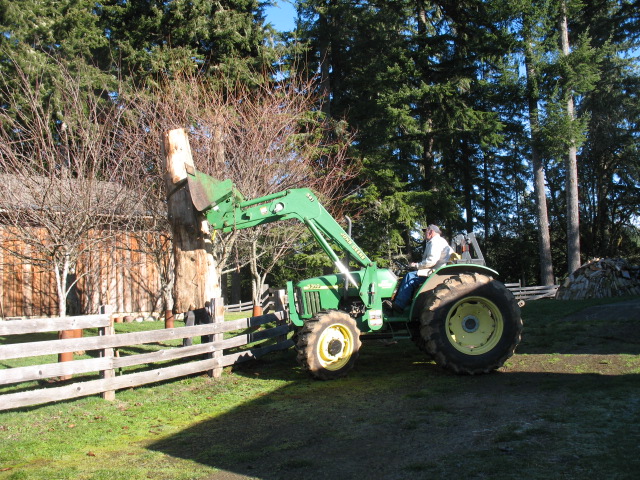
What do you use to lift a large log over a fence? A large tractor of course. LG demonstrates how to do it without smashing your fence.
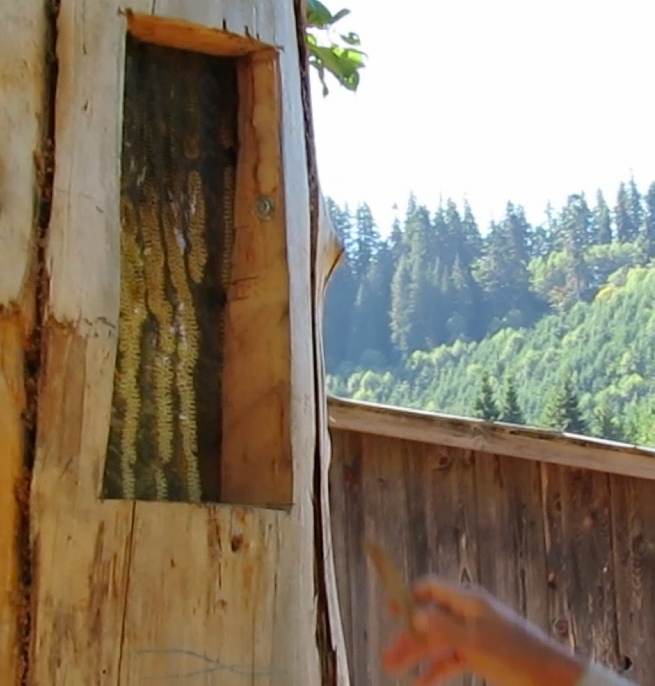
August 18, 2013 Log hive #2 built by Hal, owned by LG, is doing very well
Log Hive #2 with lots of beautiful honey comb
While visiting the 113 year old Gearhart ranch last week I had the occasion to ask LG, (the owner of the log hive) if he would show us the #2 log hive that Hal built for him last year.
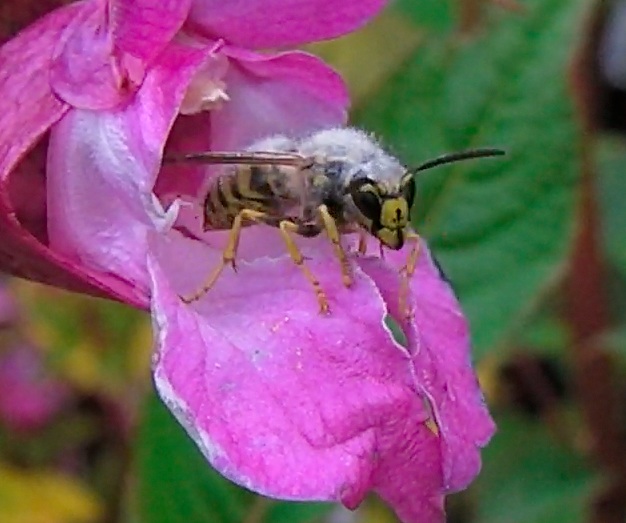
July 30, 2013…A pollen covered wasp takes off from Barbara’s Poor Man’s Orchid
On our morning walk we pass Barbara’s well-maintained flower garden. Today, Barbara called out, “Pat, did you see those white bees?” I had never heard of white bees so we looked carefully. They were certainly white, but I couldn’t get a good fix on them as they were darting in and out of the flowers so fast. After I replayed the videos I could see what they were…wasps and bumblebees covered with white pollen.
This could be a Yellow-faced Bumble Bee, Bombus vosnesenskii, or possibly a Bombus Californicus…I can’t tell the difference. The video shows this bee backing out of the flower and getting a trail of pollen up her back.
Lots of nice bee flowers here…in the foreground are the Poor Man’s Orchids.




















 Adventures in Natural Beekeeping