I asked Kiera O’hara, the composer and pianist of the background music, “Song for Earth Day.”
“I’ve got the melody replaying itself over and over again in my head. Since you wrote it can you describe the background of it? I’m always curious how a person comes up with music, probably because I’m so NOT musical.
There’s that little voice towards the end (at 3:10) that says to me, “But why can’t I?” or “but what about this?” It’s definitely a question. That’s how it sounds to me. :-)”
Her reply…
You’ve got it, exactly! That ending was meant to sound tentative–the vulnerability of the earth asking for help, and the question lingering for us humans, will we help?
In July I noticed honeybees were pollinating these bushes in the cemetery. I took photos so I could show them to knowledgeable people to ID them. I asked quite a few people who had no idea what those bushes were. Jim, the volunteer at the cemetery, said at first he thought they were planted, but later he realized the birds must have dropped seeds where the mower couldn’t reach and they just grew without being cut.
July 1, 2013 Bees love this bush. Circle shows the color of pollen.
October 26, 2013…we suddenly realize this is a cotoneaster bush. It’s just so obvious with the red berries. Thanks to the bees the birds will benefit.
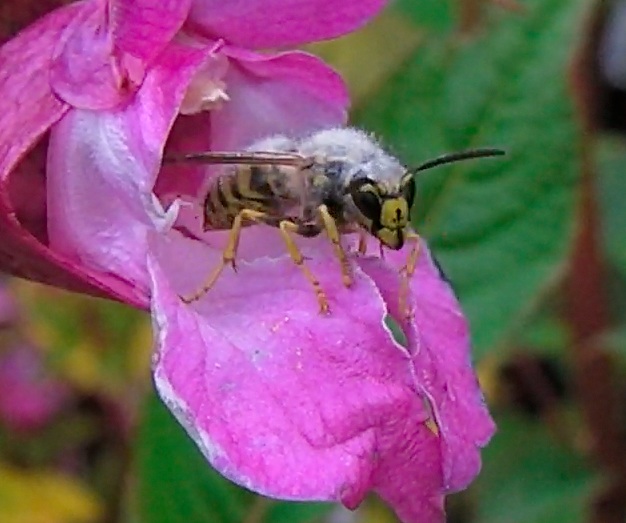
July 30, 2013…A pollen covered wasp takes off from Barbara’s Poor Man’s Orchid
On our morning walk we pass Barbara’s well-maintained flower garden. Today, Barbara called out, “Pat, did you see those white bees?” I had never heard of white bees so we looked carefully. They were certainly white, but I couldn’t get a good fix on them as they were darting in and out of the flowers so fast. After I replayed the videos I could see what they were…wasps and bumblebees covered with white pollen.
This could be a Yellow-faced Bumble Bee, Bombus vosnesenskii, or possibly a Bombus Californicus…I can’t tell the difference. The video shows this bee backing out of the flower and getting a trail of pollen up her back.
Lots of nice bee flowers here…in the foreground are the Poor Man’s Orchids.
Who ever said plant biology was boring? Certainly not me after shooting this video.
When I shot this video I didn’t realize I was witnessing an intimate relationship between flower and bee. The pistil is still showing here, but in the video, the petals clamp shut soon after the bee moves on.
The flower provides the nectar to attract the bee. The bee lands on the flower, pulling the petals apart to reveal the pistil. The flower makes pollen available which the bee carries away.
Since this is my 100th blog, I wanted to do something special. I wanted to have some music in the background. Sweet Thunder, a quartet in Portland, graciously gave me permission to use one of their tunes called, “Blues in the Barn.” Kiera O’Hara, who composed the music, said “she wrote it when she lived on a tree farm in Michigan and her piano room was a refurbished nook in an old barn.” “We are a collaborative bunch, so the sound of my tunes on the disk is very much the result of that collaboration.”
Thank you Sweet Thunder for the sweet music.
The video shows the bee and flower cooperation. I never took biology in school, so I don’t know if they show this racy stuff, but this is an unrated Bee movie in the truest sense.
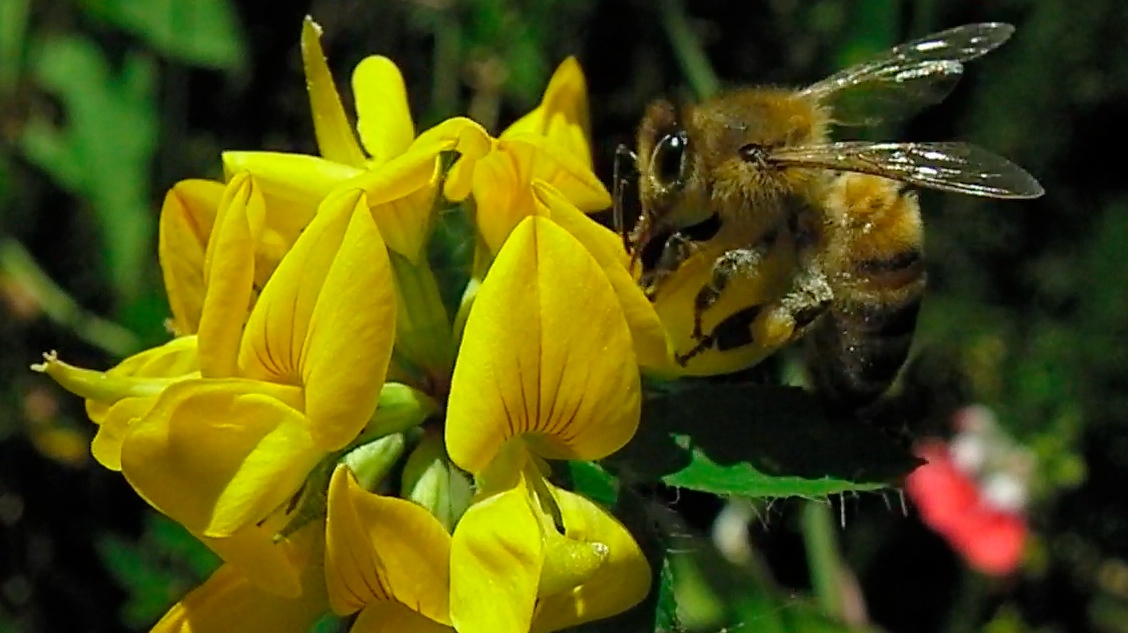
I was unsure what this blossom was. I thought it might be a yellow vetch, so I asked Morris Ostrofsky. Morris, a forty year beekeeper and scientist affiliated with the Oregon State Master Beekeeping Program positively identified this blossom as a Bird’s Foot Trefoil.
“The plant is indeed Birds Foot Trefoil. This plant ranks high on the bees’ favorite forage list. If you go back in some of the older bee publications, it was actually encouraged as bee forage. However, it’s no longer encouraged because it has been found to be invasive. However, the bees’ still love it.”





 Adventures in Natural Beekeeping