This short video shows the progress of the swarm that was transferred from the bait hive to Bee Beard on June 2nd. Now after 7 weeks, viewing through the observation window, you can see the bottom of the bee cluster is below the level of the mouth entrance. Initially, bee beard would face southwest into the winter wind. For that reason, an alternate entrance was drilled towards the north rear. When we decided to locate Bee Beard facing east, that alternate entrance was plugged with tissue paper. To my surprise, the bees have just pulled out that tissue paper and you can see a bee flying out with a bit. In the slightly out of focus video through the observation window, you can see bees carrying out bits of paper. Also seen are bees carrying pollen from blackberries and St. John’s Wort…my bees won’t suffer from depression!
Archive for the ‘Hives’ Category
Bee Beard at Week 7
Posted in Bait Hives, Hives, Log hives, Natural Beekeeping, Swarms, Videos, tagged beekeeping, Feral bees, honey bees, Log hive wood carving, Log hives, natural beekeeping, Verticle log hive, Wild pollinators, wood carving on July 22, 2012| 1 Comment »
They Didn’t Get the Memo
Posted in Hives, Log hives, Natural Beekeeping, Uncategorized, Videos, tagged beekeeping, honey bees, Log hive wood carving, Log hives, natural beekeeping, Verticle log hive, Wild pollinators, wood carving on June 20, 2012| 10 Comments »

Bee Beard sports a great entrance hole, but the bees use the slot between the hat and the top of head most of the time.
I don’t understand it…I give them a beautiful 1.5 inch (3.81 cm) diameter entrance hole in my log hive, yet they insist on using the small slot between the hat and the top of head.
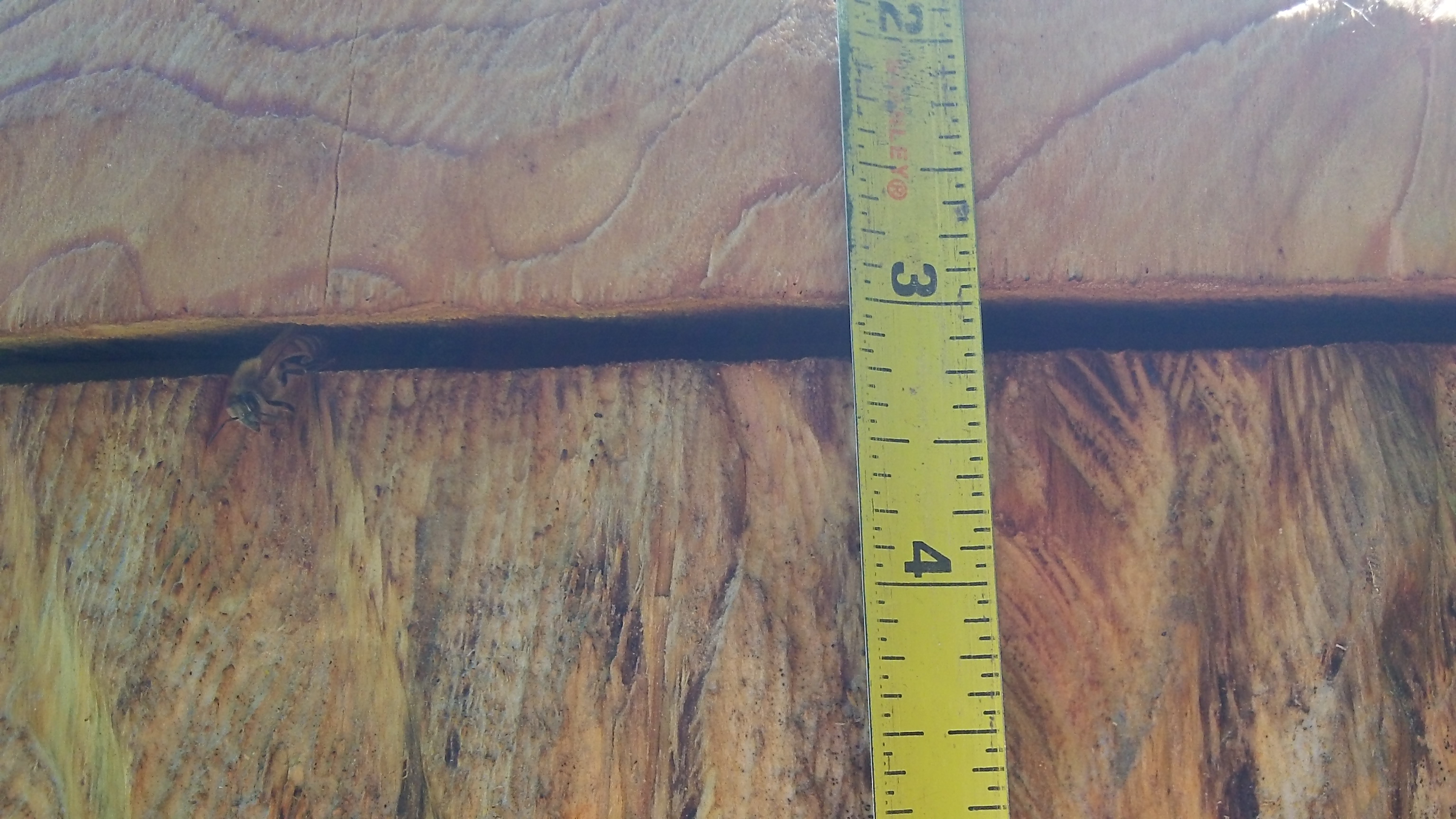
The entrance the bees are using is less than .25″ (about 6 mm) even though a beautiful round entrance hole was provided for them below.
A short video can be seen here showing the bees entering through narrow slot between hat and top of head, followed by a shot looking through the observation window to see the natural comb. This was shot 17 days after the transfer from bait box to log hive.
Bee Beard Log Hive Gets A Life (20,000 of them)
Posted in Hives, Log hives, Natural Beekeeping, Swarms, tagged attracting a swarm, Feral bees, honey bees, Log hive wood carving, Log hives, natural beekeeping, Verticle log hive, Wild pollinators, wood carving on June 6, 2012| 18 Comments »
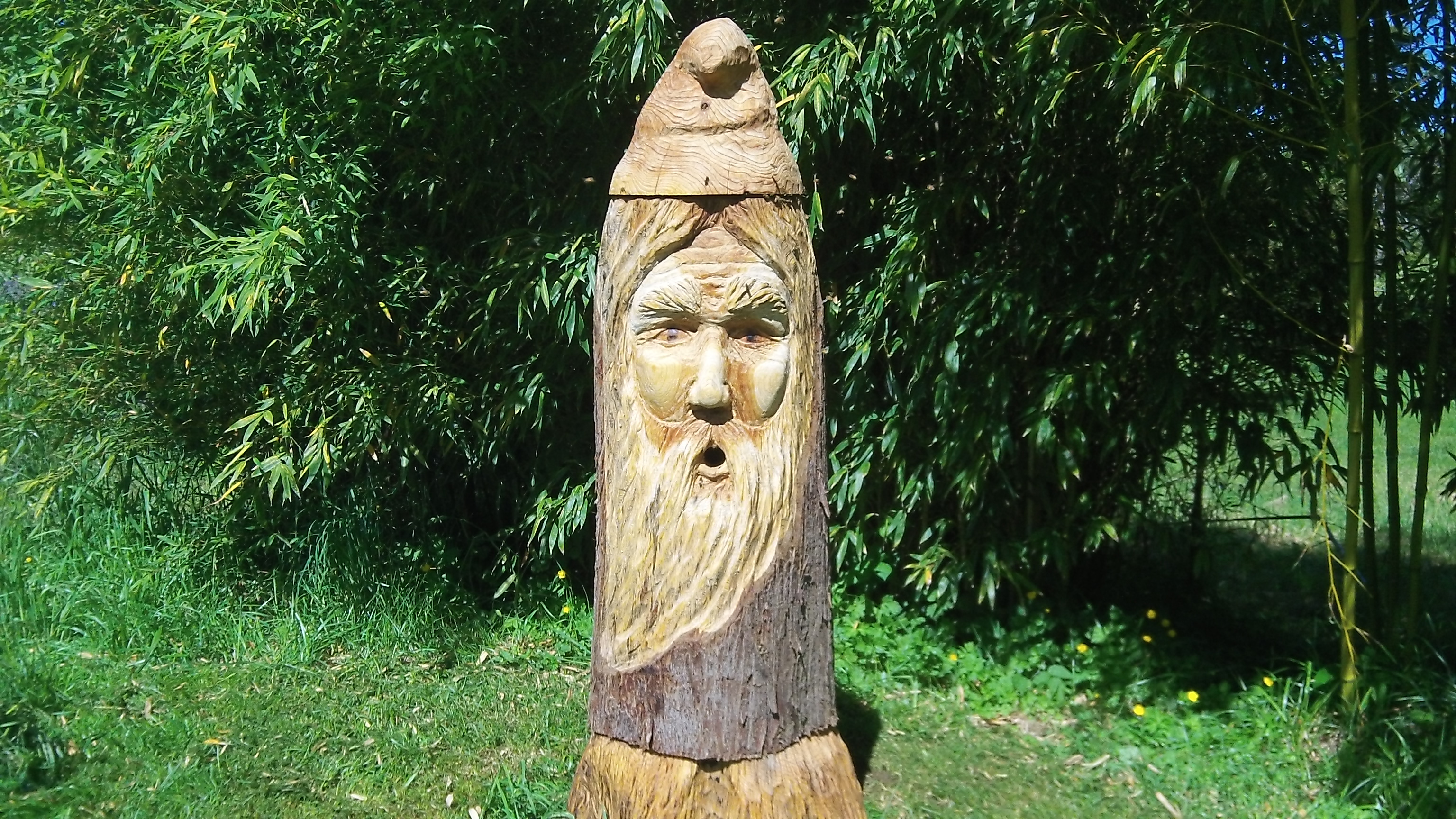
Bee Beard Gets a Life (20,000).
The creation of Bee Beard was influenced by many different people. Hal (The Story of Hal’s Bee Trees) was the main instigator. He started his first log hive around May or June 2011. I was impressed that a swarm had actually picked his log hive to live in. I liked his hands-off log hive credo…
“BEES WILL NOT BE MOVED, MEDICATED OR ROBBED OF HONEY
THE COLONY MAY SWARM AS DIRECTED BY NATURE”
I wanted to try the same thing, but not being retired I knew I wouldn’t be able to spend so much time hollowing it out. I looked up log hives on the web and came across Gaia Bees. I emailed Michael Thiele who gave me directions on hollowing out the log. It was about this time that a new beekeeping friend, Terry Kelly of Berkeley, a writer, top bar beekeeper, and mushroom log grower, started sending me packets of bee articles he liked. My log was partially hollowed out when another packet of articles came in the mail. The very first thing I saw were copies of Slovenian Bee Hive Art. Not only were there paintings but there was a face carved on the front of a hive that served as the entrance to the hive. The bees entered through the mouth, nose, and eyes into the hive. It took all of 10 seconds to decide I wanted to do something like that on my log hive.
I shared my idea of a wood carving with my wife, and she suggested I try the new chainsaw wood carver in town. I talked up the idea with Brian and Zada Vorwaller. He offered some suggestions and we came up with Bee Beard. His wife, Zada videotaped the carving and my son-in-law, Jim Montgomery edited, sped it up, and made it you-tube acceptable.
I wanted feral bees if possible, but commercial hives are placed in the bogs near me between late May into mid July. I knew I had to populate the hives before the bog bees got interested. How to get feral bees became an obsession. After reading McCartney Taylor’s book on Swarm Traps and Bait Hives, I built 9 bait hives. Hung them mostly on private property. I want to thank Bernhard Zaunreiter (see Swarm Trapping 2012) for posting a photographic “how-to prepare bait hives” post on the biobee.com forum,” and answering my bait hive questions.
I finally was rewarded after placing two boxes on or near feral bee hive trees. On one of the weekly inspections, both had caught swarms. This bottom tree supplied Bee Beard.
The transfer of bees from bait hive to Bee Beard was quite an adventure, but the bees are settling in now and the itching is subsiding.
I want to express my appreciation to Phil Chandler for creating biobees.com forum. I’ve got so much to learn and this is a very friendly, positive and informative place to do that. Thanks to those stalwart friends who gave me encouragement during my dark days of no bees, when I started regretting not ordering package bees and despairing that I wouldn’t get ANY bees for another year. Mobeek, Bugscouter, KittyLabyrinth, newwoman, baz, and jaywoo kept me going.
This short video shows the bees entering through the hat. I left a little gap in the quilt box to make it easier to pull out. I think that’s where they are going. A few enter through the mouth entrance. I’m hoping when the comb gets built down that far, they will use the mouth entrance more.
I noticed the bamboo is shading the hive too much in the afternoon…the Warre Hive, on the south side of the bamboo works 1-2 hours longer, so I’m going to trim back the bamboo to get more sun in late afternoon. After all, that could spell the difference between making it, or not making it.
Bee-atrice Log Hive Steps into Prime Time
Grand Kids Log Hive gets bees…two swarms almost at same time.
Randy and Loni Save the Day
Posted in Bait Hives, Hives, Log hives, Natural Beekeeping, tagged attracting a swarm, beekeeping, Feral bees, honey bees, Log hives, natural beekeeping, Verticle log hive, wood carving on June 4, 2012| Leave a Comment »
Saturday brought the usual “check the bait boxes routine”, sigh over no bees yet, and daub some lemon grass oil on the outside. The first box I looked at was on the feral tree on private land. “WOW, I’ve got bees and they’re bringing in pollen. That means they’ve got a laying queen.” What do I do now? I’ll check the other bait hive across from the park…”WOW, that’s got bees too, and they’re are also bringing in pollen. Yikes, I can’t handle two at once.” I talked with Hal who advised me to wait until all the foragers came in. That would be another two hours. Went home to get my wife so she could provide moral support.
At 8:15 pm we stuffed some paper into the entrance hole and duct taped it securely. Got back around 8:45 pm. Should we stick them in now or wait til morning? We might get rain in the morning and it’ll only take a few minutes, let’s just put them in now. Plan is to unscrew the lid of the bait box, lift out the bars, put them in the top of Bee Beard log hive, put the quilt box in and pivot the hat back in place.
Since I had just had a successful swarm retrieval two days prior, I had confidence this would take about 15 minutes then we sit down for a cup of tea and congratulate ourselves.
The transfer did not go as planned…I didn’t suit up properly, it was almost dark, and as soon as I started to remove the lid I knew I was in trouble. Wife says…”sounds like they’re mad.” I tried gently lifting the bars out, but had to jerk them a bit. The bees went ballistic. Then the stings started. They got up into my bee suit between the veil and my face, up my pant legs, and on my wrists. At least I found out I’m not allergic to multiple bee stings, although I’m itching a bit. I had to vacate the area with the box lid part way open, the top of the log hive open, and our confidence shot.
All night I’m trying to formulate a plan of action for the next day…wondering what the heck I was doing…how did I ever think I would be able to pull this off, are these bees going to attack my wife and I when we’re working in the garden? What about our pets? Why did I want feral bees? What was I thinking?
Next day I called Shigeo from the Coos County Beekeepers Association. We talked about the incident and about the other bait hive which I was NOT about to get. He says to call Randy. Well, I know Randy, he’s awfully busy with his regular job, plus the last count of swarms he had gotten, was 23 and that was a week ago. He probably doesn’t need any more. I’ll call Del, another club member. We talk for awhile, he builds up my confidence and says “call Randy.” I call Randy who luckily happens to be working with the bees in the blueberry farm on the coast. (my area). Randy says he’ll be over as he finished up early on the blueberries.
I better get ready. Find the smoker. (never been used), light it up so it looks like we know what we’re doing. Very soon, Randy and Loni were driving in. “Hey I got my smoker lit up, do you want it?” “Don’t need it with suits, besides the bees don’t like smoke.” They zipped up their veils, walked confidently up to the hive, bees still circling angrily. Within a few minutes, they emptied the bait box of the remaining bees, got the bars into the log hive, installed the quilt box and pivoted the hat in place. They said the bees will settle down in a while and not too worry too much about working in the garden, they’d get used to you, but if they go through a dearth, they might get a little testy. We were much relieved.
It was nice to see a husband and wife team working with bees. They have worked together for about 20 years so know exactly what to do to put things right. Their business name is Oregon Mountain Wild Honey.
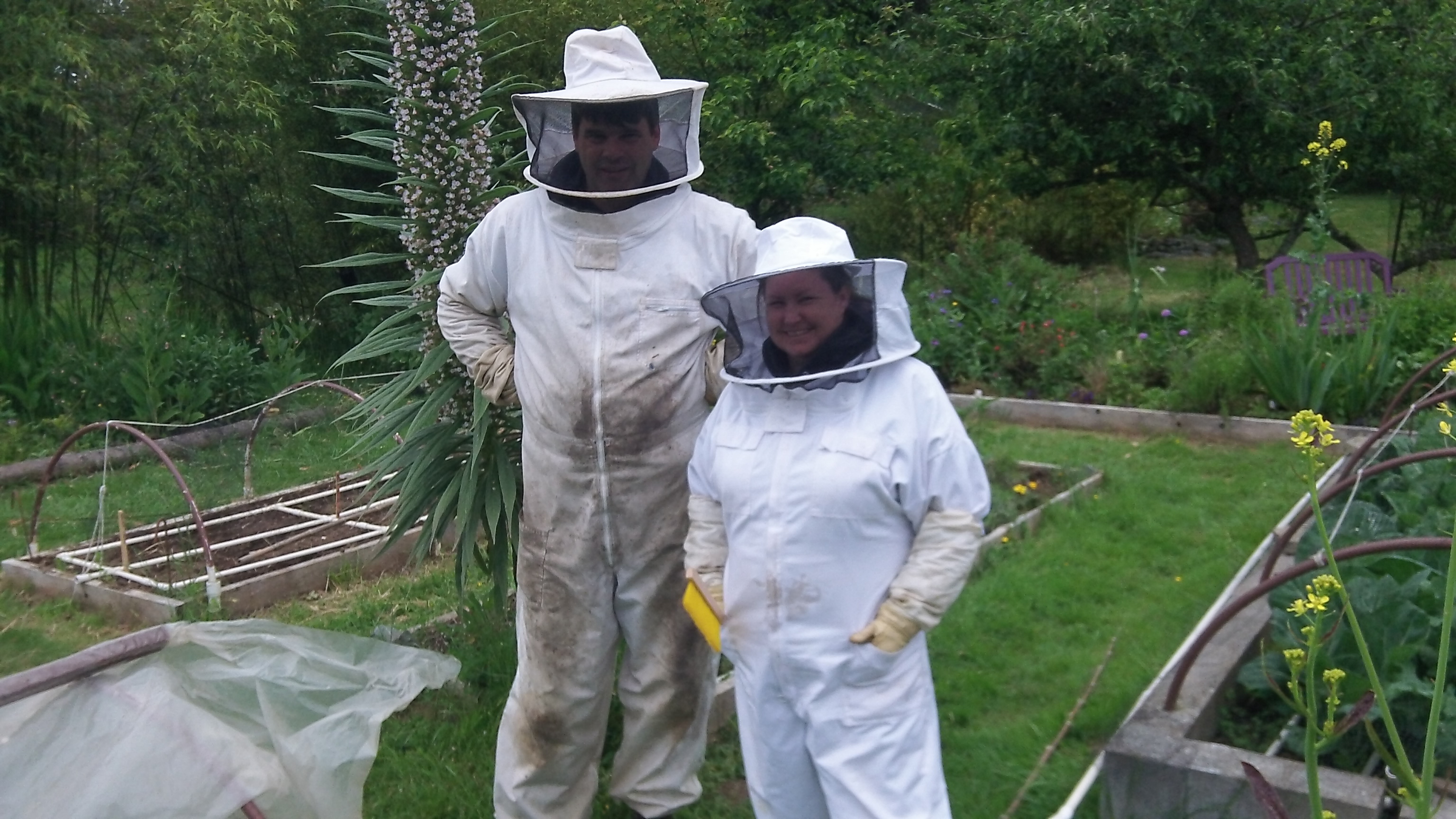
Randy and Loni after getting bees into Bee Beard
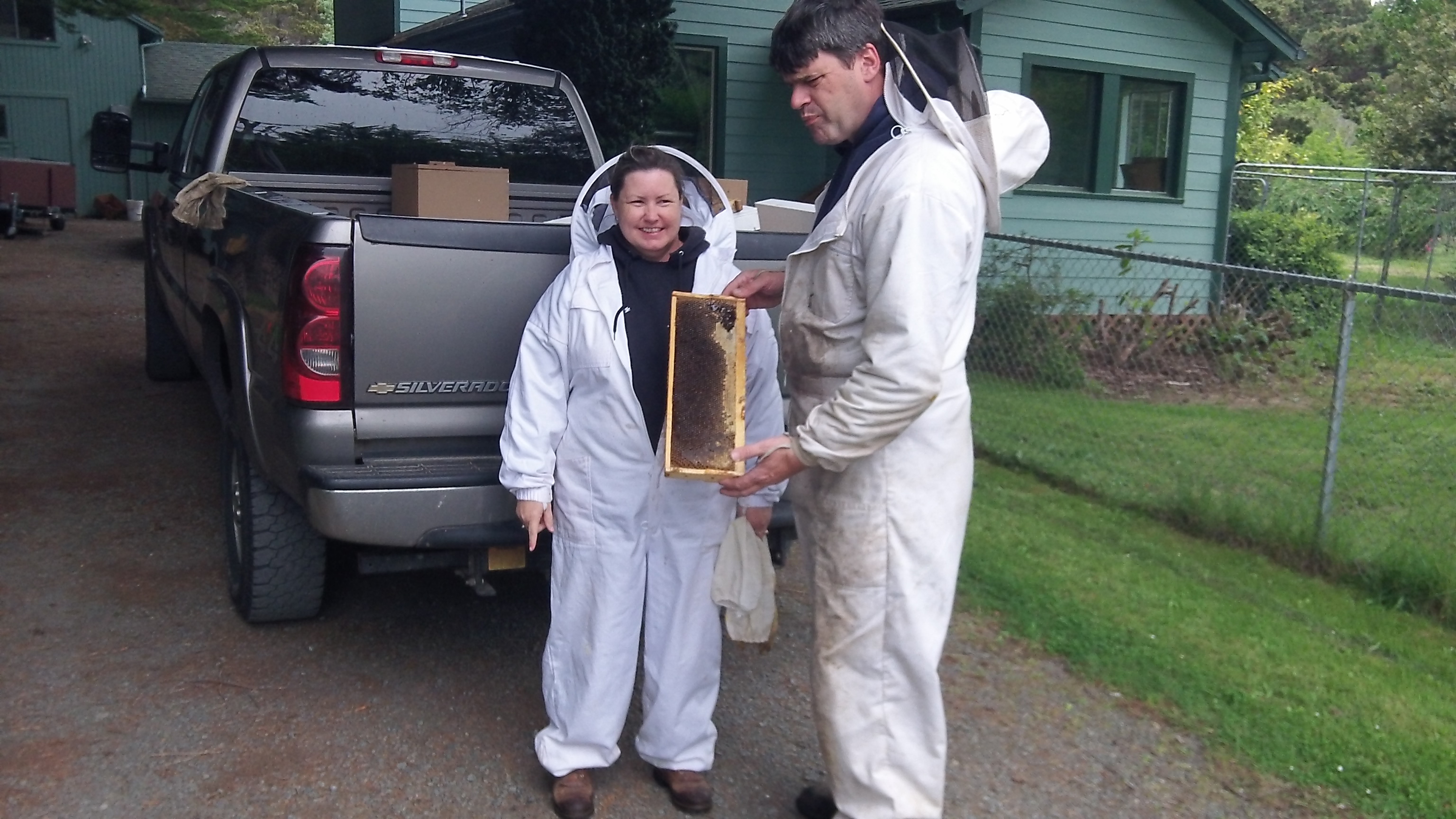
Randy and Loni give us a taste of their blueberry honey, fresh off the comb
A short video of Bee Beard can be seen here… Bee Beard Gets Bees
Video of the carving of Bee Beard
Kicked out of State Park
Posted in Bait Hives, Hives, Log hives, Natural Beekeeping, Swarms, tagged bee tree, Feral bees, natural beekeeping on May 26, 2012| 3 Comments »
I had hung two bait hives in a state park, admittedly without prior permission, but up high, in no one’s way. This was a spot where a tall bee tree was located. Each week I would visit, check the box and dab a little lemon grass oil on the outside near the entrance. I had been doing that for three weeks and on the fourth week the hives were gone. I was astonished. Who could have taken them? Only another beekeeper would really want them, but the size was for my Warre Hive and Log hive, not a common ‘Lang.’ Would vandals completely remove them? They’re a little heavy and you need a ladder to reach up to them. I walked around and around trying to puzzle it out when I noticed a business card laying on the ground. It had the name of a park ranger. I emailed him and, you guessed it, HE removed the hives. It turns out that you (me) are not allowed to hang bait hives in a state park.
“…we cannot set the precedent to collect any species for private use.” “We also don’t want to add a liability in regards to a swarm of bees at a park.”
So I consulted my beekeeper sources who advised me to hang a bait hive across the road in some trees. I took their advice…

Bait hive in small tree east of feral bee hive in state park. Maybe a better location because it’s more hidden.
The other bait hive went to a private party. I had talked to a pest control person, giving him my solarbeez.com business card and asking him to tell me of any bee swarms that he might be called for. He told me of a bee tree in a small town that I was familiar with. I contacted the owner who let me hang a bait hive on the very tree where the bees were flying in and out.
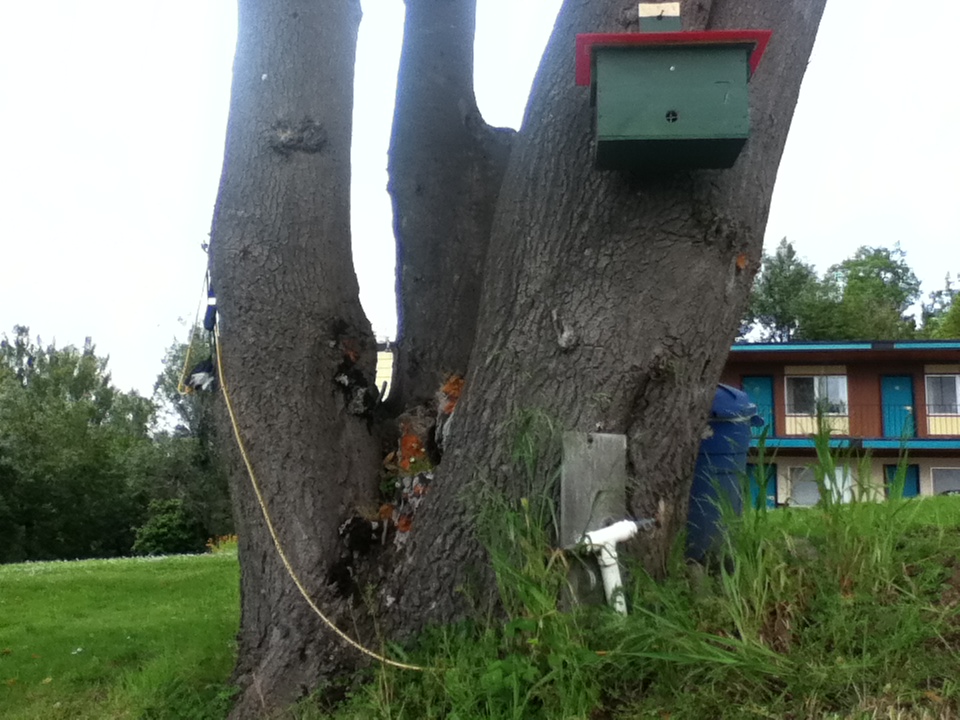
Feral Bee Tree on Private Land. Bees loaded with pollen. Wife and I standing near the flight path with no unfriendly bee problems. I would really, really like to get a swarm from this tree.
My log hive is eagerly awaiting some bees and I’m eagerly anxious to accommodate.
Footnote: The bees from this tree are now populating my Bee Beard log hive!
Hal Talks About His Log Hive
Posted in Hives, Log hives, Natural Beekeeping, Swarms, tagged Log hives, natural beekeeping, pollinators, Verticle log hive on May 15, 2012| Leave a Comment »
Last week I was able to catch up with Hal and ask him about his log hives.
The hive cavity measures about 10 in. x 10 in. x 36 in. (59 liters) There is a large observation window in the back covered by a wedge of wood.
I admire his spunk in trying something different and his attitude for not feeding, treating them, or taking their honey. And I’d love to get a swarm off that hive.
(High) Hive Hopes
Posted in Bait Hives, Hives, Natural Beekeeping, tagged attracting a swarm, natural beekeeping on April 27, 2012| Leave a Comment »
Randy seems to know all the bee trees in the county. I asked him if he thought hanging a bait hive up a certain logging road would be permissible with the owners. He said “There’s no bees up there. What you ought to do, is hang it at (a not to be disclosed) wayside. There’s a bee tree there.” Deep in the middle of a shaded grove of Myrtlewood trees was a bee tree. It was spotted by a picnicker who was interested in what I was doing. About 20-25 feet (6-8 meters) up was a bunch of bee activity. I chose a tree about 50 feet (15 meters) away facing the river to hang the bait hive after baiting it with old comb and LGO. The family of picnickers and their kids were excited to learn the plight of the bees and what backyard beekeepers are doing to help out.

It’s not as pretty as Bernhard Zaunreiter‘s, but hopefully it’ll do the job.
Updated to “Kicked out of State Park.”
Randy’s Feral Bee Log Hive
Posted in Hives, Log hives, Natural Beekeeping, tagged beekeeping, Feral bees, honey bees, log hive on April 16, 2012| 2 Comments »
This log was cut from deep in the forest on the Oregon Coast. It was being cut into lengths when the saw bit into the bee hive and bees came flying out. Rather than lose the hive, one of the guys called Randy, a known beekeeper, who patched up the log and brought it to his bee yard. These very feral bees are now adjusted to their new surroundings and are out flying.
Bait Hives Are Going Up
Posted in Bait Hives, Hives on April 9, 2012| 2 Comments »
All of a sudden it’s time to get serious about this. I built most of the bait hives in February. April and May are the best months on the Oregon Coast. I don’t want to start too late because I’ll be advised to feed the bees and I DON’T want to do that.
This one is not as high as I would like, but it’s a start. I’m using old brood comb from last year, some melted pine sap, and Lemon Grass Oil. I’ll check it in a week and daub some more LGO on the outside of the hive.

I used a ladder with this one and got a little higher. This one has top bars that fit a Warre Hive. It’s located within walking distance of my house so I can check on it more often. It’s located near a creek in a stand of firs and cedars.
Baiting the hives
Posted in Bait Hives on March 18, 2012| 2 Comments »

Let’s see…lemongrass oil on a piece of paper towel, inside a ziplock plastic bag and old comb melted on a couple of top bars. All that’s left to do is to put on the top.

That one is done. Let’s check out the bait hive in the tree.
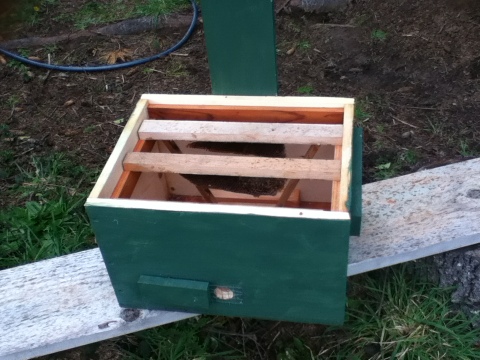
This one came through last week’s storm system with 70 mph gusts and a freak rare snowstorm of 4″. It passed the wind test. So we’ll give it some old comb and lemongrass oil as well. Is it 12 ft. off the ground. Hmmmm, no, but I’m somewhat allergic to ladders so hopefully six feet will be enough.
 Adventures in Natural Beekeeping